Thank you for visiting SNEWPapers!
Sign up free
Story
May 18, 1819
Elizabeth Town Gazette
Elizabeth, Union County, New Jersey
What is this article about?
A debtor appeals a bank's lawsuit on a $62 promissory note, counters with $70 in bank notes as set-off, wins a verdict for 11 cents against the bank, and dismisses related suits after multiple court actions.
Clipping
OCR Quality
95%
Excellent
Full Text
From the Cape Fear Recorder
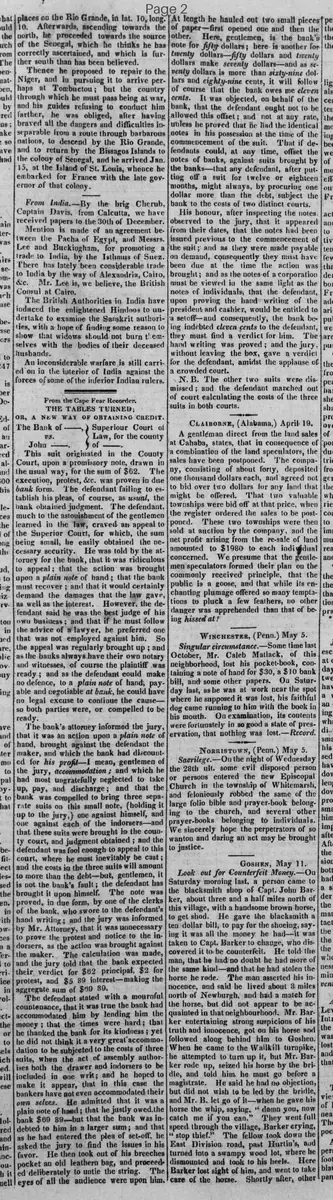
THE TABLES TURNED:
OR, A NEW WAY OF OBTAINING CREDIT.
The Bank of .
Superiour Court of
vs.
Law, for the county
John
of
This suit originated in the County Court, upon a promissory note, drawn in the usual way, for the sum of $62. The execution, protest, &c. was proven in due bank form. The defendant failing to establish his pleas, of course, as usual, the bank obtained judgment. The defendant, much to the astonishment of the gentlemen learned in the law, craved an appeal to the Superior Court, on which, the sum being small, he easily obtained the necessary security. He was told by the attorney for the bank, that it was ridiculous to appeal; that the action was brought upon a plain note of hand; that the bank must recover; and that it would certainly demand the damages that the law gave, as well as the interest. However, the defendant said he was the best judge of his own business; and that if he must follow the advice of a lawyer, he preferred one that was not employed against him. So the appeal was regularly brought up; and as the banks always have their own notary and witnesses, of course the plaintiff was ready; and as the defendant could make no defence, to a plain note of hand, payable and negotiable at bank, he could have no legal excuse to continue the cause—so both parties were, or compelled to be ready.
The bank's attorney informed the jury, that it was an action upon a plain note of hand, brought against the defendant the maker, and which the bank had discounted for his profit—I mean, gentlemen of the jury, accommodation; and which he had most ungratefully neglected to take up, pay, and discharge; and that the bank was compelled to bring three separate suits on this small note, (holding it up to the jury,) one against himself, and one against each of the indorsers—and that these suits were brought in the county court, and judgment obtained; and the defendant was fool enough to appeal to this court, where he must inevitably be cast; and the costs in the three suits will amount to more than the debt—but, gentlemen, it is not the bank's fault; the defendant has brought it upon himself. The note was proved, in due form, by one of the clerks of the bank, who swore to the defendant's hand writing; and the jury was informed by Mr. Attorney, that it was unnecessary to prove the protest and notice to the indorsers, as the action was brought against the maker. The calculation was made, and the jury told that the bank expected their verdict for $62 principal, $2 for protest, and $5 89 interest—making the aggregate sum of $69 89.
The defendant stated with a mournful countenance, that it was true the bank had accommodated him by lending him the money; that the times were hard; that he thanked the bank for its kindness; yet he did not think it a very great accommodation to be subjected to the costs of three suits, when the act of assembly authorizes both the drawer and indorsers to be included in one writ; and he hoped to make it appear, that in this case the bankers have not even accommodated their own selves. He admitted that it was a plain note of hand; that he justly owed the bank $69 89—but that the bank was indebted to him in a larger sum; and that as he had entered the plea of set-off, he asked the jury to find the issues in his favor. He then took out of his breeches pocket an old leathern bag, and proceeded deliberately to untie the string. The eyes of all the audience were upon him.
At length he hauled out two small pieces of paper—first opened one and then the other. Here, gentlemen, is the bank's note for fifty dollars; here is another for twenty dollars—fifty dollars and twenty dollars make seventy dollars—and as seventy dollars is more than sixty-nine dollars and eighty-nine cents, it will follow of course that the bank owes me eleven cents. It was objected, on behalf of the bank, that the defendant ought not to be allowed this offset; and not at any rate, unless he proved that he had the identical notes in his possession at the time of the commencement of the suit. That if defendants could, at any time, offset the notes of banks, against suits brought by the banks—that any defendant, after putting off a suit for twelve or eighteen months, might always, by procuring one dollar more than the debt, subject the bank to the costs of two distinct courts.
His honour, after inspecting the notes, observed to the jury, that it appeared from their dates, that the notes had been issued previous to the commencement of the suit; and as they were made payable on demand, consequently they must have been due at the time the action was brought; and as the notes of a corporation must be viewed in the same light as the notes of individuals; that the defendant, upon proving the hand writing of the president and cashier, would be entitled to a set-off—and consequently, the bank being indebted eleven cents to the defendant, they must find a verdict for him. The hand writing was proved; and the jury, without leaving the box, gave a verdict for the defendant, amidst the applause of a crowded court.
N. B. The other two suits were dismissed; and the defendant marched out of court calculating the costs of the three suits in both courts.
THE TABLES TURNED:
OR, A NEW WAY OF OBTAINING CREDIT.
The Bank of .
Superiour Court of
vs.
Law, for the county
John
of
This suit originated in the County Court, upon a promissory note, drawn in the usual way, for the sum of $62. The execution, protest, &c. was proven in due bank form. The defendant failing to establish his pleas, of course, as usual, the bank obtained judgment. The defendant, much to the astonishment of the gentlemen learned in the law, craved an appeal to the Superior Court, on which, the sum being small, he easily obtained the necessary security. He was told by the attorney for the bank, that it was ridiculous to appeal; that the action was brought upon a plain note of hand; that the bank must recover; and that it would certainly demand the damages that the law gave, as well as the interest. However, the defendant said he was the best judge of his own business; and that if he must follow the advice of a lawyer, he preferred one that was not employed against him. So the appeal was regularly brought up; and as the banks always have their own notary and witnesses, of course the plaintiff was ready; and as the defendant could make no defence, to a plain note of hand, payable and negotiable at bank, he could have no legal excuse to continue the cause—so both parties were, or compelled to be ready.
The bank's attorney informed the jury, that it was an action upon a plain note of hand, brought against the defendant the maker, and which the bank had discounted for his profit—I mean, gentlemen of the jury, accommodation; and which he had most ungratefully neglected to take up, pay, and discharge; and that the bank was compelled to bring three separate suits on this small note, (holding it up to the jury,) one against himself, and one against each of the indorsers—and that these suits were brought in the county court, and judgment obtained; and the defendant was fool enough to appeal to this court, where he must inevitably be cast; and the costs in the three suits will amount to more than the debt—but, gentlemen, it is not the bank's fault; the defendant has brought it upon himself. The note was proved, in due form, by one of the clerks of the bank, who swore to the defendant's hand writing; and the jury was informed by Mr. Attorney, that it was unnecessary to prove the protest and notice to the indorsers, as the action was brought against the maker. The calculation was made, and the jury told that the bank expected their verdict for $62 principal, $2 for protest, and $5 89 interest—making the aggregate sum of $69 89.
The defendant stated with a mournful countenance, that it was true the bank had accommodated him by lending him the money; that the times were hard; that he thanked the bank for its kindness; yet he did not think it a very great accommodation to be subjected to the costs of three suits, when the act of assembly authorizes both the drawer and indorsers to be included in one writ; and he hoped to make it appear, that in this case the bankers have not even accommodated their own selves. He admitted that it was a plain note of hand; that he justly owed the bank $69 89—but that the bank was indebted to him in a larger sum; and that as he had entered the plea of set-off, he asked the jury to find the issues in his favor. He then took out of his breeches pocket an old leathern bag, and proceeded deliberately to untie the string. The eyes of all the audience were upon him.
At length he hauled out two small pieces of paper—first opened one and then the other. Here, gentlemen, is the bank's note for fifty dollars; here is another for twenty dollars—fifty dollars and twenty dollars make seventy dollars—and as seventy dollars is more than sixty-nine dollars and eighty-nine cents, it will follow of course that the bank owes me eleven cents. It was objected, on behalf of the bank, that the defendant ought not to be allowed this offset; and not at any rate, unless he proved that he had the identical notes in his possession at the time of the commencement of the suit. That if defendants could, at any time, offset the notes of banks, against suits brought by the banks—that any defendant, after putting off a suit for twelve or eighteen months, might always, by procuring one dollar more than the debt, subject the bank to the costs of two distinct courts.
His honour, after inspecting the notes, observed to the jury, that it appeared from their dates, that the notes had been issued previous to the commencement of the suit; and as they were made payable on demand, consequently they must have been due at the time the action was brought; and as the notes of a corporation must be viewed in the same light as the notes of individuals; that the defendant, upon proving the hand writing of the president and cashier, would be entitled to a set-off—and consequently, the bank being indebted eleven cents to the defendant, they must find a verdict for him. The hand writing was proved; and the jury, without leaving the box, gave a verdict for the defendant, amidst the applause of a crowded court.
N. B. The other two suits were dismissed; and the defendant marched out of court calculating the costs of the three suits in both courts.
What sub-type of article is it?
Curiosity
Personal Triumph
What themes does it cover?
Fortune Reversal
Justice
Triumph
What keywords are associated?
Bank Lawsuit
Set Off
Promissory Note
Court Appeal
Legal Victory
Tables Turned
Where did it happen?
Superior Court
Story Details
Location
Superior Court
Story Details
A defendant appeals a bank's judgment on a $62 promissory note, presents $70 in bank notes as set-off in court, proves they were due prior to the suit, wins a verdict for 11 cents, leading to dismissal of related suits against indorsers.