Thank you for visiting SNEWPapers!
Sign up free
Poem
November 24, 1826
Richmond Enquirer
Richmond, Richmond County, Virginia
What is this article about?
A satirical dialogue in verse between personified Cotton (representing manufacturing, impoverished) and Corn (representing wealthy landowners), where Cotton pleads for aid and Corn mocks him, alluding to economic policies, taxes, and class divides in England.
Clipping
OCR Quality
95%
Excellent
Full Text
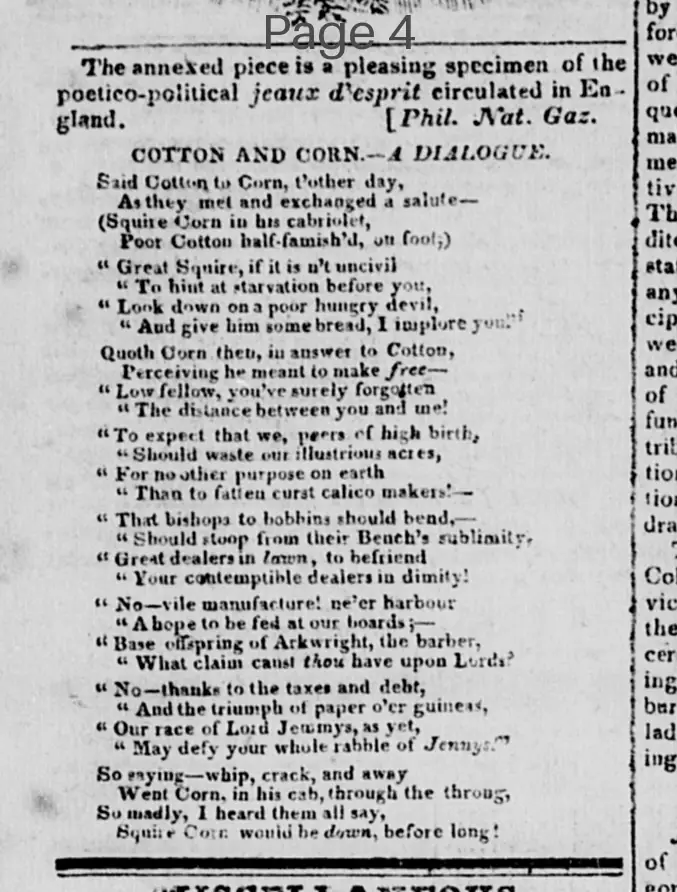
The annexed piece is a pleasing specimen of the poetico-political jeux d'esprit circulated in England.
[Phil. Nat. Gaz.]
COTTON AND CORN.--A DIALOGUE.
Said Cotton to Corn, t'other day,
As they met and exchanged a salute—
(Squire Corn in his cabriolet,
Poor Cotton half-famish'd, on foot,)
"Great Squire, if it isn't uncivil
To hint at starvation before you,
Look down on a poor hungry devil,
And give him some bread, I implore you."
Quoth Corn then, in answer to Cotton,
Perceiving he meant to make free—
"Low fellow, you've surely forgotten
The distance between you and me!
To expect that we, peers of high birth,
Should waste our illustrious acres,
For no other purpose on earth
Than to fatten curs'd calico makers!—
That bishops to bobbin should bend.—
Should stoop from their Bench's sublimity.
Great dealers in Lawn, to befriend
Your contemptible dealers in dimity!
No—vile manufacture! ne'er harbour
A hope to be fed at our boards;
Base offspring of Arkwright, the barber,
What claim canst thou have upon Lords
No—thanks to the taxes and debt,
And the triumph of paper o'er guineas,
Our race of Lord Jenkyns, as yet,
May defy your whole rabble of Jennys."
So saying—whip, crack, and away
Went Corn, in his cab, through the throng,
So madly, I heard them all say,
Squire Corn would be down, before long.
[Phil. Nat. Gaz.]
COTTON AND CORN.--A DIALOGUE.
Said Cotton to Corn, t'other day,
As they met and exchanged a salute—
(Squire Corn in his cabriolet,
Poor Cotton half-famish'd, on foot,)
"Great Squire, if it isn't uncivil
To hint at starvation before you,
Look down on a poor hungry devil,
And give him some bread, I implore you."
Quoth Corn then, in answer to Cotton,
Perceiving he meant to make free—
"Low fellow, you've surely forgotten
The distance between you and me!
To expect that we, peers of high birth,
Should waste our illustrious acres,
For no other purpose on earth
Than to fatten curs'd calico makers!—
That bishops to bobbin should bend.—
Should stoop from their Bench's sublimity.
Great dealers in Lawn, to befriend
Your contemptible dealers in dimity!
No—vile manufacture! ne'er harbour
A hope to be fed at our boards;
Base offspring of Arkwright, the barber,
What claim canst thou have upon Lords
No—thanks to the taxes and debt,
And the triumph of paper o'er guineas,
Our race of Lord Jenkyns, as yet,
May defy your whole rabble of Jennys."
So saying—whip, crack, and away
Went Corn, in his cab, through the throng,
So madly, I heard them all say,
Squire Corn would be down, before long.
What sub-type of article is it?
Satire
Epigram
What themes does it cover?
Political
Commerce Trade
Taxation Tyranny
What keywords are associated?
Cotton Corn Dialogue
Political Satire
Economic Disparity
Manufacturing Agriculture
Taxes Debt
Arkwright Jenkyns
Poem Details
Title
Cotton And Corn. A Dialogue.
Subject
Dialogue On Economic Disparity Between Manufacturing And Agriculture
Form / Style
Rhymed Couplets
Key Lines
Said Cotton To Corn, T'other Day, / As They Met And Exchanged A Salute— / (Squire Corn In His Cabriolet, / Poor Cotton Half Famish'd, On Foot,)
"Low Fellow, You've Surely Forgotten / The Distance Between You And Me!"
"No—Thanks To The Taxes And Debt, / And The Triumph Of Paper O'er Guineas,"