Thank you for visiting SNEWPapers!
Sign up free
Editorial
November 3, 1796
Gazette Of The United States, & Philadelphia Daily Advertiser
Philadelphia, Philadelphia County, Pennsylvania
What is this article about?
In this installment of the Phocion series, the author accuses Thomas Jefferson, as Secretary of State, of supporting Citizen Genet's anti-government intrigues and opposing the federal administration's financial policies, including the funding system, which the author claims would lead to national disunion, disorder, and discredit.
Clipping
OCR Quality
95%
Excellent
Full Text
For the Gazette of the United States.
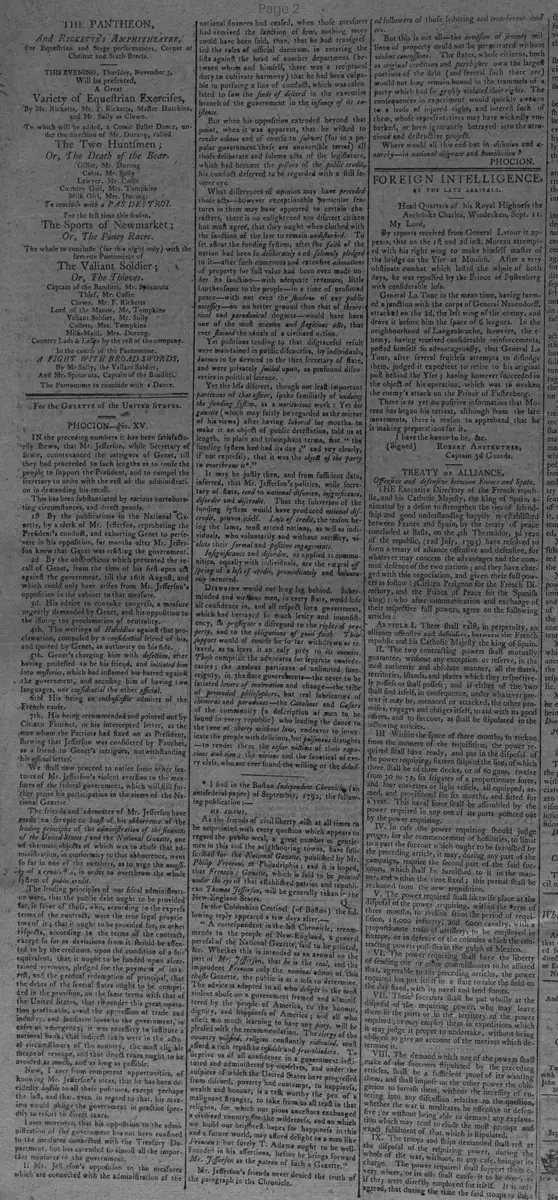
PHOCION—No. XV.
IN the preceding numbers it has been satisfactorily shown, that Mr. Jefferson, while Secretary of State, countenanced the intrigues of Genet, till they had proceeded to such lengths as to rouse the people to support the President, and to compel the Secretary to unite with the rest of the administration in demanding his recall.
This has been substantiated by various corroborating circumstances, and direct proofs.
1st. By the publications in the National Gazette, by a clerk of Mr. Jefferson, reprobating the President's conduct, and exhorting Genet to persevere in his opposition, for months after Mr. Jefferson knew that Genet was resisting the government.
2d. By the obstructions which prevented the recall of Genet, from the time of his first open act against the government, till the 16th August, and which could only have arisen from Mr. Jefferson's opposition in the cabinet to that measure.
3d. His advice to convoke congress, a measure urgently demanded by Genet, and his opposition to the issuing the proclamation of neutrality.
4th. The writings of Helvidius against that proclamation, composed by a confidential friend of his, and quoted by Genet, as authority on his side.
5th. Genet's charging him with defection, after having professed to be his friend, and initiated him into mysteries, which had inflamed his hatred against the government, and accusing him of having two languages, one confidential the other official.
6th. His being an enthusiastic admirer of the French cause.
7th. His being recommended and pointed out by Citizen Fauchet, in his intercepted letter, as the man whom the Patriots had fixed on as President, showing that Jefferson was considered by Fauchet, as a friend to Genet's intrigues, notwithstanding his official letter.
We shall now proceed to notice some other features of Mr. Jefferson's violent aversion to the measures of the federal government, which will still further prove his participation in the views of the National Gazette.
The friends and advocates of Mr. Jefferson have made no scruple to boast of his abhorrence of the leading principles of the administration of the finances of the United States; and the National Gazette, one of the main objects of which was to abuse that administration, in conformity to that abhorrence, went so far in one of the numbers, as to urge the necessity of a revolution, in order to overthrow the whole system of public credit.
The leading principles of our fiscal administration were, that the public debt ought to be provided for, in favor of those, who, according to the express terms of the contract, were the true legal proprietors of it: that it ought to be provided for, in other respects, according to the terms of the contract, except so far as deviations from it should be assented to by the creditors, upon the condition of a fair equivalent, that it ought to be funded upon ascertained revenues, pledged for the payment of interest, and the gradual redemption of principal, that the debts of the several states ought to be comprehended in the provision, on the same terms with that of the United States, that to render this great operation practicable, avoid like oppression of trade and industry, and facilitate loans to the government, in cases of emergency, it was necessary to institute a national bank, that indirect taxes were in the actual circumstances of the country, the most eligible means of revenue, and that direct taxes ought to be avoided as much, and as long as possible.
Now, I aver from competent opportunities, of knowing Mr. Jefferson's ideas, that he has been decidedly hostile to all these positions, except perhaps the last, and that, even in regard to that, his maxims would oblige the government in practice speedily to resort to direct taxes.
I aver moreover, that his opposition to the administration of the government has not been confined to the measures connected with the Treasury Department, but has extended to almost all the important measures of the government.
If Mr. Jefferson's opposition to the measures which are connected with the administration of the national finances had ceased, when those measures had received the sanction of law, nothing more could have been said, than, that he had transgressed the rules of official decorum, in entering the lists against the head of another department (between whom and himself, there was a reciprocal duty to cultivate harmony) that he had been culpable in pursuing a line of conduct, which was calculated to sow the seeds of discord in the executive branch of the government in the infancy of its existence.
But when his opposition extended beyond that point, when it was apparent, that he wished to render odious and of course to subvert (for in a popular government these are convertible terms) all those deliberate and solemn acts of the legislature, which had become the pillars of the public credit, his conduct deserved to be regarded with a still severer eye.
What differences of opinion may have preceded those acts—however exceptionable particular features in them may have appeared to certain characters, there is no enlightened nor discreet citizen but must agree, that they ought when clothed with the sanction of the law to remain undisturbed. To set afloat the funding system, after the faith of the nation had been so deliberately and solemnly pledged to it—after such numerous and extensive alienations of property for full value had been even made under its sanction—with adequate revenues, little burthensome to the people—in a time of profound peace—with not even the shadow of any public necessity—on no better ground than that of theoretical and paradoxical dogmas—would have been one of the most wanton and flagitious acts, that ever stained the annals of a civilized nation.
Yet positions tending to that disgraceful result were maintained in public discourses, by individuals, known to be devoted to the then secretary of state, and were privately smiled upon, as profound discoveries in political science.
Yet the less discreet, though not least important partizans of that officer, spoke familiarly of undoing the funding system, as a meritorious work: Yet his gazette (which may fairly be regarded as the mirror of his views) after having labored for months to make it an object of public detestation, told us at length, in plain and triumphant terms, that "the funding system had had its day;" and very clearly, if not expressly, that it was the object of the party to overthrow it*.
It may be justly then, and from sufficient data, inferred, that Mr. Jefferson's politics, while secretary of state, tend to national disunion, insignificance, disorder and discredit. That the subversion of the funding system would have produced national discredit, proves itself. Loss of credit, the reason being the same, must attend nations, as well as individuals, who voluntarily and without necessity, violate their solemn and positive engagements
Insignificance and disorder, as applied to communities, equally with individuals, are the natural offspring of a loss of credit, premeditatedly and voluntarily incurred.
Disunion would not long lag behind. Sober-minded and virtuous men, in every state, would lose all confidence in, and all respect for a government, which had betrayed so much levity and inconsistency, so profligate a disregard to the rights of property, and to the obligations of good faith. Their support would of course be so far withdrawn or relaxed, as to leave it an easy prey to its enemies.
These comprise the advocates for separate confederacies; the zealous partizans of unlimited sovereignty, in the state governments—the never to be satiated lovers of innovation and change—the tribe of pretended philosophers, but real fabricators of chimeras and paradoxes—the Catalines and Caesars of the community (a description of men to be found in every republic) who leading the dance to the tune of liberty without law, endeavor to intoxicate the people with delicious, but poisonous draughts—to render them the easier victims of their rapacious ambition; the vicious and the fanatical of every class, who are ever found the willing or the deluded seduced followers of those seducing and treacherous leaders.
But this is not all—the invasion of seventy millions of property could not be perpetrated without violent convulsions. The states, whose citizens, both as original creditors and purchasers own the largest portions of the debt (and several such there are) would not long remain bound in the trammels of a party which had so grossly violated their rights. The consequences in experiment would quickly awaken to a sense of injured right, and interest such of them, whose representatives may have wickedly embarked, or been ignorantly betrayed into the atrocious and destructive project.
Where would all this end but in disunion and anarchy—in national disgrace and humiliation?
PHOCION.
* I find in the Boston Independent Chronicle (an antifederal paper) of September, 1792, the following publication :—
MR. ADAMS.
As the friends of civil liberty wish at all times to be acquainted with every question which appears to regard the public weal, a great number of gentlemen in this and the neighbouring towns, have subscribed for the National Gazette, published by Mr. Philip Freneau, at Philadelphia: and it is hoped, that Freneau's Gazette, which is said to be printed under the eye of that established patriot and republican Thomas Jefferson, will be generally taken in the New-England-States.
G.
In the Columbian Centinel (of Boston) the following reply appeared a few days after.—
" A correspondent in the last Chronicle, recommends to the people of New-England, a general perusal of the National Gazette, said to be printed, &c. Whether this is intended as an avowal on the part of Mr. Jefferson, that he is the real, and the imprudent Freneau only the nominal editor of this chaste Gazette, the public is at a loss to determine. The advice is adapted to all who delight in the most violent abuse on a government framed and administered by the people of America, to the honour, dignity, and happiness of America; and all who affect so much learning to have any piety, will be pleased with the recommendation. The clergy of the country vilified, religion constantly ridiculed, must afford a rich repast to infidels and free-thinkers. To depelve us of all confidence in a government instituted and administered by ourselves, and under the auspices of which the United States have progressed from discord, poverty and contempt, to happiness, wealth and honour, is a task worthy the pen of a malignant stranger, to take from us all trust in that religion, for which our pious ancestors exchanged a civilized country for the wilderness, and on which we build our brightest hopes for happiness in this and a future world, may afford delight to a man like Freneau: but surely T. Adams ought to be well-founded in his assertions, before he brings forward Mr. Jefferson as the patron of such a Gazette."
Mr. Jefferson's friends never denied the truth of the paragraph in the Chronicle.
PHOCION—No. XV.
IN the preceding numbers it has been satisfactorily shown, that Mr. Jefferson, while Secretary of State, countenanced the intrigues of Genet, till they had proceeded to such lengths as to rouse the people to support the President, and to compel the Secretary to unite with the rest of the administration in demanding his recall.
This has been substantiated by various corroborating circumstances, and direct proofs.
1st. By the publications in the National Gazette, by a clerk of Mr. Jefferson, reprobating the President's conduct, and exhorting Genet to persevere in his opposition, for months after Mr. Jefferson knew that Genet was resisting the government.
2d. By the obstructions which prevented the recall of Genet, from the time of his first open act against the government, till the 16th August, and which could only have arisen from Mr. Jefferson's opposition in the cabinet to that measure.
3d. His advice to convoke congress, a measure urgently demanded by Genet, and his opposition to the issuing the proclamation of neutrality.
4th. The writings of Helvidius against that proclamation, composed by a confidential friend of his, and quoted by Genet, as authority on his side.
5th. Genet's charging him with defection, after having professed to be his friend, and initiated him into mysteries, which had inflamed his hatred against the government, and accusing him of having two languages, one confidential the other official.
6th. His being an enthusiastic admirer of the French cause.
7th. His being recommended and pointed out by Citizen Fauchet, in his intercepted letter, as the man whom the Patriots had fixed on as President, showing that Jefferson was considered by Fauchet, as a friend to Genet's intrigues, notwithstanding his official letter.
We shall now proceed to notice some other features of Mr. Jefferson's violent aversion to the measures of the federal government, which will still further prove his participation in the views of the National Gazette.
The friends and advocates of Mr. Jefferson have made no scruple to boast of his abhorrence of the leading principles of the administration of the finances of the United States; and the National Gazette, one of the main objects of which was to abuse that administration, in conformity to that abhorrence, went so far in one of the numbers, as to urge the necessity of a revolution, in order to overthrow the whole system of public credit.
The leading principles of our fiscal administration were, that the public debt ought to be provided for, in favor of those, who, according to the express terms of the contract, were the true legal proprietors of it: that it ought to be provided for, in other respects, according to the terms of the contract, except so far as deviations from it should be assented to by the creditors, upon the condition of a fair equivalent, that it ought to be funded upon ascertained revenues, pledged for the payment of interest, and the gradual redemption of principal, that the debts of the several states ought to be comprehended in the provision, on the same terms with that of the United States, that to render this great operation practicable, avoid like oppression of trade and industry, and facilitate loans to the government, in cases of emergency, it was necessary to institute a national bank, that indirect taxes were in the actual circumstances of the country, the most eligible means of revenue, and that direct taxes ought to be avoided as much, and as long as possible.
Now, I aver from competent opportunities, of knowing Mr. Jefferson's ideas, that he has been decidedly hostile to all these positions, except perhaps the last, and that, even in regard to that, his maxims would oblige the government in practice speedily to resort to direct taxes.
I aver moreover, that his opposition to the administration of the government has not been confined to the measures connected with the Treasury Department, but has extended to almost all the important measures of the government.
If Mr. Jefferson's opposition to the measures which are connected with the administration of the national finances had ceased, when those measures had received the sanction of law, nothing more could have been said, than, that he had transgressed the rules of official decorum, in entering the lists against the head of another department (between whom and himself, there was a reciprocal duty to cultivate harmony) that he had been culpable in pursuing a line of conduct, which was calculated to sow the seeds of discord in the executive branch of the government in the infancy of its existence.
But when his opposition extended beyond that point, when it was apparent, that he wished to render odious and of course to subvert (for in a popular government these are convertible terms) all those deliberate and solemn acts of the legislature, which had become the pillars of the public credit, his conduct deserved to be regarded with a still severer eye.
What differences of opinion may have preceded those acts—however exceptionable particular features in them may have appeared to certain characters, there is no enlightened nor discreet citizen but must agree, that they ought when clothed with the sanction of the law to remain undisturbed. To set afloat the funding system, after the faith of the nation had been so deliberately and solemnly pledged to it—after such numerous and extensive alienations of property for full value had been even made under its sanction—with adequate revenues, little burthensome to the people—in a time of profound peace—with not even the shadow of any public necessity—on no better ground than that of theoretical and paradoxical dogmas—would have been one of the most wanton and flagitious acts, that ever stained the annals of a civilized nation.
Yet positions tending to that disgraceful result were maintained in public discourses, by individuals, known to be devoted to the then secretary of state, and were privately smiled upon, as profound discoveries in political science.
Yet the less discreet, though not least important partizans of that officer, spoke familiarly of undoing the funding system, as a meritorious work: Yet his gazette (which may fairly be regarded as the mirror of his views) after having labored for months to make it an object of public detestation, told us at length, in plain and triumphant terms, that "the funding system had had its day;" and very clearly, if not expressly, that it was the object of the party to overthrow it*.
It may be justly then, and from sufficient data, inferred, that Mr. Jefferson's politics, while secretary of state, tend to national disunion, insignificance, disorder and discredit. That the subversion of the funding system would have produced national discredit, proves itself. Loss of credit, the reason being the same, must attend nations, as well as individuals, who voluntarily and without necessity, violate their solemn and positive engagements
Insignificance and disorder, as applied to communities, equally with individuals, are the natural offspring of a loss of credit, premeditatedly and voluntarily incurred.
Disunion would not long lag behind. Sober-minded and virtuous men, in every state, would lose all confidence in, and all respect for a government, which had betrayed so much levity and inconsistency, so profligate a disregard to the rights of property, and to the obligations of good faith. Their support would of course be so far withdrawn or relaxed, as to leave it an easy prey to its enemies.
These comprise the advocates for separate confederacies; the zealous partizans of unlimited sovereignty, in the state governments—the never to be satiated lovers of innovation and change—the tribe of pretended philosophers, but real fabricators of chimeras and paradoxes—the Catalines and Caesars of the community (a description of men to be found in every republic) who leading the dance to the tune of liberty without law, endeavor to intoxicate the people with delicious, but poisonous draughts—to render them the easier victims of their rapacious ambition; the vicious and the fanatical of every class, who are ever found the willing or the deluded seduced followers of those seducing and treacherous leaders.
But this is not all—the invasion of seventy millions of property could not be perpetrated without violent convulsions. The states, whose citizens, both as original creditors and purchasers own the largest portions of the debt (and several such there are) would not long remain bound in the trammels of a party which had so grossly violated their rights. The consequences in experiment would quickly awaken to a sense of injured right, and interest such of them, whose representatives may have wickedly embarked, or been ignorantly betrayed into the atrocious and destructive project.
Where would all this end but in disunion and anarchy—in national disgrace and humiliation?
PHOCION.
* I find in the Boston Independent Chronicle (an antifederal paper) of September, 1792, the following publication :—
MR. ADAMS.
As the friends of civil liberty wish at all times to be acquainted with every question which appears to regard the public weal, a great number of gentlemen in this and the neighbouring towns, have subscribed for the National Gazette, published by Mr. Philip Freneau, at Philadelphia: and it is hoped, that Freneau's Gazette, which is said to be printed under the eye of that established patriot and republican Thomas Jefferson, will be generally taken in the New-England-States.
G.
In the Columbian Centinel (of Boston) the following reply appeared a few days after.—
" A correspondent in the last Chronicle, recommends to the people of New-England, a general perusal of the National Gazette, said to be printed, &c. Whether this is intended as an avowal on the part of Mr. Jefferson, that he is the real, and the imprudent Freneau only the nominal editor of this chaste Gazette, the public is at a loss to determine. The advice is adapted to all who delight in the most violent abuse on a government framed and administered by the people of America, to the honour, dignity, and happiness of America; and all who affect so much learning to have any piety, will be pleased with the recommendation. The clergy of the country vilified, religion constantly ridiculed, must afford a rich repast to infidels and free-thinkers. To depelve us of all confidence in a government instituted and administered by ourselves, and under the auspices of which the United States have progressed from discord, poverty and contempt, to happiness, wealth and honour, is a task worthy the pen of a malignant stranger, to take from us all trust in that religion, for which our pious ancestors exchanged a civilized country for the wilderness, and on which we build our brightest hopes for happiness in this and a future world, may afford delight to a man like Freneau: but surely T. Adams ought to be well-founded in his assertions, before he brings forward Mr. Jefferson as the patron of such a Gazette."
Mr. Jefferson's friends never denied the truth of the paragraph in the Chronicle.
What sub-type of article is it?
Partisan Politics
Economic Policy
What keywords are associated?
Jefferson Critique
Genet Intrigues
Funding System
National Gazette
Federal Finances
Partisan Opposition
Public Credit
What entities or persons were involved?
Mr. Jefferson
Genet
President
Fauchet
National Gazette
Philip Freneau
Editorial Details
Primary Topic
Critique Of Jefferson's Opposition To Federal Financial Policies And Support For Genet
Stance / Tone
Strongly Critical Of Jefferson And Pro Federal Administration
Key Figures
Mr. Jefferson
Genet
President
Fauchet
National Gazette
Philip Freneau
Key Arguments
Jefferson Countenanced Genet's Intrigues Until Public Pressure Forced His Recall.
Publications In National Gazette By Jefferson's Clerk Opposed The President And Supported Genet.
Jefferson Opposed Genet's Recall And The Neutrality Proclamation.
Jefferson's Aversion To Federal Financial Principles, Including The Funding System And National Bank.
Opposition To Funding System Would Lead To National Discredit, Disunion, And Anarchy.
National Gazette Urged Revolution Against Public Credit System.