Thank you for visiting SNEWPapers!
Sign up free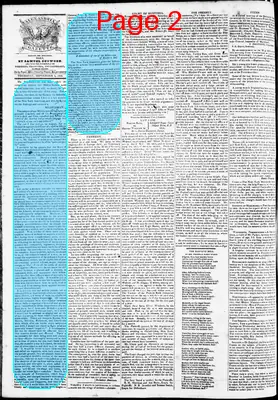
Phenix Gazette
Alexandria, Virginia
What is this article about?
A letter to the editor defends the U.S. militia system against criticisms, arguing its necessity for national defense without a standing army. It quotes a New York American piece highlighting its utility in emergencies and past wars like 1812, and includes the paper's proposed modifications for efficiency.
Clipping
OCR Quality
Full Text
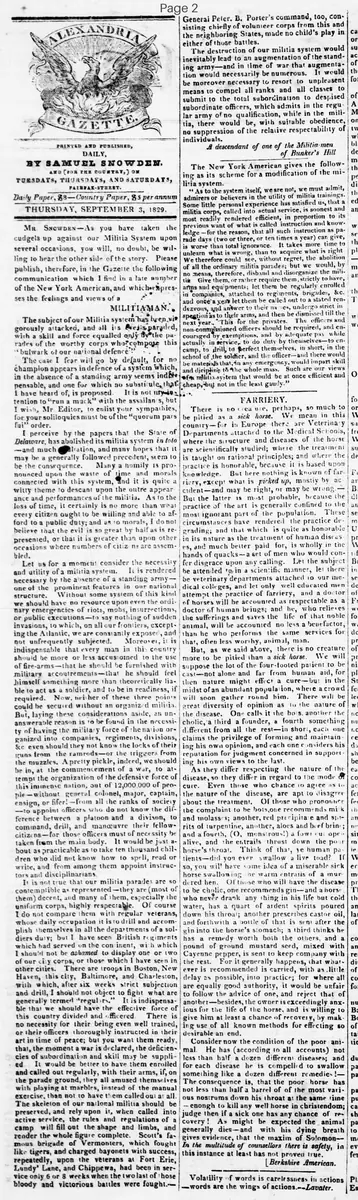
The subject of our Militia system has been vigorously attacked, and all its evils paraded, with a skill and force equalled only by the parades of the worthy corps who compose this "bulwark of our national defence."
The case I fear will go by default, for no champion appears in defence of a system which, in the absence of a standing army seems indispensable, and one for which no substitute, that I have heard of, is proposed. It is not my intention to "run a muck" with the assailants, but I wish, Mr. Editor, to enlist your sympathies, for your soliloquies must be of the "quorum pars fui" order.
I perceive by the papers that the State of Delaware, has abolished its militia system in toto—and much elation, and many hopes that it may be a generally followed precedent, seem to be the consequence.
Many a homily is pronounced upon the waste of time and morals connected with this system, and it is quite a witty theme to descant upon the outré appearance and performances of the militia. As to the loss of time, it certainly is no more than what every citizen ought to be willing and able to afford to a public duty; and as to morals, I do not believe that the evil is so great by half as is represented, or that it is greater than upon other occasions where numbers of citizens are assembled.
Let us for a moment consider the necessity and utility of a militia system. It is rendered necessary by the absence of a standing army—one of the prominent features in our national structure.
Without some system of this kind we should have no resource upon even the ordinary emergencies of riots, mobs, insurrections, or public executions—to say nothing of sudden invasions, to which, on all our frontiers, excepting the Atlantic, we are constantly exposed, and not unfrequently subjected. Moreover, it is indispensable that every man in this country should be more or less accustomed to the use of fire-arms—that he should be furnished with military accoutrements—that he should feel himself something more than theoretically liable to act as a soldier, and to be in readiness, if required. Now, neither of these three points could be secured without an organized militia.
But, laying these considerations aside, an unanswerable reason is to be found in the necessity of having the military force of the nation organized into companies, regiments, divisions, &c. even should they not know the locks of their guns from the ramrods—or the triggers from the muzzles. A pretty pickle, indeed, we should be in, at the commencement of a war, to attempt the organization of the defensive force of this immense nation, out of 12,000,000 of people—without general, colonel, major, captain, ensign, or fifer!—from all the ranks of society—to appoint officers who do not know the difference between a platoon and a division, to command, drill, and manœuvre their fellow-citizens—for those officers must of necessity be taken from the main body. It would be just about as practicable as to take ten thousand children who did not know how to spell, read or write, and from among them appoint instructors and disciplinarians.
It is not true that our militia parades are so contemptible as represented—they are (most of them) decent, and many of them, especially the uniform corps, highly respectable. Of course I do not compare them with regular veterans, whose daily occupation it is to drill and accomplish themselves in all the departments of a soldier's duty; but I have seen British regiments which had served on the continent, with which I should not be ashamed to display one or two of our city corps, or those which I have seen in other cities. There are troops in Boston, New Haven, this city, Baltimore, and Charleston, with which, after six weeks strict subjection and drill, I should not object to fight what are generally termed "regulars." It is indispensable that we should have the effective force of this country divided and officered. There is no necessity for their being even well trained, or their officers thoroughly instructed in their art in time of peace; but you want them ready, that, the moment a war is declared, the deficiencies of subordination and skill may be supplied. It would be better to have them enrolled and called out regularly, with their arms, if, on the parade ground, they all amused themselves with playing at marbles, instead of the manual exercise, than not to have them called out at all.
The skeleton of our national militia should be preserved, and rely upon it, when called into active service, the rules and regulations of a camp will fill out the shape and limbs, and render the whole figure complete. Scott's famous brigade of Vermonters, which fought like tigers, and charged bayonets with success, repeatedly, upon the veterans at Fort Erie, Lundy's Lane, and Chippewa, had been in service only 6 or 8 weeks when the two last of those bloody and victorious battles were fought.
General Peter B. Porter's command, too, consisting chiefly of volunteer corps from this and the neighboring States, made no child's play in either of those battles.
The destruction of our militia system would inevitably lead to an augmentation of the standing army—and in time of war that augmentation would necessarily be numerous. It would be moreover necessary to resort to unpleasant means to compel all ranks and all classes to submit to the total subordination to despised subordinate officers, which admits in the regular army of no qualification, while in the militia, there would be, with suitable obedience, no suppression of the relative respectability of individuals.
A descendant of one of the Militia-men of Bunker's Hill
The New York American gives the following as its scheme for a modification of the militia system.
Some little personal experience has satisfied us, that a militia corps, called into actual service, is soonest and most readily rendered efficient, in proportion to its previous want of what is called instruction and knowledge—for the reason, that all such instruction as parade days (two or three, or ten times a year) can give, is worse than total ignorance. It takes more time to unlearn what is wrong, than to acquire what is right. We therefore could see, without regret, the abolition of all the ordinary militia parades; but we would, by no means, therefore, disband and disorganize the militia. Give them, or rather require them, strictly to have, arms and equipments; let them be regularly enrolled in companies, attached to regiments, brigades, &c. and once a year let them be called out to a stated rendezvous, and answer to their names, undergo strict inspection as to their arms, and then be dismissed till the next year. This for the privates. The officers and non-commissioned officers should be required, and encouraged by exemptions, and by adequate pay while actually in service, to do duty by themselves—to encamp, to drill, to perfect themselves, in short, in the school of the soldier, and the officer—and there would be materials that, in any emergency, would impart skill and discipline to the whole mass. Such are our views of a militia system that would be at once efficient and cheap, but not in the least gaudy.
What sub-type of article is it?
What themes does it cover?
What keywords are associated?
What entities or persons were involved?
Letter to Editor Details
Author
A Descendant Of One Of The Militia Men Of Bunker's Hill
Recipient
Mr. Snowden
Main Argument
the militia system is indispensable for national defense in the absence of a standing army, providing organization and readiness for emergencies and wars; its abolition would necessitate a larger regular army and is countered by examples from the war of 1812 showing rapid effectiveness.
Notable Details