Thank you for visiting SNEWPapers!
Sign up free
National Gazette
Philadelphia, Philadelphia County, Pennsylvania
What is this article about?
A Republican from Kentucky criticizes Representative Christopher Greenup for refusing to justify his vote supporting the Secretary of the Treasury, despite evidence from Giles' resolutions showing misconduct in misusing borrowed funds intended for foreign and domestic debts, instead benefiting the Bank of the United States.
Clipping
OCR Quality
Full Text
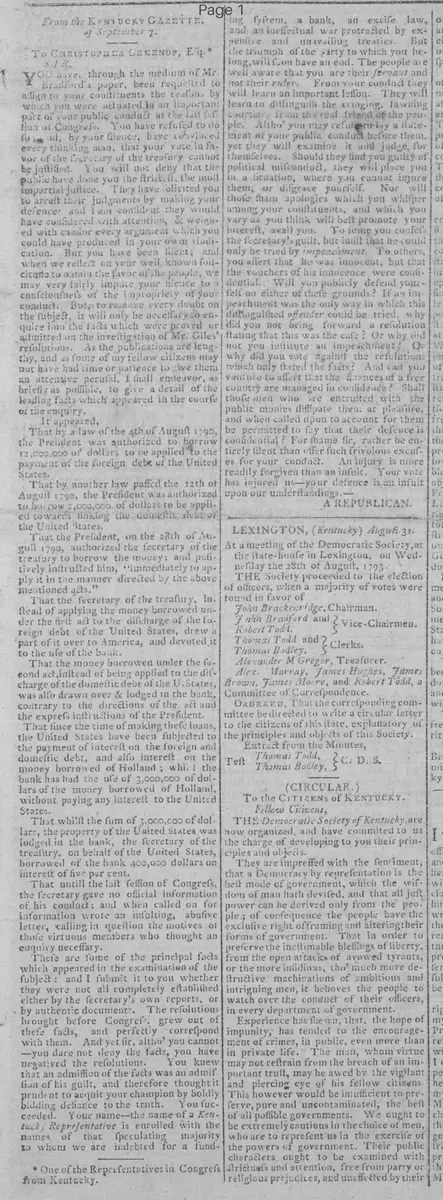
TO CHRISTOPHER GREENUP, Esq.
SIR,
You have, through the medium of Mr. Bradford's paper, been requested to assign to your constituents the reason, by which you were actuated in an important part of your public conduct at the last session of Congress. You have refused to do so; and, by your silence, have convinced every thinking man, that your vote in favor of the secretary of the treasury cannot be justified. You will not deny that the public have done you the strictest, the most impartial justice. They have solicited you to arrest their judgments by making your defence: and I am confident they would have considered with attention, & weighed with candor every argument which you could have produced in your own vindication. But you have been silent; and when we reflect on your well known solicitude to obtain the favor of the people, we may very fairly impute your silence to a consciousness of the impropriety of your conduct. But, to remove every doubt on the subject, it will only be necessary to enquire into the facts which were proved or admitted on the investigation of Mr. Giles' resolutions. As the publications are lengthy, and as some of my fellow citizens may not have had time or patience to give them an attentive perusal, I shall endeavor, as briefly as possible, to give a detail of the leading facts which appeared in the course of the enquiry.
It appeared,
That by a law of the 4th of August 1790, the President was authorized to borrow 12,000,000 of dollars to be applied to the payment of the foreign debt of the United States.
That by another law passed the 12th of August 1790, the President was authorized to borrow 2,000,000 of dollars to be applied towards sinking the domestic debt of the United States.
That the President, on the 28th of August 1790, authorized the secretary of the treasury to borrow the money: and positively instructed him, "immediately to apply it in the manner directed by the above mentioned acts."
That the secretary of the treasury, instead of applying the money borrowed under the first act to the discharge of the foreign debt of the United States, drew a part of it over to America, and devoted it to the use of the bank.
That the money borrowed under the second act, instead of being applied to the discharge of the domestic debt of the U. States, was also drawn over & lodged in the bank, contrary to the directions of the act and the express instructions of the President.
That since the time of making these loans, the United States have been subjected to the payment of interest on the foreign and domestic debt, and also interest on the money borrowed of Holland; whilst the bank has had the use of 3,000,000 of dollars of the money borrowed of Holland, without paying any interest to the United States.
That whilst the sum of 3,000,000 of dollars, the property of the United States was lodged in the bank, the secretary of the treasury, on behalf of the United States, borrowed of the bank 400,000 dollars on interest of five per cent.
That until the last session of Congress, the secretary gave no official information of his conduct: and when called on for information wrote an insulting, abusive letter, calling in question the motives of those virtuous members who thought an enquiry necessary.
These are some of the principal facts which appeared in the examination of the subject: and I submit it to you whether they were not all completely established either by the secretary's own reports, or by authentic documents. The resolutions brought before Congress, grew out of these facts, and perfectly correspond with them. And yet sir, although you cannot—you dare not deny the facts, you have negatived the resolutions.
You knew that an admission of the facts was an admission of his guilt, and therefore thought it prudent to acquit your champion by boldly bidding defiance to the truth. You succeeded. Your name—the name of a Kentucky Representative is enrolled with the names of that peculating majority to whom we are indebted for a funding system, a bank, an excise law,
ing yrem, a bank, an excise law, and an ineffectual war protracted by expensive and unavailing treaties. But the triumph of the party to which you belong, will soon have an end. The people are well aware that you are their servant and not their ruler. From your conduct they will learn an important lesson. They will learn to distinguish the cringing, fawning courtier from the real friend of the people. Although you may refuse to lay a statement of your public conduct before them, yet they will examine it and judge for themselves. Should they find you guilty of political misconduct, they will place you in a situation, where you cannot injure them, or disgrace yourself. Nor will those sham apologies which you whisper among your constituents, and which you vary as you think will best promote your interest, avail you. To some you confess the secretary's guilt, but insist that he could only be tried by impeachment. To others, you assert that he was innocent, but that the vouchers of his innocence were confidential. Will you publicly defend yourself on either of these grounds? If an impeachment was the only way in which this distinguished offender could be tried, why did you not bring forward a resolution stating that this was the case? Or why did you not institute an impeachment? Or why did you vote against the resolutions which only stated the facts? And can you venture to assert that the finances of a free country are managed in confidence? Shall those men who are entrusted with the public monies dissipate them at pleasure, and when called upon to account for them be permitted to say that their defence is confidential? For shame sir, rather be entirely silent than offer such frivolous excuses for your conduct. An injury is more readily forgiven than an insult. Your vote has injured us—your defence is an insult upon our understandings.
A REPUBLICAN.
What sub-type of article is it?
What themes does it cover?
What keywords are associated?
What entities or persons were involved?
Letter to Editor Details
Author
A Republican.
Recipient
Christopher Greenup, Esq.
Main Argument
christopher greenup unjustifiably voted against resolutions condemning the secretary of the treasury's misconduct in misappropriating borrowed funds for public debts to benefit the bank, demonstrating his alignment with corrupt interests over the people's.
Notable Details