Thank you for visiting SNEWPapers!
Sign up free
New York Daily Tribune
New York, New York County, New York
What is this article about?
Transcript of testimonies in an emigration inquiry about alleged mistreatment and poor provisions on the immigrant ship Villafranca from London to New York. Crew defends quality and fairness; passengers rebut with claims of rotten meat, shortages, and captain's hostility. (248 characters)
Clipping
OCR Quality
Full Text
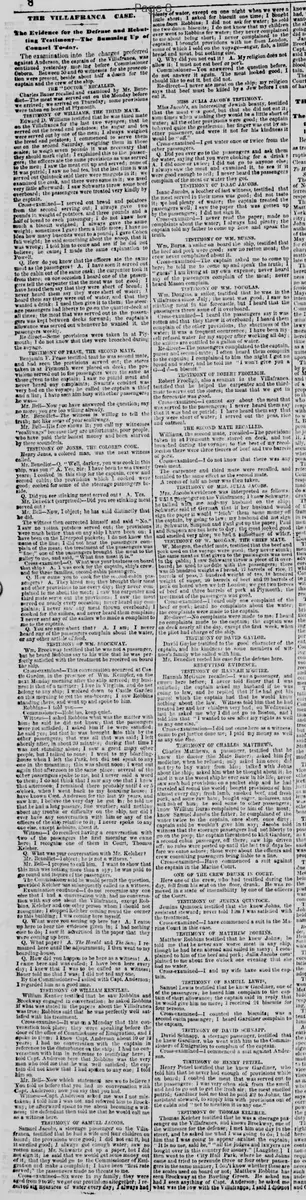
Charles Bauer recalled and examined by Mr. Benedict.
The meat was served out on the Monday before we arrived; we arrived on Thursday; some provisions were taken on board at Plymouth.
Edward D. Williams testified that he was third mate on the Villafranca for the last two voyages; that he served out the bread and potatoes; the sugar and tea were served out by one of the men; I always weighed them in these scales; to weigh seven pounds it was necessary that they should mark eight: I explained this to the passengers; I commenced to serve them out on the second Saturday, weighing them in these scales; the bread and potatoes; I saw the meat cut up and served; none of it was putrid; I saw no bad tea, but the last time it was served out Quintock said there were maggots in it; we examined the cask, and there were some in it: we used very little afterward: I saw Schwartz throw some beef overboard; the passengers were treated very kindly by the captain.
From the second serving out; I always gave two pounds in weight of potatoes, and three pounds and a half of bread to each passenger; I do not know how much a biscuit weighed; I always gave the same weight; sometimes I gave them a little more: I have no idea how many biscuits went to a pound; I gave Cohen full weight; he said something about the scoop, that it was wrong; I told him to come and see if he did not believe; he came; I made the same explanation to Powell.
Q. How do you know that the officers ate the same meat as the passengers? A. I have seen it served out to the cabin out of the same cask; the carpenter took it from there; on one occasion I heard one of the passengers tell the carpenter that the meat was not good; I never heard them say they were short of water: I have heard them say that they were short of bread: I heard them say they were out of water, and that they wanted a drink; I used then give it to them; the steerage passengers had liberty to go on the quarter-deck at all times; the meat that was served out to the passengers; the captain's allowance was served out whenever he wanted it, the sugar was kept between decks forward; the officers ate the same provisions as was served to the men; I saw the meat cut up and served; none of it was putrid; I saw no bad tea, but the last time it was served out Quintock said there were maggots in it; we examined the cask, and there were some in it: we used very little afterward: I saw Schwartz throw some beef overboard; the passengers were treated very kindly by the captain.
Re direct-Some provisions were taken in at Plymouth during the voyage.
TESTIMONY OF PEASE, THE SECOND MATE.
Benjamin F. Pease testified that he was second mate, and had seen the provisions served out: the stores taken in at Plymouth were placed on deck; the provisions served out to the passengers were the same as those given to the captain: I saw no putrid meat and never heard any complaints; Swartz's conduct was very bad on the voyage; he called the captain a thief and a liar; I have seen him busy with other passengers; he was-
Mr. Bell-Now you have answered the question; say no more; you are too willing already.
Mr. Benedict-The witness is willing to tell the truth; not like some of your scalliwags.
Mr. Bell-His face shows it: you call my witnesses who have paid their honest money and been starved by these scoundrels "scalliwags" because they are unfortunate, poor people.
TESTIMONY OF JONES, THE COLORED COOK.
Henry Jones, a colored man, was the next witness called.
Mr. Benedict-Q. "Well, darkey, you was cook in this ship, was you?" A. Yes. Sir; I have been to sea twenty years; I cooked in this ship for the captain, crew and second cabin; the provisions which I cooked were good; cooked for some of the steerage passengers besides.
Q. Did you see stinking meat served out? A. Yes.
Mr. Benedict (surprised)--Did you see stinking meat served out?
Mr. Bell-Now, I object; he has said distinctly that he did.
The witness then corrected himself and said "No."
I saw no rotten potatoes served out; the provisions were much better than on any ship I have been on; I have been on the Liverpool packets: I do not know the name of the line: I did not hear the passengers complain of the meat; the treatment of the passengers was good; "fine," one of the passengers brought the meat to the galley to me, and said, "What fine meat it is."
Cross-examined-Q. What was your business on board that ship? A. I was cook for the captain, ship's crew, and for three families, second cabin passengers.
Q. How came you to cook for the second-cabin passengers? A. They hired me; they brought their meat and other provisions to me every day; they never complained to me about the meat; I saw the carpenter and third mate serve out the provisions: I saw the meat served out nearly every occasion; never heard any complaints: I never saw any meat thrown overboard: I cooked for the sailors, and never heard them complain; I never sent any of the sailors who made a complaint to me to the captain.
Q. You are sure about that? A. I am: I never heard any of the passengers complain about the water, or any other article of food.
TESTIMONY OF WM. BROCKWAY.
Wm. Brockway testified that he was not a passenger, but he heard Robbins say to his wife that he was perfectly satisfied with the treatment he received on board the ship.
Cross examined-This conversation occurred at Castle Garden, in the presence of Wm. Kempler, on the next Monday morning after the ship arrived; my business is that of a mariner; I live in Virginia, and do not belong to any ship: I walked down to Castle Garden on this morning to get the sea-breeze; I saw Robbins standing there, and went up and spoke to him.
Commissioner-Robbins, keep quiet.
Witness-I asked Robbins what was the matter with him; he said he did not know; that the passengers were not satisfied. I asked him if he were satisfied; he said yes; but that he was brought into this by the other passengers: that was all that was said; I left shortly after, in about 20 minutes; during that time I was not standing alone; I saw a great many other people, but I talked to none; I went to my boarding house when I left the Park, but did not speak to any one in the meantime; this was about noon; I went out again that afternoon to the same place; several of the other passengers spoke to me, but I never said a word to them; I do not think that I saw any one that I knew that afternoon; I remained there probably until 4 or 5 o'clock, when I went back to my boarding house; I have known Capt. Anderson for the last 20 years, and saw him, I believe the very day he got in; he told me that he had a long passage, fine weather; said nothing about any trouble or difficulty on the ship, nor did I ever have any conversation with him or any of the officers of the ship relative to it; I never spoke to any one else, except Robbins, about it.
Witness-I do recollect having a conversation with two of the passengers the first morning we came here: I recognize one of them in Court, Thomas Keleher.
Q. What was your conversation with Mr. Keleher?
Mr. Benedict-I object: he is not a witness.
Mr. Bell-I propose to call him. I want to show that this man was nothing more than a spy; he was paid to go round and inquire of the passengers.
The Commissioner said he would permit the question, provided Keleher was subsequently called as a witness.
Examination continued-I do not recognize any one else that I had a conversation with: had no conversation with any one about the Villafranca, except Robbins, Keleher and one other person whom I should not recognize: I stopped Keleher coming round the corner to this building; I was coming here myself.
Q. What were you coming up here for? A. I came up here to hear the evidence given in; I had nothing else to do; I saw it advertised in the paper that they were coming up here.
Q. What paper? A. The Herald and The Sun; I remained here until the adjournment; I then went to my boarding-house.
Q. How did you happen to be here as a witness? A. I came here and was called; I have been here every day; I knew that I was to be called as a witness; Bauer told me that I was; I did not tell any one.
By the Commissioner-I sailed with Capt. Anderson; I regarded him as a good man.
TESTIMONY OF WILLIAM KENTLER.
William Kentler testified that he saw Robbins and Brockway engaged in conversation: he asked Robbins if what was stated in the papers about the Villafranca was true; Robbins said that he was perfectly well satisfied with his treatment.
Cross-examined-It was on a Monday that this conversation took place: they were speaking before the door of the office of Commissioner of Emigration, and I spoke to them: I know Capt. Anderson about 10 or 12 years; I had no conversation with the captain in reference to the disturbance on the ship; I had no conversation with him in reference to testifying here: I told Capt. Anderson here that Robbins was the very man who told me that he was well satisfied; the captain did not know that I had spoken to any one; I told him so.
Mr. Bell-Now which statement are we to believe? You told us before that you had no conversation with Capt. Anderson: now you say that you had.
Witness-Capt. Anderson asked me was I not mistaken; I told him I was not, and referred him to Brockway; he afterward spoke to me about becoming a witness; the defendant then told me that he would call me as a witness here.
TESTIMONY OF SAMUEL JACOBS.
Samuel Jacobs, a steerage passenger on the Villafranca, testified that he had a wife and four children on board: the provisions were good; I did not eat it, but it smelled good; I always got enough water; saw no rotten meat: Mr. Schwartz got up a paper, but I did not sign it; he said that we would get some money out of it; that they would go to the Commissioner of Emigration and make a complaint; I have been "first rate served;" the passengers made no threats to me.
Cross-examined-Six were in my family; they were aged from 9 to 20; we got our provisions altogether; I received plenty of water, except for biscuit." I bought some from Robbins; I did not ask for water: he sold me two dozen biscuits: I do not know that my children ever went to Robbins for water; they never complained to me about being short; I never complained to the captain; I brought provisions with me from London, some of which I sold on the voyage-sugar, fish, a little bread and meat, but nothing else.
Q. Why did you not eat it? A. My religion does not allow it; I must not eat beef or pork.
Commissioner-You answered the question before. Do not answer it again. The meat looked good; I should like to eat it, but did not.
Re-direct-I never ate meat on the ship: my religion says that beef must be killed by a Jew before I can eat it.
Miss Julia Jacobs, an interesting Jewish beauty, testified that the meat was good, but that she did not eat it;
MISS JULIA JACOBS'S TESTIMONY.
sometimes when washing they would be a little short of water; all the other provisions were good; the captain behaved quite the gentleman: her finger was cut by another passenger, and were it not for his kindness it would be "off."
Cross-examined-I got water once or twice from the other passengers.
Q. Did you ever go to the passengers and ask them for water, saying that you were choking for a drink?
A. I did once or twice; I did not go to anyone else; I always saw the meat and examined it, to see if it were good enough to sell; I never heard the passengers complain of the meat or water they got.
TESTIMONY OF ISAAC JACOBS.
Isaac Jacobs, a brother of last witness, testified that the meat served in their mess was good; did not taste it; we had plenty of water: the captain treated the passengers well; I saw the paper that was gotten up by the passengers: I did not sign it.
Cross-examined-I never read the paper: made no complaints about the water: I always had plenty: the captain told my father to come up here and speak the truth.
TESTIMONY OF WM. BURNS.
Wm. Burns, a sailor on board the ship, testified that the beef and pork were good; saw no rotten meat; the crew never complained about it.
Cross-examined-The captain asked me to come up here: he told me to come up and speak the truth; I "guess" I am living at my own expense; never heard any of the passengers complain of the meat; never heard Mason complain.
TESTIMONY OF WM. DOUGLAS.
Wm. Douglas, a sailor, testified that he was in the Villafranca since July; the meat was good: I saw no stinking meat in the forecastle, but I heard that the passengers threw some of it overboard.
Cross-examined-I heard the passengers say it was rotten and that they threw it overboard: I heard them complain of the other provisions: the shortness of the water: it was a frequent occurrence; I have been my self refused water for my supper after working all day; the sailors are entitled to a gallon of water.
Re-direct-The passengers complained to the captain, purser and second-mate: I often heard them complain to the captain: I complained to him the night I got no bread and water, and he told me "I won't give you a G-d-d-n biscuit."
TESTIMONY OF ROBERT FROELIGH.
Robert Froeligh, also a seaman in the Villafranca, testified that he helped the carpenter and the third mate to serve out the stores; the meat that we got in the forecastle was good.
Cross-examined-I cannot say about the meat that was served to the passengers; I never heard them say that it was bad or putrid: I have heard them say that they were short of water; I served out the peas, rice and oatmeal.
THE SECOND MATE RECALLED.
Williams, the second mate, recalled-The provisions taken in at Plymouth were stored on deck, and not broached during the voyage: to the best of my recollection there were three tierces of beef and two barrels of pork.
Cross-examined-I do not know that there was any fresh meat.
The carpenter and third mate were recalled, and testified to the same effect as the second mate.
A recess of half an hour was then taken.
TESTIMONY OF MRS. JULIA JACOBS.
Mrs. Jacobs's evidence was interpreted as follows: I was a passenger on the Villafranca; I know Schwartz: he talked with me and my husband on the ship: Schwartz said in German that if her husband would sign the paper it would "fetch" them some money off the captain, by going to law: my husband did not sign it: Schwartz, Simpson and Paul got up the paper: Paul and Simpson are not here to-day; the meat looked good and smelled very nice; we had a sufficiency of water.
TESTIMONY OF W. MORGAN, THE CHIEF MATE.
W. Morgan, the chief mate, testified that the beef and pork used on the voyage were good; they never stunk; the same meat as that given to the passengers was used in the cabin; I saw Schwartz throw a piece of it overboard; he used to meddle with the passengers; there was 55 hundred weight of bread, 17 barrels of rice, 17 barrels of peas, 3 hundred weight of tea, 18 hundred weight of sugar, 20 barrels of beef and 20 barrels of pork on board when we left London; we got two tierces of beef and three barrels of pork at Plymouth, the treatment of the passengers was good.
Cross-examined-I heard only one complaint of the beef or pork; heard no complaints about the water; the complaints were made to the captain.
Re-direct-No complaints were made to me: I heard no complaints made to the captain: the captain was on deck nearly all the day, except the first week, when the pilot had charge of the ship.
TESTIMONY OF DAVID GAYLOR.
David Gaylor testified to the good character of the captain, and his kindness to some members of witness's family who sailed with him.
Mr. Benedict rested his case for the defense here.
REBUTTING EVIDENCE.
TESTIMONY OF HANNAH M'GUIRE.
Hannah McGuire recalled--I was a passenger, and sworn here before; I never told Bauer that I was satisfied; the captain asked my husband if he was going to law, and he replied that if he had got his parcel which the captain had that he would know nothing about the law. Witness told him that he had treated her and her children very bad; on Wednesday last he asked me why I did not go to Boston, and I told him that "I wanted to see after my rights as well as any one else."
Cross-examination-I did not come here as a witness: came to get justice done me; I paid my money as well as any one else.
TESTIMONY OF CHARLES MATTHEWS.
Charles Matthews, a passenger, testified that he knew the doctor (the Mate Bauer): asked him for medicine, when he refused; only asked him once: did not try to buy water from him: talked with Johns about the ship: asked him what he thought about it: he said it was the worst ship he ever saw in his life; never saw such bad provisions on a packet ship and he had traveled all round the world; bought provisions of him almost every day: fresh lamb, smoked beef, and fresh pork, and some raw ham; bought sugar, molasses, and salt fish of him: he sold some to other passengers; know William Burns complained to him of the meat; know Samuel Jacobs the father: he complained of the water twice to the captain, once short, once dirty; captain said he wouldn't give him any; Jacobs told witness that the steerage passengers had not liberty to go on the poop; the captain threatened to kick Gardner, a second cabin passenger, off there; saw him driven off: no rules were posted up until the last two days before we came ashore; those were about the officers and crew consulting passengers being liable to a fine.
Cross-examined-Have commenced a suit against the captain in the Marine Court.
ONE OF THE CREW DRUNK IN COURT.
Here one of the crew, who had testified during the day, fell from his seat on the floor, drunk. He was removed in a state of insensibility by one of the officers of the Court.
TESTIMONY OF JEMINA QUINTOCK.
Jemina Quintock testified that she knew Johns, the assistant steward: never told him I was satisfied with the treatment.
Cross-examined-I have commenced a suit in the Marine Court in this case.
TESTIMONY OF MATTHEW ROBBINS.
Matthew Robbins testified that he knew Johns: he told me that he never saw worse meat in any ship, though he had been abroad and sailed in many: I complained to him of the beef and pork: Julia Jacobs complained to me about five o'clock one evening that she had no water.
Cross-examined-I and my wife have sued the captain.
TESTIMONY OF SAMUEL LEWIS.
Samuel Lewis testified that he knew Gardiner, one of the passengers; he heard him complain to the captain of short allowance; the captain said in reply that he would give him no more; I received 24 biscuits for four persons.
Cross-examined-I counted the biscuits; was a second cabin passenger; I heard Gardiner complain to the captain.
TESTIMONY OF DAVID SCHNAPP.
David Schnapp, a steerage passenger, testified that he knew Gardiner, who went with him to the Commissioners of Emigration to complain of the captain.
Cross-examined-I commenced a suit against Anderson.
TESTIMONY OF HENRY PETZEL.
Henry Petzel testified that he knew Gardiner, who told him that he never had enough of provisions while on board; I cooked the meat that was served out to the passengers: I was very often sick from the smell, and had to go out to get the fresh air: the meat smelled putrid; Gardiner told me that he paid 2 to Johns, the assistant steward, to supply him with provisions out of the cabin and "not to mention it to any one."
TESTIMONY OF THOMAS KELEHER.
Thomas Keleher testified that he was a steerage passenger on the Villafranca, and knows Brockway, one of the witnesses for the defense; I met him one day in the street, and he asked me what I was going to do: I told him that I was going to appear against the captain; "It is no use, said he." "all the judges and lawyers are bought over in this country for money." [Laughter.] I then went to the City Hall Park, where he and Johns came and tried to persuade three or four other passengers in the same manner; I don't know whether these are the scales used on board or not: Matthew Robbins has seen Brockway at the Bowling Green. He asked me had I seen anything of Capt. Anderson; he asked me if I had any complaint; I said I had, we were short of rations and water; he said he did not know; he asked me if I had any complaint; I said I had, we were short of rations and water; he said he did not know; the ship, as the carpenter (meaning Cooney) was not going out again with her; no one else spoke to me; I did not say I was perfectly satisfied with the treatment.
James Cotty recalled-Had and spoken with Brockway, last Monday, just outside; he told me that Capt. Anderson bore a better character than I did; he said he did not mean me only, but all the passengers together; that our own lawyer said we were a set of bloody rogues, and we had no chance against the captain.
The evidence was here closed on both sides. The Court adjourned till to-day at 2 o'clock, for the purpose of having counsel sum up the case.
What sub-type of article is it?
What themes does it cover?
What keywords are associated?
What entities or persons were involved?
Where did it happen?
Story Details
Key Persons
Location
Aboard The Ship Villafranca; Plymouth; Castle Garden, New York; Commissioner Of Emigration Office
Event Date
Recent Voyage From London Via Plymouth To New York; Hearing In Progress
Story Details
Testimonies in a legal proceeding before the Commissioner of Emigration regarding passenger complaints of poor provisions, rotten meat, short water rations, and mistreatment on the ship Villafranca under Captain Anderson. Defense witnesses, including crew and some passengers, claim provisions were good and treatment kind; rebuttal evidence from passengers describes bad meat, shortages, and threats.