Thank you for visiting SNEWPapers!
Sign up free
Literary
March 1, 1867
The Wheeling Daily Register
Wheeling, Ohio County, West Virginia
What is this article about?
A passenger on the steamer 'Queen' from London befriends engineer Angove, who shares a near-miss in the engine room during rough seas. Angove then recounts his past voyage to San Francisco amid the gold rush, including crew desertions, a drunken chief engineer, a new suspicious chief, and the captain's unexpected new wife.
Clipping
OCR Quality
85%
Good
Full Text
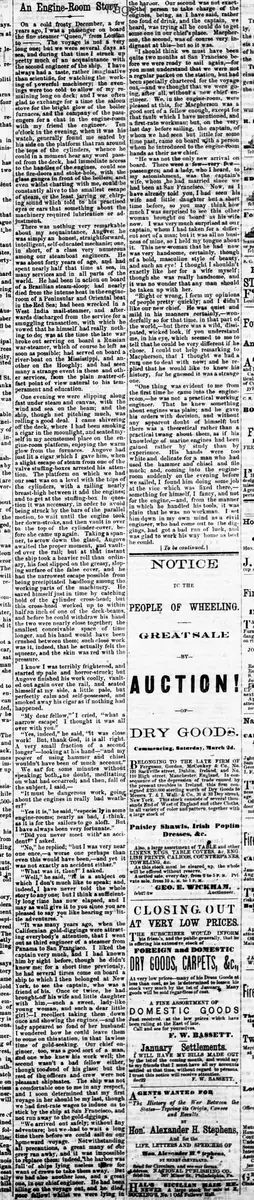
On a cold, frosty December, a few years ago, I was passenger on board the fine steamer "Queen," from London to [destination]. The voyage is not a very long one; but we were several days at sea, and during that time I struck up pretty much of an acquaintance with the second engineer of the ship. I have always had a taste, rather imaginative than scientific, for watching the working of powerful machinery; the evenings were too cold to allow of my remaining long on deck; and I was often glad to exchange for a time the saloon stove for the bright glow of the boiler furnaces, and the company of the passengers for a chat in the engine-room with my friend the engineer. Ten o'clock in the evening, when it was his watch, generally found me seated by his side on the platform that ran around the tops of the cylinders, whence he could in a moment hear any word passed from the deck, had immediate access to the handles of the engines, could see the fire-door and stoke-hole, with the glass gauges in front of the boilers; and even whilst chatting with me, could be constantly alive to the smallest escape of steam, or the least jarring or chirping sound which told to his practised eyes or ear that something about the machinery required lubrication or adjustment.
There was nothing very remarkable about my acquaintance, Angove: he was simply an honest, straightforward, intelligent, self-educated mechanic; one, in short, of a class very numerous among our steamboat engineers. He was about forty years of age, and had spent nearly half that time at sea, in many services and in all parts of the world. He had been in action on board of a Brazilian steam-sloop; had nearly died from the intense heat in the engine-room of a Peninsular and Oriental boat in the Red Sea: had been wrecked in a West India mail-steamer, and afterwards discharged from the service for a smuggling transaction, with which he vowed that he himself had really nothing to do; was at the time the late war broke out serving on board a Russian war-steamer, which of course he left as soon as possible; had served on board a river-boat on the Mississippi, and another on the Hooghly: and had seen many a strange event in these and other services, from the plain matter-of-fact point of view natural to his temperament and education.
One evening we were slipping along fast under steam and canvas, with the wind and sea on the beam; and the ship, though not pitching much, was rolling a good deal. I came shivering off the deck, where I had been smoking a cigar in the moonlight, and seated myself in my accustomed place on the engine-room platform, enjoying the warm glow from the furnaces. Angove had just lit a cigar which I gave him, when a slight escape of steam from one of the valve stuffing-boxes arrested his attention. The platform on which we had our seat was on a level with the tops of the cylinders, with a railing nearly breast-high between it and the engines: and to get at the stuffing-box in question it was necessary, in order to avoid being struck by the bars of the parallel motion, to wait until the engine took her down-stroke, and then vault in over to the top of the cylinder-cover, before she came up again. Taking a spanner, to screw down the gland, Angove awaited the proper moment, and vaulted over the rail; but at that instant the ship took a heavier roll than ordinary, his foot slipped on the greasy, sloping surface of the false cover, and he had the narrowest escape possible from being precipitated headlong among the working parts of the machinery.
He saved himself just in time by catching hold of the cylinder cross-head; but this cross-head worked up to within half an inch of one of the deck-beams, and before he could withdraw his hand the two were nearly close together; the smallest conceivable space of time longer, and his hand would have been crushed between them; such close work was it, indeed, that he actually felt the squeeze, and the skin was red with the pressure.
I know I was terribly frightened, and started up pale and horror-struck; but Angove finished his work coolly, vaulted out again over the rail, and seated himself at my side, a little pale, but perfectly calm and self-possessed, and smoked away his cigar as if nothing had happened.
"My dear fellow," I cried, "what a narrow escape! I thought it was all over with you."
"Yes, indeed," he said, "it was close work! But, thank God, it is all right. A very small fraction of a second longer"-looking at his hand-"and my power of using hammer and chisel wouldn't have been of much account."
We sat for some minutes without speaking; both, no doubt, meditating on what had occurred; and then, full of the subject, I said:-
"It must be dangerous work, going about the engines in really bad weather?"
"Yes it is," he said, "especially in some engine-rooms; nearly as bad, I think, as it is for the sailors to go aloft. But I have always been very fortunate."
"Did you never meet with an accident?" I asked.
"No," he replied; "but I was very near one once,-a worse one perhaps than even this would have been,--and yet it was not exactly an accident either."
"What was it, then?" I asked.
"Well," he said, "is a subject on which I don't much like to speak; and, indeed, I have never told the whole story to anyone; but I think a sufficiently long time has now elapsed, and I may as well give it to you since you are pleased to say you like hearing my little adventures.
"It was many years ago, when the Californian gold-digging were attracting everybody's attention, that I went out as third engineer of a steamer from Panama to San Francisco. I liked the captain very much, and I had known him by sight before, though he didn't know me; for a short time previously, he had several times come on board ship to which I then belonged at New York, to see the captain, who was friend of his. Once or twice, he had brought his wife and little daughter with him,--such a sweet, lady-like young woman, and such a dear little girl! I recollect taking them down once and showing the engines.-and the lady appeared so fond of her husband I wondered how he could leave them to come out on this station, in that feverish time of gold-seeking. Our chief engineer, too, was a good sort of a man, and one who knew his work well; the second wasn't a bad fellow either though too fond of his glass; but the rest of the officers and crew were not pleasant shipmates. The ship was not a comfortable one to me in any respect, and I soon determined that my "first voyage in her should be my last, though we had first-rate wages to induce us to stick by the ship at San Francisco, and not run away to the gold-diggings.
"We arrived out safely; without any adventure: but we had to wait a long time there before we could sail on our homeward voyage. Notwithstanding all precautions, a great many of our crew left the ship, and left our ship's company poor; our chief engineer, being as he was too fond of drink, and the captain, we heard, was trying all he could do to get some one in our chief's place. Macpherson, the second, was of course very indignant at this-but so it was.
I should think we must have been quite two months at San Francisco before we were ready to sail again,-for you must understand that we were not a regular packet on the station, but had been specially chartered for the voyage out,-and we thought that we were going, after all, without a new chief engineer. We, in the engine-room, were pleased at this, for Macpherson was a good sort of a fellow enough, except for that fault which I have mentioned, and a first-rate workman; but, on the very last day before sailing, the captain, of whom we had seen but little for some time past, came on board with a person whom he introduced to the engine-room hands as their new chief.
"He was not the only new arrival on board. There were a few-very few- passengers; and a lady, who I heard, to my astonishment, was the captain's wife, whom he had married since we had been at San Francisco. Now, as I have already told you, I had seen his wife and little daughter but a short time before, so you may think how much I was surprised to see this other woman brought on board as his wife now. I was very much surprised at our captain, whom I had taken for a different sort of a man; but it was all no business of mine, so I held my tongue about it. This new woman that he had now was very handsome, certainly, though of a bold, masculine style of beauty, and such an eye! I thought I shouldn't exactly like her for a wife myself; though she was really handsome, and it was no wonder that any man should be taken up with her.
"Right or wrong, I form my opinions of people pretty quickly; and I didn't like our new chief. He was quiet and mild in his manners, certainly,-wonderfully so for that time, in that part of the world,-but there was a wild, dissipated, wicked look, if you understand me, in his eye, which seemed to me to tell that he could be very different if he chose. I could not help remarking to Macpherson, that I thought we had a rum one to deal with now; and he replied that he would like to know his history, for he guessed it was a strange one.
"One thing was evident to me from the first time he came into the engine-room,-he was not a practical working engineer. That he knew something about engines was plain; and he gave his orders with decision, and without any apparent doubt of himself; but there was a theoretical rather than a practical twang about them, as if his knowledge of marine engines had been gained rather by study than by experience. His hands were too white and delicate for a man who had used the hammer and chisel and file much; and, coming into the engine-room suddenly on the evening before we sailed, I found him doing some job at the vice which was fixed there,- something for himself, I fancy, and not for the engine,-and, from the manner in which he handled his tools, it was plain that he was no workman. I set him down in my own mind as a civil engineer, who had come out to the diggings, had got a bad run of luck, and was glad to work his way home as best he could.
To be continued.
There was nothing very remarkable about my acquaintance, Angove: he was simply an honest, straightforward, intelligent, self-educated mechanic; one, in short, of a class very numerous among our steamboat engineers. He was about forty years of age, and had spent nearly half that time at sea, in many services and in all parts of the world. He had been in action on board of a Brazilian steam-sloop; had nearly died from the intense heat in the engine-room of a Peninsular and Oriental boat in the Red Sea: had been wrecked in a West India mail-steamer, and afterwards discharged from the service for a smuggling transaction, with which he vowed that he himself had really nothing to do; was at the time the late war broke out serving on board a Russian war-steamer, which of course he left as soon as possible; had served on board a river-boat on the Mississippi, and another on the Hooghly: and had seen many a strange event in these and other services, from the plain matter-of-fact point of view natural to his temperament and education.
One evening we were slipping along fast under steam and canvas, with the wind and sea on the beam; and the ship, though not pitching much, was rolling a good deal. I came shivering off the deck, where I had been smoking a cigar in the moonlight, and seated myself in my accustomed place on the engine-room platform, enjoying the warm glow from the furnaces. Angove had just lit a cigar which I gave him, when a slight escape of steam from one of the valve stuffing-boxes arrested his attention. The platform on which we had our seat was on a level with the tops of the cylinders, with a railing nearly breast-high between it and the engines: and to get at the stuffing-box in question it was necessary, in order to avoid being struck by the bars of the parallel motion, to wait until the engine took her down-stroke, and then vault in over to the top of the cylinder-cover, before she came up again. Taking a spanner, to screw down the gland, Angove awaited the proper moment, and vaulted over the rail; but at that instant the ship took a heavier roll than ordinary, his foot slipped on the greasy, sloping surface of the false cover, and he had the narrowest escape possible from being precipitated headlong among the working parts of the machinery.
He saved himself just in time by catching hold of the cylinder cross-head; but this cross-head worked up to within half an inch of one of the deck-beams, and before he could withdraw his hand the two were nearly close together; the smallest conceivable space of time longer, and his hand would have been crushed between them; such close work was it, indeed, that he actually felt the squeeze, and the skin was red with the pressure.
I know I was terribly frightened, and started up pale and horror-struck; but Angove finished his work coolly, vaulted out again over the rail, and seated himself at my side, a little pale, but perfectly calm and self-possessed, and smoked away his cigar as if nothing had happened.
"My dear fellow," I cried, "what a narrow escape! I thought it was all over with you."
"Yes, indeed," he said, "it was close work! But, thank God, it is all right. A very small fraction of a second longer"-looking at his hand-"and my power of using hammer and chisel wouldn't have been of much account."
We sat for some minutes without speaking; both, no doubt, meditating on what had occurred; and then, full of the subject, I said:-
"It must be dangerous work, going about the engines in really bad weather?"
"Yes it is," he said, "especially in some engine-rooms; nearly as bad, I think, as it is for the sailors to go aloft. But I have always been very fortunate."
"Did you never meet with an accident?" I asked.
"No," he replied; "but I was very near one once,-a worse one perhaps than even this would have been,--and yet it was not exactly an accident either."
"What was it, then?" I asked.
"Well," he said, "is a subject on which I don't much like to speak; and, indeed, I have never told the whole story to anyone; but I think a sufficiently long time has now elapsed, and I may as well give it to you since you are pleased to say you like hearing my little adventures.
"It was many years ago, when the Californian gold-digging were attracting everybody's attention, that I went out as third engineer of a steamer from Panama to San Francisco. I liked the captain very much, and I had known him by sight before, though he didn't know me; for a short time previously, he had several times come on board ship to which I then belonged at New York, to see the captain, who was friend of his. Once or twice, he had brought his wife and little daughter with him,--such a sweet, lady-like young woman, and such a dear little girl! I recollect taking them down once and showing the engines.-and the lady appeared so fond of her husband I wondered how he could leave them to come out on this station, in that feverish time of gold-seeking. Our chief engineer, too, was a good sort of a man, and one who knew his work well; the second wasn't a bad fellow either though too fond of his glass; but the rest of the officers and crew were not pleasant shipmates. The ship was not a comfortable one to me in any respect, and I soon determined that my "first voyage in her should be my last, though we had first-rate wages to induce us to stick by the ship at San Francisco, and not run away to the gold-diggings.
"We arrived out safely; without any adventure: but we had to wait a long time there before we could sail on our homeward voyage. Notwithstanding all precautions, a great many of our crew left the ship, and left our ship's company poor; our chief engineer, being as he was too fond of drink, and the captain, we heard, was trying all he could do to get some one in our chief's place. Macpherson, the second, was of course very indignant at this-but so it was.
I should think we must have been quite two months at San Francisco before we were ready to sail again,-for you must understand that we were not a regular packet on the station, but had been specially chartered for the voyage out,-and we thought that we were going, after all, without a new chief engineer. We, in the engine-room, were pleased at this, for Macpherson was a good sort of a fellow enough, except for that fault which I have mentioned, and a first-rate workman; but, on the very last day before sailing, the captain, of whom we had seen but little for some time past, came on board with a person whom he introduced to the engine-room hands as their new chief.
"He was not the only new arrival on board. There were a few-very few- passengers; and a lady, who I heard, to my astonishment, was the captain's wife, whom he had married since we had been at San Francisco. Now, as I have already told you, I had seen his wife and little daughter but a short time before, so you may think how much I was surprised to see this other woman brought on board as his wife now. I was very much surprised at our captain, whom I had taken for a different sort of a man; but it was all no business of mine, so I held my tongue about it. This new woman that he had now was very handsome, certainly, though of a bold, masculine style of beauty, and such an eye! I thought I shouldn't exactly like her for a wife myself; though she was really handsome, and it was no wonder that any man should be taken up with her.
"Right or wrong, I form my opinions of people pretty quickly; and I didn't like our new chief. He was quiet and mild in his manners, certainly,-wonderfully so for that time, in that part of the world,-but there was a wild, dissipated, wicked look, if you understand me, in his eye, which seemed to me to tell that he could be very different if he chose. I could not help remarking to Macpherson, that I thought we had a rum one to deal with now; and he replied that he would like to know his history, for he guessed it was a strange one.
"One thing was evident to me from the first time he came into the engine-room,-he was not a practical working engineer. That he knew something about engines was plain; and he gave his orders with decision, and without any apparent doubt of himself; but there was a theoretical rather than a practical twang about them, as if his knowledge of marine engines had been gained rather by study than by experience. His hands were too white and delicate for a man who had used the hammer and chisel and file much; and, coming into the engine-room suddenly on the evening before we sailed, I found him doing some job at the vice which was fixed there,- something for himself, I fancy, and not for the engine,-and, from the manner in which he handled his tools, it was plain that he was no workman. I set him down in my own mind as a civil engineer, who had come out to the diggings, had got a bad run of luck, and was glad to work his way home as best he could.
To be continued.
What sub-type of article is it?
Prose Fiction
What themes does it cover?
Commerce Trade
War Peace
Moral Virtue
What keywords are associated?
Steamer Voyage
Engine Room
Narrow Escape
Gold Rush
California
Chief Engineer
Captains Wife
Literary Details
Key Lines
"My Dear Fellow," I Cried, "What A Narrow Escape! I Thought It Was All Over With You."
"Yes, Indeed," He Said, "It Was Close Work! But, Thank God, It Is All Right. A Very Small Fraction Of A Second Longer" Looking At His Hand "And My Power Of Using Hammer And Chisel Wouldn't Have Been Of Much Account."
"It Was Many Years Ago, When The Californian Gold Digging Were Attracting Everybody's Attention, That I Went Out As Third Engineer Of A Steamer From Panama To San Francisco."