Thank you for visiting SNEWPapers!
Sign up free
Editorial
November 3, 1858
Alexandria Gazette
Alexandria, Alexandria County, District Of Columbia
What is this article about?
Lord Napier's speech at the Agricultural Banquet in Richmond, Virginia, on October 29, 1858, expresses pride in his agricultural roots, praises the rapid progress of American farming, its economic benefits to England via key staples, the role of emigration, and fosters goodwill between the nations, highlighting Virginia's hospitality.
Clipping
OCR Quality
95%
Excellent
Full Text
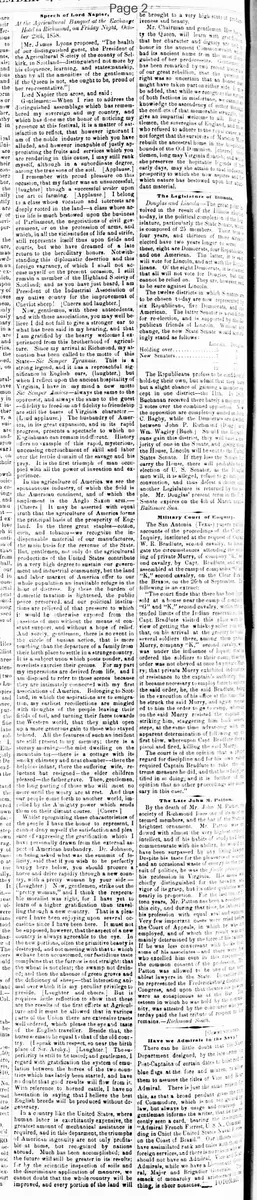
SPEECH OF LORD NAPIER,
At the Agricultural Banquet at the Exchange Hotel in Richmond, on Friday Night, October 29th, 1858.
[Mr. James Lyons proposed, "The health of our distinguished guest, the President of the Agricultural Society of the county of Selkirk, in Scotland--distinguished not more by his eloquence, learning, and statesmanship, than by all the amenities of the gentleman; if the Queen is not, she ought to be, proud of her representative."]
Lord Napier then arose, and said:
Gentlemen:-When I rise to address the distinguished assemblage which has remembered my sovereign and my country, and which has done me the honor of noticing my presence at this festival, it is a matter of satisfaction to reflect, that however ignorant I am of the noble industry to which you have alluded, and however incapable of justly appreciating the fruits and services which you are rendering in this cause, I may still rank myself, although in a subordinate degree, among the true sons of the soil. [Applause.]
I remember with proud pleasure on this occasion, that my father was an unsuccessful, though a successful writer upon the art of farming. [Applause] I belong to a class whose vocation and interests are deeply rooted in the land--a class whose active life is much bestowed upon the business of Parliament, the negotiations of civil government, or on the profession of arms, and which, in all the vicissitudes of life and strife, still represents itself thus upon fields and courts, but who have dreamed of late return to the hereditary honors. Notwithstanding this diplomatic desertion and this foreign vagrancy, of which I shall not accuse myself on the present occasion, I still remain a member of the Highland Society of Scotland: and as you have just heard, I am President of the Industrial Association of my native county for the improvement of Cheviot sheep!! [Cheers and laughter.]
Now, gentlemen, with these antecedents, and with these associations, you may well believe I did not fail to give a stronger ear to what has been said in my hearing, and that I am gratified by the hearty welcome I experienced from this brotherhood of agriculture. Since my arrival at Richmond, my attention has been called to the motto of this State--Sic Semper Tyrannis. This is strong legend, and it has a reproachful significance in English ears, (laughter,) but when I reflect upon the ancient hospitality of Virginia, I have in my mind a new motto Sic Semper Amices-always the same to the oppressor, and always the same to the guest --fidelity to freedom and fidelity to friendship are still the bases of Virginia character.- (Loud applause.) The husbandry of America, in its great expansion, and in its rapid progress, presents a spectacle to which no Englishman can remain indifferent. History offers no example of this rapid, mysterious unceasing encroachment of skill and labor over the fertile domain of the savage and his prey. It is the first triumph of man occupied with all the power of invention and experience.
In the agriculture of America we see the spontaneous industry, of which the field is the American continent, and of which the implement is the Anglo Saxon arm.-- Cheers! It may be asserted with equal truth that the agriculture of America forms the principal basis of the prosperity of England. In the three great staples-cotton corn, and tobacco-we recognize the indispensable material of our manufactures, the main basis for the revenue of the State. But, gentlemen, not only do the agricultural productions of the United States contribute in a very high degree to sustain our government and industrial community, but the land and labor market of America offer to our whole population an inevitable refuge in the hour of distress. By these the burden of domestic taxation is lightened, the public peace preserved, and our political institutions are relieved of that pressure to which it would be otherwise exposed from the passions of men without the means of constant support, and without a hope of relief.
And surely, gentlemen, there is no event in the circle of human action, that is more touching than the departure of a family from their birth place to settle in a strange country It is a subject upon which poets ponder, and novelists exercise their genius. For my part my impressions are derived from life, and I am disposed to refer to those scenes because they are intimately connected with my first associations of America. Belonging to Scotland, in which the aspirations are to emigration, my earliest recollections are mingled with thoughts of the people leaving their fields of toil, and turning their faces toward the Western world, that they might open up a more generous gain to those who stayed behind. All the features of such an incident are still present to my memory; there is a stormy morning--the mist dwelling on the mountain top--there is a cottage with its smoky chimney and thatched chamber--there the helpless infant, there the suffering wife, reluctant but resigned-the elder children pleased-the father grave. Then, gentlemen the long parting of those who will meet no more until the weary are at rest. And thus our people come forth to another world, impelled by the Almighty power which sends them on their distant course. I Cheers! ]
Whilst recognizing these characteristics of the people I have the honor to represent, I cannot deny myself the satisfaction and pleasure of expressing the gratification which I have personally drawn from the external aspect of American husbandry. Dr. Johnson, on being asked what was the summit of felicity, said that if you wish to be perfectly happy here below, you should procure a horse and drive rapidly through a new country, with a pretty woman by your side- (Laughter) Now, gentlemen, strike out the "pretty woman," and I think the respectable moralist was right, for I have yet to learn of a higher gratification than travelling through a new country. That is a pleasure I have been enjoying upon several occasions since I have been here. It must not be supposed, however, that the aspect of a new country is always agreeable to the eye. In the new portions, often the primitive beauty is destroyed, and not meeting with that to which we have been accustomed, our fastidious taste complains that the furrow is not straight: that the wheat is not clear; the swamp not drained: and then the absence of green groves and the deficiency of sheep--that interesting animal over which it is my peculiar privilege to preside. [Laughter and cheers.] But it requires little reflection to show that these are the results of the first efforts at Agriculture and it must be allowed that in various parts of the Union there are extensive tracts well ordered, which please the eye and taste of the English traveller. Beside that, the horse seems to be equal to that of the old country. (I speak with respect, so near the birth place of Sir. Archy.) [Laughter.] The superiority is still to be tested; and gentlemen, I regard with gratification the system of emulation between the horses of the two countries which has lately been started, and have no doubt that good results will flow from it.
With reference to horned cattle, I have no hesitation in saying that I believe the best English breeds will be produced without degeneracy.
In a country like the United States, where human labor is exorbitantly expensive, the greatest amount of mechanical assistance is required, and in this department, the triumphs of American ingenuity are not only profitable at home, but recognized by nations abroad. Much has been accomplished; and the future will still be greater in its results; for by the scientific inspection of soils and the discriminate application of manures, we cannot doubt that the whole country will be improved, and every portion of the land will be brought to a very high state of productiveness and beauty.
Mr. Chairman and gentlemen I hope the Queen, will learn with gratification that her character and dignity are held in honor in the ancient Commonwealths: and had its ancient name in the midst of the distinguished of her predecessors. It has been remarked by two recent historians of our great rebellion, that the question of right was so uncertain that an honest man might have taken part on either side I may be added, that while we recognize the virtues of both factions in misfortune, we cannot acknowledge the ascendency of either through the conflicts of that memorable struggle. We give an impartial welcome to all. But gentlemen, the sovereigns of England, and those who refused to adhere to the royal cause, do not forget that the survivors of Maryland and Virginia rebuilt the ancestral home in the blest bounds of the Old Dominion. [Cheers.]
Gentlemen, long may Virginia flourish, and while she preserves the hospitable legends of her early days, may she attain to that industrial prosperity to which she now aspires and to which nature has bestowed upon her abundant material.
At the Agricultural Banquet at the Exchange Hotel in Richmond, on Friday Night, October 29th, 1858.
[Mr. James Lyons proposed, "The health of our distinguished guest, the President of the Agricultural Society of the county of Selkirk, in Scotland--distinguished not more by his eloquence, learning, and statesmanship, than by all the amenities of the gentleman; if the Queen is not, she ought to be, proud of her representative."]
Lord Napier then arose, and said:
Gentlemen:-When I rise to address the distinguished assemblage which has remembered my sovereign and my country, and which has done me the honor of noticing my presence at this festival, it is a matter of satisfaction to reflect, that however ignorant I am of the noble industry to which you have alluded, and however incapable of justly appreciating the fruits and services which you are rendering in this cause, I may still rank myself, although in a subordinate degree, among the true sons of the soil. [Applause.]
I remember with proud pleasure on this occasion, that my father was an unsuccessful, though a successful writer upon the art of farming. [Applause] I belong to a class whose vocation and interests are deeply rooted in the land--a class whose active life is much bestowed upon the business of Parliament, the negotiations of civil government, or on the profession of arms, and which, in all the vicissitudes of life and strife, still represents itself thus upon fields and courts, but who have dreamed of late return to the hereditary honors. Notwithstanding this diplomatic desertion and this foreign vagrancy, of which I shall not accuse myself on the present occasion, I still remain a member of the Highland Society of Scotland: and as you have just heard, I am President of the Industrial Association of my native county for the improvement of Cheviot sheep!! [Cheers and laughter.]
Now, gentlemen, with these antecedents, and with these associations, you may well believe I did not fail to give a stronger ear to what has been said in my hearing, and that I am gratified by the hearty welcome I experienced from this brotherhood of agriculture. Since my arrival at Richmond, my attention has been called to the motto of this State--Sic Semper Tyrannis. This is strong legend, and it has a reproachful significance in English ears, (laughter,) but when I reflect upon the ancient hospitality of Virginia, I have in my mind a new motto Sic Semper Amices-always the same to the oppressor, and always the same to the guest --fidelity to freedom and fidelity to friendship are still the bases of Virginia character.- (Loud applause.) The husbandry of America, in its great expansion, and in its rapid progress, presents a spectacle to which no Englishman can remain indifferent. History offers no example of this rapid, mysterious unceasing encroachment of skill and labor over the fertile domain of the savage and his prey. It is the first triumph of man occupied with all the power of invention and experience.
In the agriculture of America we see the spontaneous industry, of which the field is the American continent, and of which the implement is the Anglo Saxon arm.-- Cheers! It may be asserted with equal truth that the agriculture of America forms the principal basis of the prosperity of England. In the three great staples-cotton corn, and tobacco-we recognize the indispensable material of our manufactures, the main basis for the revenue of the State. But, gentlemen, not only do the agricultural productions of the United States contribute in a very high degree to sustain our government and industrial community, but the land and labor market of America offer to our whole population an inevitable refuge in the hour of distress. By these the burden of domestic taxation is lightened, the public peace preserved, and our political institutions are relieved of that pressure to which it would be otherwise exposed from the passions of men without the means of constant support, and without a hope of relief.
And surely, gentlemen, there is no event in the circle of human action, that is more touching than the departure of a family from their birth place to settle in a strange country It is a subject upon which poets ponder, and novelists exercise their genius. For my part my impressions are derived from life, and I am disposed to refer to those scenes because they are intimately connected with my first associations of America. Belonging to Scotland, in which the aspirations are to emigration, my earliest recollections are mingled with thoughts of the people leaving their fields of toil, and turning their faces toward the Western world, that they might open up a more generous gain to those who stayed behind. All the features of such an incident are still present to my memory; there is a stormy morning--the mist dwelling on the mountain top--there is a cottage with its smoky chimney and thatched chamber--there the helpless infant, there the suffering wife, reluctant but resigned-the elder children pleased-the father grave. Then, gentlemen the long parting of those who will meet no more until the weary are at rest. And thus our people come forth to another world, impelled by the Almighty power which sends them on their distant course. I Cheers! ]
Whilst recognizing these characteristics of the people I have the honor to represent, I cannot deny myself the satisfaction and pleasure of expressing the gratification which I have personally drawn from the external aspect of American husbandry. Dr. Johnson, on being asked what was the summit of felicity, said that if you wish to be perfectly happy here below, you should procure a horse and drive rapidly through a new country, with a pretty woman by your side- (Laughter) Now, gentlemen, strike out the "pretty woman," and I think the respectable moralist was right, for I have yet to learn of a higher gratification than travelling through a new country. That is a pleasure I have been enjoying upon several occasions since I have been here. It must not be supposed, however, that the aspect of a new country is always agreeable to the eye. In the new portions, often the primitive beauty is destroyed, and not meeting with that to which we have been accustomed, our fastidious taste complains that the furrow is not straight: that the wheat is not clear; the swamp not drained: and then the absence of green groves and the deficiency of sheep--that interesting animal over which it is my peculiar privilege to preside. [Laughter and cheers.] But it requires little reflection to show that these are the results of the first efforts at Agriculture and it must be allowed that in various parts of the Union there are extensive tracts well ordered, which please the eye and taste of the English traveller. Beside that, the horse seems to be equal to that of the old country. (I speak with respect, so near the birth place of Sir. Archy.) [Laughter.] The superiority is still to be tested; and gentlemen, I regard with gratification the system of emulation between the horses of the two countries which has lately been started, and have no doubt that good results will flow from it.
With reference to horned cattle, I have no hesitation in saying that I believe the best English breeds will be produced without degeneracy.
In a country like the United States, where human labor is exorbitantly expensive, the greatest amount of mechanical assistance is required, and in this department, the triumphs of American ingenuity are not only profitable at home, but recognized by nations abroad. Much has been accomplished; and the future will still be greater in its results; for by the scientific inspection of soils and the discriminate application of manures, we cannot doubt that the whole country will be improved, and every portion of the land will be brought to a very high state of productiveness and beauty.
Mr. Chairman and gentlemen I hope the Queen, will learn with gratification that her character and dignity are held in honor in the ancient Commonwealths: and had its ancient name in the midst of the distinguished of her predecessors. It has been remarked by two recent historians of our great rebellion, that the question of right was so uncertain that an honest man might have taken part on either side I may be added, that while we recognize the virtues of both factions in misfortune, we cannot acknowledge the ascendency of either through the conflicts of that memorable struggle. We give an impartial welcome to all. But gentlemen, the sovereigns of England, and those who refused to adhere to the royal cause, do not forget that the survivors of Maryland and Virginia rebuilt the ancestral home in the blest bounds of the Old Dominion. [Cheers.]
Gentlemen, long may Virginia flourish, and while she preserves the hospitable legends of her early days, may she attain to that industrial prosperity to which she now aspires and to which nature has bestowed upon her abundant material.
What sub-type of article is it?
Agriculture
Foreign Affairs
Trade Or Commerce
What keywords are associated?
Agriculture
Anglo American Relations
Virginia Hospitality
Emigration
Agricultural Progress
Cheviot Sheep
American Ingenuity
Industrial Prosperity
What entities or persons were involved?
Lord Napier
Queen
Virginia
Agricultural Society Of The County Of Selkirk
Highland Society Of Scotland
Industrial Association Of Selkirk
Dr. Johnson
Sir Archy
Editorial Details
Primary Topic
Lord Napier's Speech Praising American Agriculture And Anglo American Relations
Stance / Tone
Appreciative And Promotional Of Friendship And Shared Interests
Key Figures
Lord Napier
Queen
Virginia
Agricultural Society Of The County Of Selkirk
Highland Society Of Scotland
Industrial Association Of Selkirk
Dr. Johnson
Sir Archy
Key Arguments
Lord Napier Identifies With Agriculture Despite His Diplomatic Background
American Agriculture Advances Rapidly And Benefits England Through Staples Like Cotton, Corn, And Tobacco
America Provides Refuge For British Population Easing Domestic Pressures
Emigration From Scotland To America Is A Poignant But Necessary Event
American Landscapes Offer Gratification To Travelers Despite Initial Imperfections
English Horse And Cattle Breeds Will Thrive In America
American Ingenuity In Machinery Enhances Agriculture
Virginia Honors The Queen And Preserves Hospitality