Thank you for visiting SNEWPapers!
Sign up free
The National Intelligencer And Washington Advertiser
Washington, District Of Columbia
What is this article about?
Ceremonial promulgation of the new Colonial Constitution for St. Domingo on July 7 in Cape-Francois, led by General Toussaint Louverture. Features speeches by Assembly President Borgella and others praising the end of anarchy, local governance suited to the colony, and loyalty to France, subject to ratification by the French Republic.
Merged-components note: This is a clear continuation of the story about the revolution and constitution in St. Domingo, with the text flowing directly from the end of the first component to the start of the second across pages 1 and 2.
Clippings
1 of 2
OCR Quality
Full Text
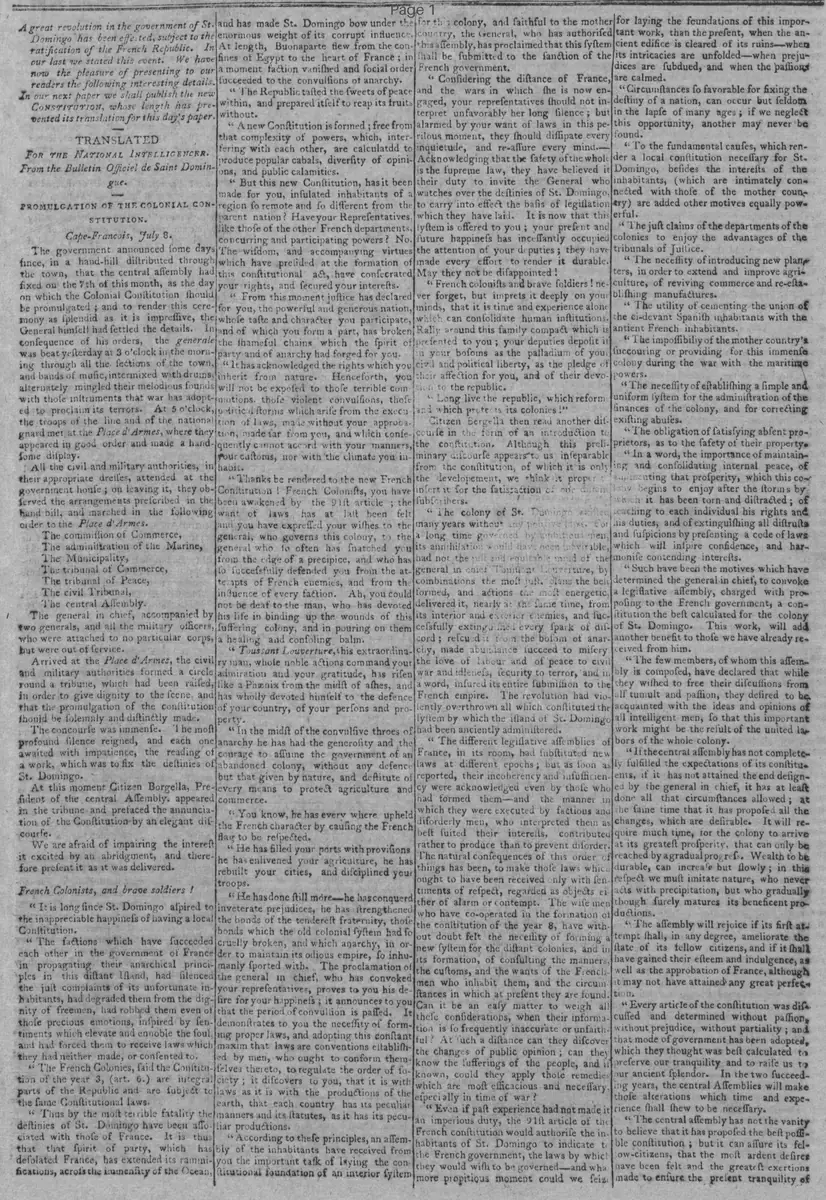
TRANSLATED FOR THE NATIONAL INTELLIGENCER.
From the Bulletin Officiel de Saint Domingue.
PROMULGATION OF THE COLONIAL CONSTITUTION.
Cape-Francois, July 8.
The government announced some days since, in a hand-bill distributed through the town, that the central assembly had fixed on the 7th of this month, as the day on which the Colonial Constitution should be promulgated; and to render this ceremony as splendid as it is impressive, the General himself had settled the details. In consequence of his orders, the générale was beat yesterday at 3 o'clock in the morning through all the sections of the town, and bands of music, intermixed with drums, alternately mingled their melodious sounds with those instruments that war has adopted to proclaim its terrors. At 5 o'clock, the troops of the line and of the national guard met at the Place d'Armes, where they appeared in good order and made a handsome display.
All the civil and military authorities, in their appropriate dresses, attended at the government house; on leaving it, they observed the arrangements prescribed in the hand bill, and marched in the following order to the Place d'Armes.
The commission of Commerce,
The administration of the Marine,
The Municipality,
The tribunal of Commerce,
The tribunal of Peace,
The civil Tribunal,
The central Assembly.
The general in chief, accompanied by two generals, and all the military officers, who were attached to no particular corps, but were out of service.
Arrived at the Place d'Armes, the civil and military authorities formed a circle round a tribune, which had been raised, in order to give dignity to the scene, and that the promulgation of the constitution should be solemnly and distinctly made.
The concourse was immense. The most profound silence reigned, and each one awaited with impatience, the reading of a work, which was to fix the destinies of St. Domingo.
At this moment Citizen Borgella, President of the central Assembly, appeared in the tribune and prefaced the annunciation of the Constitution by an elegant discourse.
We are afraid of impairing the interest it excited by an abridgment, and therefore present it as it was delivered.
French Colonists, and brave soldiers!
"It is long since St. Domingo aspired to the inappreciable happiness of having a local Constitution.
"The factions which have succeeded each other in the government of France in propagating their anarchical principles in this distant island, had silenced the just complaints of its unfortunate inhabitants, had degraded them from the dignity of freemen, had robbed them even of those precious emotions, inspired by sentiments which elevate and ennoble the soul, and had forced them to receive laws which they had neither made, nor consented to.
"The French Colonies, said the Constitution of the year 3, (art. 6.) are integral parts of the Republic and are subject to the same Constitutional laws.
"Thus by the most terrible fatality the destinies of St. Domingo have been associated with those of France. It is thus that that spirit of party, which has desolated France, has extended its ramifications, across the immensity of the Ocean,
and has made St. Domingo bow under the enormous weight of its corrupt influence.
At length, Buonaparte flew from the confines of Egypt to the heart of France; in a moment faction vanished and social order succeeded to the convulsions of anarchy.
"The Republic tasted the sweets of peace within, and prepared itself to reap its fruits without.
"A new Constitution is formed; free from that complexity of powers, which, interfering with each other, are calculated to produce popular cabals, diversity of opinions, and public calamities.
"But this new Constitution, has it been made for you, insulated inhabitants of a region so remote and so different from the parent nation? Have your Representatives, like those of the other French departments, concurring and participating powers? No.
The wisdom, and accompanying virtues which have presided at the formation of this constitutional act, have consecrated your rights, and secured your interests.
"From this moment justice has declared for you, the powerful and generous nation, whose state and character you participate, and of which you form a part, has broken the shameful chains which the spirit of party and of anarchy had forged for you.
"It has acknowledged the rights which you inherit from nature. Henceforth, you will not be exposed to those terrible commotions, those violent convulsions, those political storms which arise from the execution of laws, made without your approbation, made so far from you, and which consequently cannot accord with your manners, your customs, nor with the climate you inhabit.
"Thanks be rendered to the new French Constitution! French Colonies, you have been awakened by the 9th article; the want of laws has at last been felt and you have expressed your wishes to the general, who governs this colony, to the general who so often has snatched you from the edge of a precipice, and who has so successfully defended you from the attempts of French enemies, and from the influence of every faction. Ah, you could not be deaf to the man, who has devoted his life in binding up the wounds of this suffering colony, and in pouring on them a healing and consoling balm.
"Toussaint Louverture, this extraordinary man, whose noble actions command your admiration and your gratitude, has risen like a Phœnix from the midst of ashes, and has wholly devoted himself to the defence of your country, of your persons and property.
"In the midst of the convulsive throes of anarchy he has had the generosity and the courage to assume the government of an abandoned colony, without any defence but that given by nature, and destitute of every means to protect agriculture and commerce.
"You know, he has everywhere upheld the French character by causing the French flag to be respected.
"He has filled your ports with provisions he has enlivened your agriculture, he has rebuilt your cities, and disciplined your troops.
"He has done still more—he has conquered inveterate prejudices, he has strengthened the bonds of the tenderest fraternity, those bonds which the old colonial system had so cruelly broken, and which anarchy, in order to maintain its odious empire, so inhumanly sported with. The proclamation of the general in chief, who has convoked your representatives, proves to you his desire for your happiness; it announces to you that the period of convulsion is passed. It demonstrates to you the necessity of forming proper laws, and adopting this constant maxim that laws are conventions established by men, who ought to conform themselves thereto, to regulate the order of society; it discovers to you, that it is with laws as it is with the productions of the earth, that each country has its peculiar manners and its statutes, as it has its peculiar productions.
"According to these principles, an assembly of the inhabitants have received from you the important task of laying the constitutional foundation of an interior system for the colony. And faithful to the mother country, the general, who has authorized this assembly, has proclaimed that this system shall be submitted to the sanction of the French government.
"Considering the distance of France, and the wars in which she is now engaged, your representatives should not interpret unfavorably her long silence; but alarmed by your want of laws in this perilous moment, they should dissipate every inquietude, and reassure every mind.
Acknowledging that the safety of the whole is the supreme law, they have believed it their duty to invite the General who watches over the destinies of St. Domingo, to carry into effect the basis of legislation which they have laid. It is now that this system is offered to you; your present and future happiness has incessantly occupied the attention of your deputies; they have made every effort to render it durable.
May they not be disappointed!
"French colonists and brave soldiers! never forget, but impress it deeply on your minds, that it is time and experience alone which can consolidate human institutions.
Rally around this family compact which is presented to you; your deputies deposit it in your bosoms as the palladium of your civil and political liberty, as the pledge of their affection for you, and of their devotion to the republic.
Long live the republic, which reforms and which protects its colonies!"
Citizen Borgella then read another discourse in the form of an introduction to the constitution. Although this preliminary discourse appears to us inseparable from the constitution, of which it is only the development, we think it proper to insert it for the satisfaction of our subscribers.
"The colony of St. Domingo existed many years without any positive laws. For a long time governed by arbitrary men, its annihilation would have been inevitable, had not the full and equitable mind of the general in chief Toussaint L'Ouverture, by combinations the most just, plans the best formed, and actions the most energetic, delivered it, nearly at the same time, from its interior and exterior enemies, and successfully extinguished every spark of discord; rescued it from the bosom of anarchy, made abundance succeed to misery the love of labour and of peace to civil war and idleness, security to terror, and in a word, insured its entire submission to the French empire. The revolution had violently overthrown all which constituted the system by which the island of St. Domingo had been anciently administered.
"The different legislative assemblies of France, in its room, had substituted new laws at different epochs; but as soon as reported, their incoherency and insufficiency were acknowledged even by those who had formed them—and the manner in which they were executed by factious and disorderly men, who interpreted them as best suited their interests, contributed rather to produce than to prevent disorder.
The natural consequences of this order of things has been, to make those laws which ought to have been received only with sentiments of respect, regarded as objects either of alarm or contempt. The wise men who have co-operated in the formation of the constitution of the year 8, have without doubt felt the necessity of forming a new system for the distant colonies, and in its formation, of consulting the manners, the customs, and the wants of the Frenchmen who inhabit them, and the circumstances in which at present they are found.
Can it be an easy matter to weigh all these considerations, when their information is so frequently inaccurate or unfaithful? At such a distance can they discover the changes of public opinion; can they know the sufferings of the people, and if known, could they apply those remedies which are most efficacious and necessary, especially in time of war?
"Even if past experience had not made it an imperious duty, the 9th article of the French constitution would authorize the inhabitants of St. Domingo to indicate to the French government, the laws by which they would wish to be governed—and what more propitious moment could we seize for laying the foundations of this important work, than the present, when the ancient edifice is cleared of its ruins—when its intricacies are unfolded—when prejudices are subdued, and when the passions are calmed.
"Circumstances so favorable for fixing the destiny of a nation, can occur but seldom in the lapse of many ages; if we neglect this opportunity, another may never be found.
To the fundamental causes, which render a local constitution necessary for St. Domingo, besides the interests of the inhabitants, (which are intimately connected with those of the mother country) are added other motives equally powerful.
"The just claims of the departments of the colonies to enjoy the advantages of the tribunals of Justice.
"The necessity of introducing new planters, in order to extend and improve agriculture, of reviving commerce and re-establishing manufactures.
"The utility of cementing the union of the ci-devant Spanish inhabitants with the ancient French inhabitants.
"The impossibility of the mother country's succouring or providing for this immense colony during the war with the maritime powers.
"The necessity of establishing a simple and uniform system for the administration of the finances of the colony, and for correcting existing abuses.
"The obligation of satisfying absent proprietors, as to the safety of their property
"In a word, the importance of maintaining and consolidating internal peace, of cementing that prosperity, which this colony begins to enjoy after the storms by which it has been torn and distracted: of teaching to each individual his rights and his duties, and of extinguishing all distrust and suspicions by presenting a code of laws which will inspire confidence, and harmonize contending interests.
"Such have been the motives which have determined the general in chief, to convoke a legislative assembly, charged with proposing to the French government, a constitution the best calculated for the colony of St. Domingo. This work, will add another benefit to those we have already received from him.
"The few members, of whom this assembly is composed, have declared that while they wished to free their discussions from all tumult and passion, they desired to be acquainted with the ideas and opinions of all intelligent men, so that this important work might be the result of the united labors of the whole colony.
"If the central assembly has not completely fulfilled the expectations of its constituents, if it has not attained the end designed by the general in chief, it has at least done all that circumstances allowed; at the same time that it has proposed all the changes, which are desirable. It will require much time, for the colony to arrive at its greatest prosperity, that can only be reached by a gradual progress. Wealth to be durable, can increase but slowly; in this respect we must imitate nature, who never acts with precipitation, but who gradually though surely matures its beneficent productions.
"The assembly will rejoice if its first attempt shall, in any degree, ameliorate the state of its fellow citizens, and if it shall have gained their esteem and indulgence, as well as the approbation of France, although it may not have attained any great perfection.
"Every article of the constitution was discussed and determined without passion, without prejudice, without partiality; and that mode of government has been adopted, which they thought was best calculated to preserve our tranquility and to raise us to our ancient splendor. In the two succeeding years, the central Assemblies will make those alterations which time and experience shall show to be necessary.
"The central assembly has not the vanity to believe that it has proposed the best possible constitution; but it can assure its fellow-citizens, that the most ardent desires have been felt and the greatest exertions made to ensure the present tranquility of
the colony, to confirm & increase its prosperity, and to prove their attachment to the French government.
After this discourse was finished, citizen Borgella announced the reading of the constitution. On this the most profound silence reigned through all the ranks. Each individual listened to the promulgation with that interest which an act that was to determine their privileges and duties, naturally inspired.
After the constitution was read, general Toussaint took the place of the President of the central assembly and pronounced the following discourse.
PEOPLE OF ST. DOMINGO!
The Colonial Constitution, for this important island, has been transmitted to me by the central assembly, composed of legislators, who by virtue of my proclamation of the 10th Pluviose last, assembled to form the laws by which we are to be governed.
I have read it with attention, and am persuaded that it will produce the happiness of my fellow-citizens, since it is suited to our local circumstances and is founded on good morality and pure religion. I approve it. But when I consider that I am charged with the execution of these constitutional laws, I discover my task to be more difficult than that of legislators. Nevertheless, I promise that however vast and extensive this career may be, every exertion shall be made to sustain it well.
Oh you, my fellow-citizens, of every age, of every rank, and of every colour, you are free; and the constitution which is given you, shall immortalize your liberty.
Let us prostrate ourselves before the Creator of the Universe and render him thanksgiving for so inappreciable a blessing.
I ought to address you in the language of truth. This constitution inures to every individual the enjoyment of his rights; and requires of every citizen the practice of virtue, while it recognizes among us, the dominion of pure morality and the divine Religion of Jesus Christ.
Thus then, Magistrates! follow the example of a people, whose fathers and defenders you should always be. Let probity and justice direct your actions and dictate your decrees; thus will you engage the esteem of your fellow citizens, which is the sweetest consolation and best reward that awaits a man in Power.
Brave warriors, generals, officers and Soldiers! observe discipline and subordination, obey your chiefs, defend and support the Constitution, against the internal and external enemies who may seek to destroy it.
malevolent and unprincipled men; who may seek to mislead you. In me and in the general, my representatives, you will ever find the represser of abuse and injustices as meted. Industrious inhabitants of the cities! He who submits lives to the laws: they will always prove your protection and defence as well as people, magistrates and soldiers have to do your duties and mine: for on us it depends to make every exertion under the divine permission to preserve peace quiet and tranquility, and the constant happiness of my fellow citizens and I promise to execute those duties prescribed by the colonial constitution.
Do you too, swear before the supreme being and on my hands that you will submit to these laws which were calculated to secure your happiness and to confirm your liberty.
O my citizens I repeat to you that the constitution is the compass of every description of citizens when it speaks let everyone bow submissively to its requisitions in the civil and military power should be the first to set an example of obedience to the laws be close in all its parts: the constitution, the legislature and central assembly have presented to you, and let the sublime principles which it has consecrated remain indelibly engraven upon your hearts.
In every moment of my life, my dear fellow-citizens and friends, my desire, my wishes, my ambition, will consist in discovering and preparing the means of rendering you free most happy. If I attain an end so dear to my heart, I shall not regret the loss of life, but all go, free from any remorse, to render an account of my actions to the all powerful God and supreme Author of the Universe.
Live forever the French Republic and the colonial Constitution!
At this moment a four pounder at the Place D'armes was discharged, as a signal to all the forts of the town to begin a discharge of twenty-one rounds, and to each of the vessels of war in port.
a v:General Toussaint who had quitted the tribune, then received the fraternal embrace from all the civil and military authorities, and the President of the civil Tribune of this department, citizen Fongueau became the interpreter of the general satisfaction, and mounting the tribune, thus expressed himself.
Citizen General!
The greatest misfortune to which any nation can be exposed, is to be deprived of the restraints of law, and involved in the confusion of anarchy. Such however has been the state of St. Domingo during many years, and it required all your talents and all your virtues, to snatch it from the certain ruin by which it was menaced.
From the commencement of the revolution, this colony had attracted the attention of the enemies of France. This important establishment, threw on the side of the mother country a balance of many millions, and it was its importance, which caused its ruin.
Within our very bosom we saw a number of factions arise, whose contentions better served the designs of our enemies, than all the exertions of their corrupt agents. Divisions were fomented that power might be usurped.
France was deceived; for it was the interest of anarchists to conceal our true condition; incoherent laws were formed, which far from uniting the different parties, served only to inflame and reanimate their animosities.
Colonial Assemblies rapidly succeeded each other; but their labours, the offspring of passion and prejudice, served only to hasten the instant, which was completely to ruin the colony.
These Assemblies gave place to men who called themselves envoys from France, to re-establish tranquility in St. Domingo.
I will spare my fellow citizens the recollection of those miseries, which their presence inflicted on the unhappy land; I will not speak of the tormenting anxiety, which every friend of order and of the Colony of St. Domingo felt, amidst the dreadful chaos which reigned around.
France, at last determined irrevocably to fix the destiny of St. Domingo; she has made its enemies tremble. The immortal decree of the 16th Pluviose, has bestowed the blessings of liberty on a people, to whom faction would not allow even the rank of men.
Still however, factions ought to kindle anew the flames of civil war; some even dared to call to their aid the most cruel enemies of liberty. But the fatal crisis has been sounded in their ear—every heart was inflamed with the sacred fire of Liberty, and henceforth France may count not only on new children, but likewise on new defenders.
It was to your hands, Citizen General, that this precious deposit, was confided: you have preserved it inviolate to this day and you have discovered ever since the first dawning of the revolution, all that greatness of soul which characterizes a French officer.
It is useless now to repeat all that you have done for this interesting colony. One thing would have been wanting to your glory, if you had not acknowledged the necessity of supporting upon a solid foundation, the great work which you had so happily commenced.
You have judged rightly, citizen General, that the colony had need of a special constitution adapted to its local situation, and to the manners of its inhabitants.
You have concluded with justice, that no government can exist without a just distribution of its powers; you have therefore fixed in an invariable manner the rights and the duties of each citizen, and to obtain a result agreeably to your views, you ordained the formation of a central Assembly, composed of wise, honest and intelligent men. The choice of these men you have left to electors, legally nominated by all the municipal administrations of the Colony; and you may boldly say that the choice has fallen on men, rendered worthy equally by their talents and their virtues. These Representatives have endeavoured to justify your experiment, and to merit the confidence of their fellow citizens. They devoted themselves to fulfil their honorable mission with all the fidelity it required, and they have laboured in silence to give this Colony a constitution worthy of it.
Citizen General!
This epoch, so long desired, has at length arrived; this epoch which it is hoped will forever fix the empire of liberty and the destinies of St. Domingo—The constitution, which has just been read, is and will be accepted by every citizen with sentiments of gratitude and admiration.
Never, since the existence of nations and of empires, has a social act, more important and impressive, received its accomplishment, at a festival so august or so affecting. Never, beneath the eye of the Eternal, has the earth displayed a scene more tender or more sublime!
Thanks be rendered to you, citizen general; we have reached the point of national felicity, and it will not be long ere this colony with rapid strides shall attain that summit of glory and prosperity, which so long has been the object of your most ardent wishes and unceasing solicitude.
Enjoy then Citizen general, enjoy, in anticipation all the good which you are about procuring for us. Your name will be engraved on the Temple of Glory, in the list of those who have ennobled their country, and who like you, generously devoted themselves to its defence.
Behold the recompence of all great men! Like them you will live in every heart, and the most remote posterity shall never speak of St. Domingo, without repeating at the same time that Toussaint Louverture, was the reformer and the saviour of his country.
After this discourse was finished, the civil and military authorities, the instructor, instructresses and their pupils attended at the cathedral to return thanks to God, and to ask his blessings on the colony of St. Domingo.
When Mass was over, the civil and military authorities reconducted the general in chief to his house, where a splendid repast was given.
In the evening the town was illuminated.
What sub-type of article is it?
What keywords are associated?
What entities or persons were involved?
Where did it happen?
Foreign News Details
Primary Location
St. Domingo
Event Date
July 7
Key Persons
Outcome
promulgation of the colonial constitution, approved by general toussaint louverture and subject to ratification by the french republic; establishes local governance suited to the colony's circumstances, ending anarchy and ensuring liberty and prosperity.
Event Details
A grand ceremony at Place d'Armes in Cape-Francois on July 7 featured the reading of the new Colonial Constitution by the central assembly. President Borgella delivered speeches praising the end of factional anarchy, crediting Toussaint Louverture's leadership, and justifying local laws under the French Constitution's 9th article. Toussaint approved the constitution, urged obedience and virtue, and led a public oath. The event included military parade, cannon salutes, a mass at the cathedral, banquet, and town illumination.