Thank you for visiting SNEWPapers!
Sign up free
Editorial
November 26, 1819
The Rhode Island American, And General Advertiser
Providence, Providence County, Rhode Island
What is this article about?
Editorial opposes seizing East Florida from Spain amid treaty rejection, arguing for peaceful negotiation to preserve US honor and avoid war's costs. Praises forbearance, critiques aggression, suggests global congress for disputes. Notes potential treaty ratification.
Merged-components note: Continuation of editorial opinion piece on national honor, forbearance, and the Florida treaty across pages.
Clippings
1 of 2
OCR Quality
95%
Excellent
Full Text
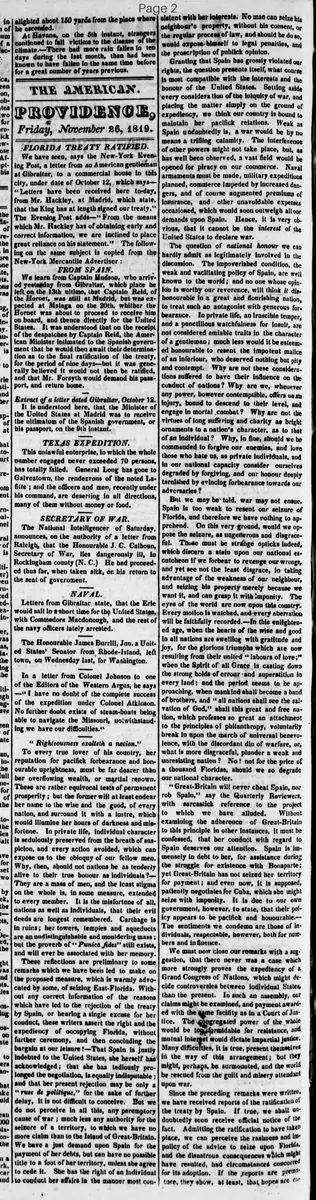
"Righteousness exalteth a nation."
To every true lover of his country, her reputation for pacifick forbearance and honourable uprightness, must be far dearer than her overflowing wealth, or martial renown. These are rather equivocal tests of permanent prosperity; but the former will at least endear her name to the wise and the good, of every nation, and surround it with a lustre, which would illumine her hours of darkness and misfortune. In private life, individual character is sedulously preserved from the breath of suspicion, and every action avoided, which can expose us to the obloquy of our fellow men. Why, then, should not nations be as tenderly alive to their true honour as individuals?- They are a mass of men, and the least stigma on the whole is, in some measure, extended to every member. It is the misfortune of all, nations as well as individuals, that their evil deeds are longest remembered. Carthage is in ruins; her towers, temples and aqueducts are an undistinguishable and mouldering mass; but the proverb of "Punica fides" still exists, and will ever be associated with her memory.
These reflections are preliminary to some remarks which we have been led to make on the proposed measure, which is warmly advocated by some, of seizing East-Florida. Without any correct information of the reasons which have led to the rejection of the treaty by Spain, or hearing a single excuse for her conduct, these writers assert the right and the expediency of occupying Florida, without further ceremony, and then concluding the bargain at our leisure!-That Spain is justly indebted to the United States, she herself has acknowledged; that she has tediously prolonged the negotiation, is equally indisputable; and that her present rejection may be only a "ruse de politique," for the sake of further delay, it is not difficult to conceive. But we do not perceive in all this, any peremptory cause of war; much less any authority for the seizure of a territory, to which we have no more claim than to the Island of Great-Britain. We have a just demand upon Spain for the payment of her debts, but can have no possible title to a foot of her territory, unless she agree to cede it. She has the right of an individual to conduct her affairs in the manner most consistent with her interests. No man can seize his neighbour's property, without his consent, or the regular process of law, and should he do so, would expose himself to legal penalties, and the proscription of publick opinion.
Granting that Spain has grossly violated our rights, the question presents itself, what course is most compatible with the interests and the honour of the United States. Setting aside every consideration of the iniquity of war, and placing the matter simply on the ground of expediency, we think our country is bound to maintain her pacifick relations. Weak as Spain undoubtedly is, a war would be by no means a trifling calamity. The interference of other powers might not take place, but, as has well been observed, a vast field would be opened for piracy on our commerce. Naval armaments must be made, military expeditions planned, commerce impeded by increased dangers, and of course augmented premiums of insurance, and other unavoidable expenses occasioned, which would soon outweigh all our demands upon Spain. Hence, it is very obvious, that it cannot be the interest of the United States to declare war.
The question of national honour we can hardly admit as legitimately involved in the discussion. The impoverished condition, the weak and vacillating policy of Spain, are well known to the world; and no one whose opinion is worthy our reverence, will think it dishonourable in a great and flourishing nation, to treat such an antagonist with generous forbearance. In private life, an irascible temper, and a punctilious watchfulness for insult, are not considered amiable traits in the character of a gentleman; much less would it be esteemed honourable to resent the impotent malice of an inferior, who deserved nothing but pity and contempt. Why are not these considerations suffered to have their influence on the conduct of nations? Why are we, whenever any power, however contemptible, offers us an injury, bound to descend to their level, and engage in mortal combat? Why are not the virtues of long suffering and charity as bright ornaments to a nation's character, as to that of an individual? Why, in fine, should we be commanded to forgive our enemies, and love those who hate us, as private individuals, and in our national capacity consider ourselves degraded by forgiving, and our honour deeply tarnished by evincing forbearance towards our adversaries?
But we may be told, war may not ensue. Spain is too weak to resent our seizure of Florida, and therefore we have nothing to apprehend. On this very ground, would we oppose the seizure, as ungenerous and disgraceful. Those must be strange opticks indeed, which discern a stain upon our national escutcheon if we forbear to revenge our wrongs, and yet see not the least disgrace, in taking advantage of the weakness of our neighbour, and seizing his property merely because we want it, and can grasp it with impunity. The eyes of the world are now upon this country. Every motion is watched, and every aberration will be faithfully recorded.-In this enlightened age, when the hearts of the wise and good in all nations are swelling with gratitude and joy, for the glorious triumphs which are now resulting from their united "labours of love;" when the Spirit of all Grace is casting down the strong holds of error-and superstition in every land; and the period seems to be approaching, when mankind shall become a band of brothers, and "all nations shall see the salvation of God," shall this great and free nation, which professes so great an attachment to the principles of philanthropy, voluntarily break in upon the march of universal benevolence, with the discordant din of warfare, or, what is more disgraceful, plunder a weak and unresisting nation? No! not for the price of a thousand Floridas, should we so degrade our national character.
"Great-Britain will never cheat Spain, nor rob Spain," say the Quarterly Reviewers, with sarcastick reference to the project to which we have alluded. Without examining the adherence of Great-Britain to this principle in other instances, it must be confessed, that her conduct with regard to Spain deserves our attention. Spain is immensely in debt to her, for assistance during the struggle for existence with Bonaparte; yet Great-Britain has not seized her territory for payment; and even now, it is supposed, patiently negotiates for Cuba, which she might seize with impunity. It is due to our own government, however, to state, that their policy appears to be pacifick and honourable.- The sentiments we condemn are those of individuals, respectable, however, both for numbers and influence.
We must now close our remarks with a suggestion, that there never was a case which more strongly proves the expediency of a Grand Congress of Nations, which might decide controversies between individual States, than the present. In such an assembly, our claims might be examined, and payment awarded with the same facility as in a Court of Justice. The congregated power of the whole world would be too formidable for resistance, and mutual interest would dictate impartial justice. Many difficulties, it is true, present themselves in the way of this arrangement; but they might, perhaps, be surmounted, and the world be rescued from the guilt and misery attendant upon war.
Since the preceding remarks were written, we have received reports of the ratification of the treaty by Spain. If true, we shall undoubtedly soon receive official notice of the act. Admitting the ratification to have taken place, we can perceive the rashness and impolicy of the advice to seize upon Florida, and the disastrous consequences which might have resulted, had circumstances concurred for its adoption. If the reports are premature, they show, at least, that hopes are entertained.
Entertained of the ratification. Spain is too deeply interested in preserving peace, not to do us justice at last, though circumstances, which she may be able to explain, may have prevented her from doing it before. The Floridas will and ought to be ours—let us preserve a dignified firmness and forbearance, and we shall at last obtain our demands, and our merchants their dues, without any compromise either of interest or honour.
To every true lover of his country, her reputation for pacifick forbearance and honourable uprightness, must be far dearer than her overflowing wealth, or martial renown. These are rather equivocal tests of permanent prosperity; but the former will at least endear her name to the wise and the good, of every nation, and surround it with a lustre, which would illumine her hours of darkness and misfortune. In private life, individual character is sedulously preserved from the breath of suspicion, and every action avoided, which can expose us to the obloquy of our fellow men. Why, then, should not nations be as tenderly alive to their true honour as individuals?- They are a mass of men, and the least stigma on the whole is, in some measure, extended to every member. It is the misfortune of all, nations as well as individuals, that their evil deeds are longest remembered. Carthage is in ruins; her towers, temples and aqueducts are an undistinguishable and mouldering mass; but the proverb of "Punica fides" still exists, and will ever be associated with her memory.
These reflections are preliminary to some remarks which we have been led to make on the proposed measure, which is warmly advocated by some, of seizing East-Florida. Without any correct information of the reasons which have led to the rejection of the treaty by Spain, or hearing a single excuse for her conduct, these writers assert the right and the expediency of occupying Florida, without further ceremony, and then concluding the bargain at our leisure!-That Spain is justly indebted to the United States, she herself has acknowledged; that she has tediously prolonged the negotiation, is equally indisputable; and that her present rejection may be only a "ruse de politique," for the sake of further delay, it is not difficult to conceive. But we do not perceive in all this, any peremptory cause of war; much less any authority for the seizure of a territory, to which we have no more claim than to the Island of Great-Britain. We have a just demand upon Spain for the payment of her debts, but can have no possible title to a foot of her territory, unless she agree to cede it. She has the right of an individual to conduct her affairs in the manner most consistent with her interests. No man can seize his neighbour's property, without his consent, or the regular process of law, and should he do so, would expose himself to legal penalties, and the proscription of publick opinion.
Granting that Spain has grossly violated our rights, the question presents itself, what course is most compatible with the interests and the honour of the United States. Setting aside every consideration of the iniquity of war, and placing the matter simply on the ground of expediency, we think our country is bound to maintain her pacifick relations. Weak as Spain undoubtedly is, a war would be by no means a trifling calamity. The interference of other powers might not take place, but, as has well been observed, a vast field would be opened for piracy on our commerce. Naval armaments must be made, military expeditions planned, commerce impeded by increased dangers, and of course augmented premiums of insurance, and other unavoidable expenses occasioned, which would soon outweigh all our demands upon Spain. Hence, it is very obvious, that it cannot be the interest of the United States to declare war.
The question of national honour we can hardly admit as legitimately involved in the discussion. The impoverished condition, the weak and vacillating policy of Spain, are well known to the world; and no one whose opinion is worthy our reverence, will think it dishonourable in a great and flourishing nation, to treat such an antagonist with generous forbearance. In private life, an irascible temper, and a punctilious watchfulness for insult, are not considered amiable traits in the character of a gentleman; much less would it be esteemed honourable to resent the impotent malice of an inferior, who deserved nothing but pity and contempt. Why are not these considerations suffered to have their influence on the conduct of nations? Why are we, whenever any power, however contemptible, offers us an injury, bound to descend to their level, and engage in mortal combat? Why are not the virtues of long suffering and charity as bright ornaments to a nation's character, as to that of an individual? Why, in fine, should we be commanded to forgive our enemies, and love those who hate us, as private individuals, and in our national capacity consider ourselves degraded by forgiving, and our honour deeply tarnished by evincing forbearance towards our adversaries?
But we may be told, war may not ensue. Spain is too weak to resent our seizure of Florida, and therefore we have nothing to apprehend. On this very ground, would we oppose the seizure, as ungenerous and disgraceful. Those must be strange opticks indeed, which discern a stain upon our national escutcheon if we forbear to revenge our wrongs, and yet see not the least disgrace, in taking advantage of the weakness of our neighbour, and seizing his property merely because we want it, and can grasp it with impunity. The eyes of the world are now upon this country. Every motion is watched, and every aberration will be faithfully recorded.-In this enlightened age, when the hearts of the wise and good in all nations are swelling with gratitude and joy, for the glorious triumphs which are now resulting from their united "labours of love;" when the Spirit of all Grace is casting down the strong holds of error-and superstition in every land; and the period seems to be approaching, when mankind shall become a band of brothers, and "all nations shall see the salvation of God," shall this great and free nation, which professes so great an attachment to the principles of philanthropy, voluntarily break in upon the march of universal benevolence, with the discordant din of warfare, or, what is more disgraceful, plunder a weak and unresisting nation? No! not for the price of a thousand Floridas, should we so degrade our national character.
"Great-Britain will never cheat Spain, nor rob Spain," say the Quarterly Reviewers, with sarcastick reference to the project to which we have alluded. Without examining the adherence of Great-Britain to this principle in other instances, it must be confessed, that her conduct with regard to Spain deserves our attention. Spain is immensely in debt to her, for assistance during the struggle for existence with Bonaparte; yet Great-Britain has not seized her territory for payment; and even now, it is supposed, patiently negotiates for Cuba, which she might seize with impunity. It is due to our own government, however, to state, that their policy appears to be pacifick and honourable.- The sentiments we condemn are those of individuals, respectable, however, both for numbers and influence.
We must now close our remarks with a suggestion, that there never was a case which more strongly proves the expediency of a Grand Congress of Nations, which might decide controversies between individual States, than the present. In such an assembly, our claims might be examined, and payment awarded with the same facility as in a Court of Justice. The congregated power of the whole world would be too formidable for resistance, and mutual interest would dictate impartial justice. Many difficulties, it is true, present themselves in the way of this arrangement; but they might, perhaps, be surmounted, and the world be rescued from the guilt and misery attendant upon war.
Since the preceding remarks were written, we have received reports of the ratification of the treaty by Spain. If true, we shall undoubtedly soon receive official notice of the act. Admitting the ratification to have taken place, we can perceive the rashness and impolicy of the advice to seize upon Florida, and the disastrous consequences which might have resulted, had circumstances concurred for its adoption. If the reports are premature, they show, at least, that hopes are entertained.
Entertained of the ratification. Spain is too deeply interested in preserving peace, not to do us justice at last, though circumstances, which she may be able to explain, may have prevented her from doing it before. The Floridas will and ought to be ours—let us preserve a dignified firmness and forbearance, and we shall at last obtain our demands, and our merchants their dues, without any compromise either of interest or honour.
What sub-type of article is it?
Foreign Affairs
War Or Peace
Moral Or Religious
What keywords are associated?
Florida Seizure
Us Spain Treaty
National Honor
Peaceful Diplomacy
War Expediency
International Congress
What entities or persons were involved?
Spain
United States
East Florida
Great Britain
Editorial Details
Primary Topic
Opposition To Seizing East Florida From Spain
Stance / Tone
Advocates Peaceful Forbearance And Honorable Diplomacy
Key Figures
Spain
United States
East Florida
Great Britain
Key Arguments
National Honor Is Preserved Through Pacific Forbearance Rather Than Aggression
Seizing Florida Lacks Legal Claim And Would Be Ungenerous Toward Weak Spain
War With Spain Would Harm Us Commerce And Economy More Than Resolve Debts
Forbearance Toward Weaker Nations Enhances Reputation Among The Wise And Good
Great Britain Has Not Seized Spanish Territory Despite Debts
A Grand Congress Of Nations Could Resolve Disputes Justly Without War
Reports Of Treaty Ratification Highlight Rashness Of Seizure Advice
Us Should Maintain Dignified Firmness To Obtain Demands Without Compromising Honor