Thank you for visiting SNEWPapers!
Sign up free
Story
May 12, 1898
The Topeka State Journal
Topeka, Shawnee County, Kansas
What is this article about?
Description of an inventive felt mat for deadening train noise, made from oiled wool and glue, exhibited in Leipsic last summer. It reduces sound and vibration on rails, bridges, and elevated roads, prolonging rail life.
Clipping
OCR Quality
98%
Excellent
Full Text
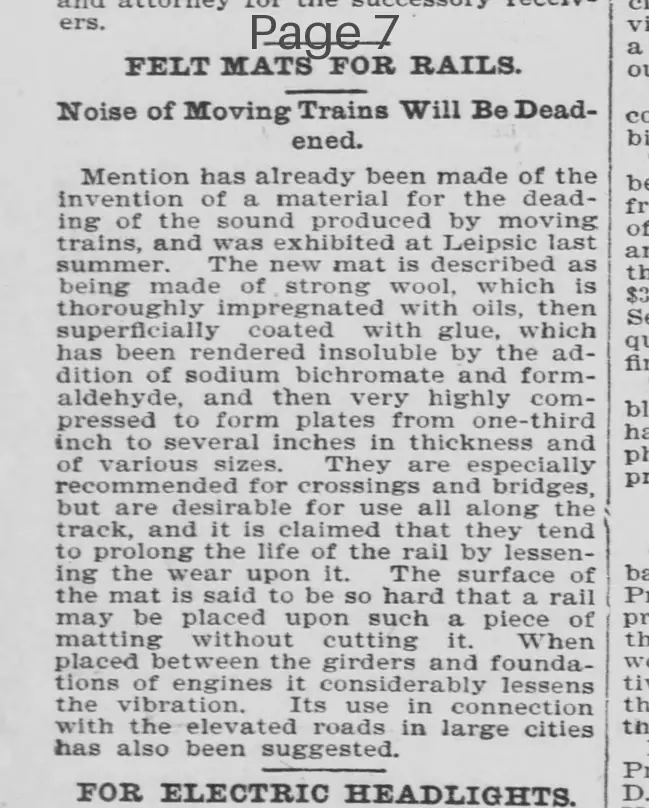
FELTMATS FOR RAILS.
Noise of Moving Trains Will Be Deadened.
Mention has already been made of the invention of a material for the deadening of the sound produced by moving trains, and was exhibited at Leipsic last summer. The new mat is described as being made of strong wool, which is thoroughly impregnated with oils, then superficially coated with glue, which has been rendered insoluble by the addition of sodium bichromate and formaldehyde, and then very highly compressed to form plates from one-third inch to several inches in thickness and of various sizes. They are especially recommended for crossings and bridges, but are desirable for use all along the track, and it is claimed that they tend to prolong the life of the rail by lessening the wear upon it. The surface of the mat is said to be so hard that a rail may be placed upon such a piece of matting without cutting it. When placed between the girders and foundations of engines it considerably lessens the vibration. Its use in connection with the elevated roads in large cities has also been suggested.
Noise of Moving Trains Will Be Deadened.
Mention has already been made of the invention of a material for the deadening of the sound produced by moving trains, and was exhibited at Leipsic last summer. The new mat is described as being made of strong wool, which is thoroughly impregnated with oils, then superficially coated with glue, which has been rendered insoluble by the addition of sodium bichromate and formaldehyde, and then very highly compressed to form plates from one-third inch to several inches in thickness and of various sizes. They are especially recommended for crossings and bridges, but are desirable for use all along the track, and it is claimed that they tend to prolong the life of the rail by lessening the wear upon it. The surface of the mat is said to be so hard that a rail may be placed upon such a piece of matting without cutting it. When placed between the girders and foundations of engines it considerably lessens the vibration. Its use in connection with the elevated roads in large cities has also been suggested.
What sub-type of article is it?
Curiosity
What themes does it cover?
Triumph
What keywords are associated?
Felt Mats
Rail Noise Deadening
Train Invention
Leipsic Exhibition
Rail Wear Reduction
Where did it happen?
Leipsic
Story Details
Location
Leipsic
Event Date
Last Summer
Story Details
Invention of a material made of strong wool impregnated with oils, coated with insoluble glue, and compressed into plates to deaden sound of moving trains, exhibited at Leipsic last summer. Recommended for crossings, bridges, and tracks to reduce noise and wear on rails; hard surface withstands rail weight; lessens vibration under engines; suggested for elevated roads in large cities.