Thank you for visiting SNEWPapers!
Sign up free
New Orleans Republican
New Orleans, Orleans County, Louisiana
What is this article about?
In 1876, abolitionist Wendell Phillips lectures in Chicago's McCormick Hall on the U.S. political crisis, lauding Grant's leadership, decrying Southern oppression of Black citizens, and arguing against a 'solid South' enabling Tilden's presidency, amid centennial reflections on the republic.
Clipping
OCR Quality
Full Text
Eloquent Lecture by Wendell Phillips.
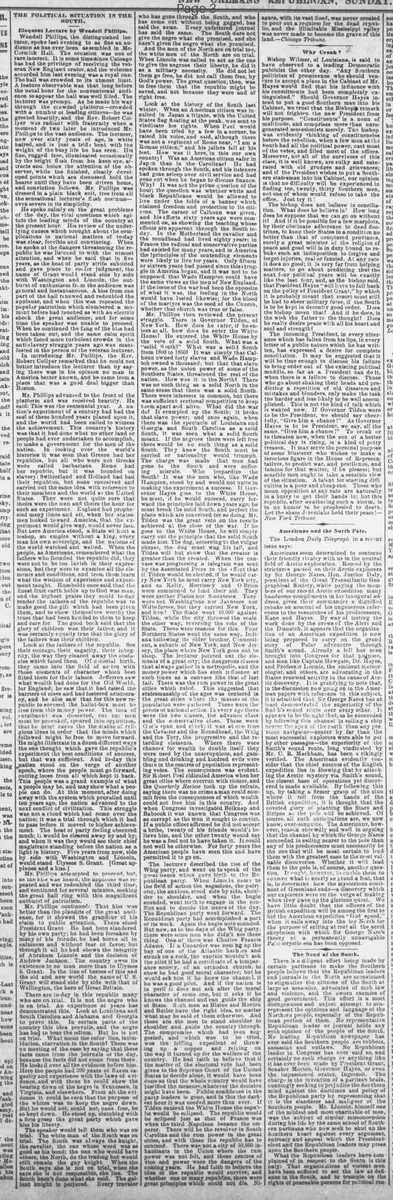
Wendell Phillips, the distinguished lecturer, spoke last evening to as fine an audience as has ever been assembled in McCormick Hall. The occasion was one of rare interest. It is some time since Chicago has had the privilege of receiving the veteran New England orator, and the welcome accorded him last evening was a royal one. The hall was crowded to its utmost limit. A feature observable was that long before the usual hour for the conventional audience to appear the hall was well filled. The lecturer was prompt. As he made his way through the crowded platform—crowded with a number of leading citizens—he was greeted heartily, and the Rev. Robert Collyer was radiant with fraternity when a moment or two later he introduced Mr. Phillips to the vast audience. The lecturer, now over sixty years of age, is white haired, and is just a trifle bent with the weight of the busy life he has seen. His fine, rugged face, illuminated occasionally by the bright flash from his keen eye, attracts and holds the attention of the observer, while the finished, clearly developed points which are discussed hold the hearer until they have been driven home, and conviction follows. Mr. Phillips was dressed in a plain black suit, free from all the sensational lecturer's flash costume—even severe in its simplicity. He spoke calmly on the great problems of the day, the vital questions which agitate the leading minds of the country at the present hour. His review of the underlying causes which brought about the complications in national matters of to-day was clear, forcible and convincing. When he spoke of the dangers threatening the republic he was listened to with the utmost attention, and when he said that in five years, as the heat of party strife subsided and gave place to cooler judgment, the name of Grant would stand side by side with Washington and Lincoln, the outburst of enthusiasm from the audience was general and instantaneous. A hiss from one part of the hall renewed and redoubled the applause, and when this was repeated the popular patriotism which slumbered a moment before had touched as with an electric shock the great audience, and for some time the speaker was unable to proceed. When he continued the fang of the hiss had been taken out, and the same calm spirit which faced more turbulent crowds in the anti-slavery struggle years ago was manifested in the person of the veteran lecturer. In introducing Mr. Phillips, the Rev. Robert Collyer remarked that he could not better introduce the lecturer than by saying there was in his opinion no man in America better known, and he came from a place that was a good deal bigger than Boston. Mr. Phillips advanced to the front of the platform and was received heartily. He said: This was the centennial year. A nation's experiment of a century had had the seal of these hundred years placed upon it, and the world had been called to witness the achievement. This country's history was that it had done what no other land or people had ever undertaken to accomplish, to make a government for the men of the nation. In looking over the world's histories it was seen that Greece had her republics, but all who were not Greeks were called barbarians. Rome had her republic, but it was founded on slavery: Switzerland and Holland had had their republics, but none conceived and carried out the same idea with reference to their members and the world as the United States. They were not quite sure that theirs were the men and theirs the hour for such an experiment. England had prophesied many times and oft, when her statesmen looked toward America, that the experiment would give way, would never last. But here America stood, a State without a bishop, an empire without a king, every man his own sovereign, and the nations of the world watched and waited. When the people, as Americans, remembered what the fathers who founded the republic did, they were not to be too lavish in their expressions, but they were to examine all the elements and conditions, and from them learn what the wisdom of experience and experiment taught. Humboldt once said that the finest fruit earth holds up to God was man, and the highest praise they could to-day render the fathers of the republic was to make good the gift which had been given them, and to show themselves worthy the trust that had been handed to them to keep and care for. The good book said that the glory of children was their father, and it was certainly equally true that the glory of the fathers was their children. Look at the fathers of the republic. See their courage, their sagacity, their integrity, the way they cleared away the obstacles which faced them. Of colonial birth, they came into the field of action with those elements of character which best fitted them for their labors. Jefferson saw what wealth had done for the Old World, for England: he saw that it had raised the barriers of class and had fostered aristocracy, and he also saw that for this new republic to succeed the ballot-box must be free from this money power. The idea of entailment was dissected, cut up: men must be provoked, spurred into opposition, that he must carve the statue of religious ideas in order that the minds which followed might be free to move forward. He might illustrate in a dozen different ways the one thought which gave the republic's experiment the best conditions of success, but that was sufficient. And to-day this nation stood on the verge of another epoch, where the people must go forward, cutting loose from all which kept it back. This people was a grand example of what a people may be, and may show what a people can do. At this moment, after doing away with the system which prevailed until ten years ago, the nation advanced to the next conflict of civilization. This struggle was not a cloud which had come over the nation; it was a trial through which it had to pass before it moved to higher achievement. The heat of party feeling obscured much; it would be cleared away by and by; and when it was they would see their chief magistrate standing before the nation as a light in history. Five years from now, side by side with Washington and Lincoln, would stand Ulysses S. Grant. [Great applause and a hiss.] Mr. Phillips attempted to proceed, but as the hiss was heard, the applause was repeated and was redoubled the third time, and continued for several minutes, making the great hall ring with this magnificent outburst of patriotism. Mr. Phillips continued: That hiss was better than the plaudits of the great audience, for it showed the grandeur of his claim to public attention. There stood President Grant. He had been slandered by his own party; he had been forsaken by many of his friends; he had borne all in calmness and without fear or favor: but through it all he had shown the integrity of Abraham Lincoln and the decision of Andrew Jackson. The country owes its existence to no man more than to Ulysses S. Grant. In the line of heroes of this and the old and new world the name of U. S. Grant will stand side by side with that of Wellington, the hero of Great Britain. There are to-day in this republic many who are on trial. It is not the negro who is on trial. An experience of years has demonstrated this. Look at Louisiana and South Carolina and Alabama and Georgia to prove this. In certain parts of the country this idea prevails, and the negro has had to bear the odium. But he is not on trial. What mean the color line, intimidation, starvation in the South! There was no meeting of the case by saying that these facts came from the journals of the day, because the facts did not come from there. He looked over all the evidence before him. Here the people had 200 years of Saxon sagacity and experience with the laws of evidence, and with these he could show the bearing down of the negro in Tennessee, in Virginia, and elsewhere. From all the evidence it could be seen that the purpose of the whites was to keep the negro down. But he would not, could not, once free, be so kept down. He stood up, clutching with a firm grasp the great party which gave him his liberty. The speaker would tell them who was on trial. The white man of the South was on trial. The South was always the knight, the cavalier, the one whose word was as good as his bond; the one who would have others, the North, do the trading but would still remain the gay knight. When the South says she is not on trial, when she says she is not responsible, she lies. The South hasn't done what she said. The gallant knight is perjured. Every traveler who has gone through the South, and who has come out without being gagged, has said the same. Every unfettered journal has said the same. The South dare not give the negro what she promised, and she hasn't given the negro what she promised. And the men of the North are on trial too, the white men of the North are on trial. When Lincoln was called to act as the one to give the negroes their liberty, he did it as a military necessity. He did not let them go free, he did not call them free, by God's power. The great question, then, was to free them that the republic might be saved, and not because they were and of right free. Look at the history of the South last winter. When an American citizen was insulted in Japan a frigate, with the United States flag floating at the peak, was sent to vindicate his rights. When Paul would have been tried by a few in a corner, he raised his voice, and said, although there was not a regiment of Rome near, "I am a Roman citizen," and his jailers fell at his feet. How was it here, in this our own country? Was an American citizen safer in Japan than in the Carolinas? He had spoken through the South, and his listeners had gone to sleep over civil service and had gone out when he began to discuss finance. Why? It was not the prime question of the hour; the question was whether white and black Republicans would be allowed to live under the folds of a banner which claimed freedom and protection to its citizens. The career of Calhoun was given, and his efforts sixty years ago were commented on, as showing the teaching whose effects are apparent through the South to-day. In the Motherland the cavalier and the roundhead had lived eighty years; in France the radical and conservative parties had existed for many years, and in America the principles of the contending elements were likely to live for years. Only fifteen or sixteen years had passed since this struggle in America began, and it was not to be supposed that Wade Hampton could have the same views as the men of New England. If the issue of the war had been the opposite of what it was, the feeling in the North would have lasted likewise; for the blood of the martyrs was the seed of the Church, whether that church was true or false. Mr. Phillips then reviewed the present struggle. There is Governor Tilden, of New York. How does he enter, if he enters at all, how does he enter the White House? He entered the White House by the vote of a solid South. What was a "solid South?" What was a solid South from 1800 to 1860? It was simply that Calhoun owned forty slaves and Wade Hampton owned a thousand; but that that slave power, as the union power of some of the Southern States, threatened the rest of the nation. How was it in the North? There was no such thing as a solid North in the same sense that there was a solid South. There were interests in common, but there was sufficient sectional competition to keep them apart and alive. What did the war do? It crumpled up the South; it broke that slave power: and once again, when there was the spectacle of Louisiana and Georgia and South Carolina as a solid South, it was seen what a solid South meant. If the negroes there were left free there would be no such thing as a solid South. They knew the South must be carried or nationality would triumph. The charge was made that men had gone to the South and were suffering misrule. Who jeopardize the South? It was the men who, like Wade Hampton, stood by and would not unite in making the experiment a success. If Governor Hayes goes to the White House, he must, if he would succeed, carry forward the principles laid down years ago; he must break the solid South, and perfect the plans which are conceived for so doing. Mr. Tilden was the great veto on the results achieved at the close of the war. If he goes to the White House, he will simply carry out the principle that the solid South made him. The dog, according to the vulgar phrase, the dog must wag his tail, and Tilden will but show that the creator is greater than the created. When the canvas was progressing a telegram was sent by the Associated Press to the effect that if Tilden would be elected, if he would carry New York he must carry New York city, and so Kelly, Morrissey and O'Brien were summoned to lend their aid. They were neither Platos nor Socrateses. They were not Washingtons nor Jayneses nor Wilberforces, but they carried New York, and how? The State went 40,000 against Tilden, while the city threw the scale the other way, reversing the vote of the State. There were reasons for this. Four Northern States went the same way. Indiana following its elder brother. Connecticut, a suburb of New York, and New Jersey, the place where New York goes out to sleep. The lecturer pointed out the elements of a great city; the dangerous classes that always gather in a metropolis, and the money power which has such influence at such times as a canvas like that of last fall. There was the rum power in the great cities which ruled. This suggested that statesmanship of the ages was centered in the great cities where the masses of the population were gathered. These were the pivots of national action. In every age there were the two classes, the advance class and the conservative class. These were God's spur and check; it was at one time the Cavalier and the Roundhead, the Whig and the Tory, the progressive and the retarding elements. Where there were chances for wealth to double itself they were used by the unscrupulous, and gambling and drinking and kindred evils were there in the centres of population representing votes. The consequence was evident. Sir Robert Peel ridiculed America when her great cities were overrun with rioters, and the Quarterly Review took up the refrain, saying there was no crime a man could commit from the consequences of which wealth could not free him in this country. And when Congress investigated Belknap and Babcock it was known that Congress was as corrupt as the men it sought to convict. If a public officer affirmed he did not accept a bribe, twenty of his friends wouldn't believe him, and the other twenty would say he was a fool not to have taken it. It could not well be otherwise. For forty years the American people have seen this and have permitted it to go on. The lecturer described the rise of the Whig party, and went on to speak of the great issues which gave birth to the Republican party. When Lincoln came to the field of action the sagacious, the patriotic, the anxious, stood side by side, shoulder to shoulder, and when the bugle sounded, went forth to engage in the conflict and to decide the issues of the day. The Republican party went forward. The Republican party had accomplished a part of its work. Again the bugle note sounded. But now, as in the days of the Whig party, there were some men who didn't see these things. One of these was Charles Francis Adams. If a Cunarder was coming up the bay of one of the Atlantic harbors and struck on a rock, the captain wouldn't ask the pilot if he had a certificate of a temperance society, of an orthodox church, to show he had good moral character; but he would ask him if he knew the channel, if he was a good pilot. And if the nation is in peril it does not ask after the moral character of some one, but it asks if he knows the channel and can guide the ship of State. Such men as Blaine and Morton and Butler have the right idea, no matter what may be said of them otherwise. And these are the men to stand shoulder to shoulder and guide the country through. The compromise which had been suggested, and which was to be tried, was the trifling expedient of throwing up a copper and relying on the way it turned up for the welfare of the country. He had faith to believe that if the matter of the electoral vote had been given to the Supreme Court of the United States to decide alone, it would have been done so that the whole country would have justified the measure, whatever the decision might have been. Public confidence in the party leaders is gone, and in this the darkest hour it was needed more than ever. If Tilden entered the White House the republic would be eclipsed. The republic would be eclipsed just as that of France was when the third Napoleon became the emperor. There will be the revolver in South Carolina and the rum power in the great cities, and with these the republic has to contend. There was not a city of 50,000 inhabitants in the Union where the rum power was not felt, and these centres of vice and power were the dangers of the coming years. He had faith to believe the idea of the republic would survive; and whether one or many republics, there were great principles which could not die. Niagara, with its vast flood, was never created to pour out a requiem for the dead republic, and the illimitable Mississippi valley was never made to become the grave of this land.—Chicago Tribune.
What sub-type of article is it?
What themes does it cover?
What keywords are associated?
What entities or persons were involved?
Where did it happen?
Story Details
Key Persons
Location
Chicago, Mccormick Hall; South (Louisiana, South Carolina, Alabama, Georgia, Tennessee, Virginia, Carolinas)
Event Date
Centennial Year (1876); Last Evening
Story Details
Wendell Phillips delivers an eloquent lecture on the political situation in the South, reviewing the republic's history, praising Grant's integrity alongside Washington and Lincoln, criticizing the solid South's treatment of negroes, and warning against Tilden's potential presidency which would uphold Southern power.