Thank you for visiting SNEWPapers!
Sign up free
The National Intelligencer And Washington Advertiser
Washington, District Of Columbia
What is this article about?
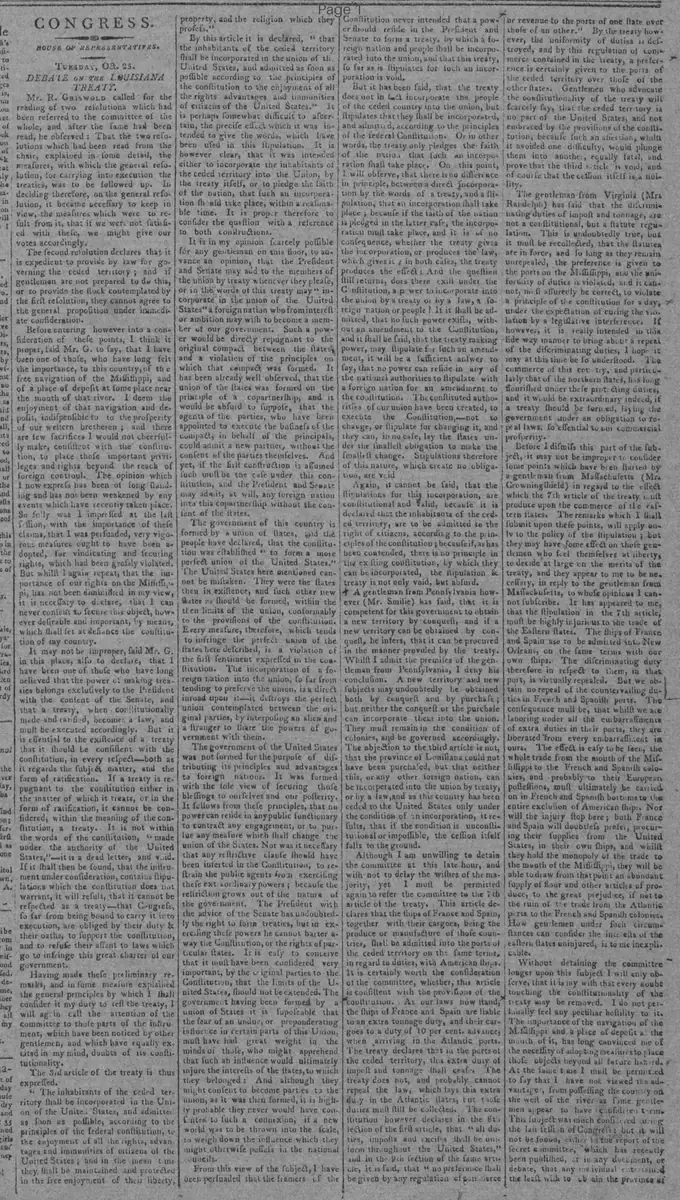
On October 25, 1803, in the U.S. House of Representatives, Mr. R. Griswold argues against the constitutionality of the Louisiana Purchase treaty, focusing on incorporation of territory and trade preferences. Mr. Nicholson defends the treaty's validity and the nation's right to acquire territory.
Merged-components note: This is a continuation of the congressional debate on the Louisiana Treaty from page 1 to page 2, as indicated by the sequential reading order and the text flow directly connecting Mr. Griswold's remarks to Mr. Nicholson's response.
Clippings
1 of 2
OCR Quality
Full Text
HOUSE OF REPRESENTATIVES.
TUESDAY, Oct. 25.
DEBATE ON THE LOUISIANA TREATY
Mr. R. Griswold called for the reading of two resolutions which had been referred to the committee of the whole, and after the same had been read, he observed: That the two resolutions which had been read from the chair, explained in some detail, the measures, with which the general resolution, for carrying into execution the treaties, was to be followed up. In deciding therefore, on the general resolution, it became necessary to keep in view, the measures which were to result from it, that if we were not satisfied with these, we might give our votes accordingly.
The second resolution declares that it is expedient to provide by law for governing the ceded territory; and if gentlemen are not prepared to do this, or to provide the stock contemplated by the first resolution, they cannot agree to the general proposition under immediate consideration.
Before entering however into a consideration of these points, I think it proper, said Mr. G. to say, that I have been one of those, who have long felt the importance, to this country, of the free navigation of the Mississippi, and of a place of deposit at some place near the mouth of that river. I deem the enjoyment of that navigation and deposit, indispensable to the prosperity of our western brethren; and there are few sacrifices I would not cheerfully make, consistent with the constitution, to place those important privileges and rights beyond the reach of foreign controul. The opinion which I now express has been of long standing and has not been weakened by any events which have recently taken place.
So fully was I impressed at the last session, with the importance of these claims, that I was persuaded, very vigorous measures ought to have been adopted, for vindicating and securing rights, which had been grossly violated.
But whilst I again repeat, that the importance of our rights on the Mississippi, has not been diminished in my view, it is necessary to declare, that I can never consent to secure this object, however desirable and important, by means, which shall set at defiance the constitution of my country.
It may not be improper, said Mr. G. in this place, also to declare, that I have been one of those who have long believed that the power of making treaties belongs exclusively to the President with the consent of the Senate, and that a treaty, when constitutionally made and ratified, becomes a law, and must be executed accordingly. But it is essential to the existence of a treaty that it should be consistent with the constitution, in every respect—both as it regards the subject matter, and the form of ratification. If a treaty is repugnant to the constitution either in the matter of which it treats, or in the form of ratification, it cannot be considered, within the meaning of the constitution, a treaty. It is not within the words of the constitution, "made under the authority of the United States," it is a dead letter, and void.
If it shall then be found, that the instrument under consideration, contains stipulations which the constitution does not warrant, it will result, that it cannot be respected as a treaty—that Congress, so far from being bound to carry it into execution, are obliged by their duty & their oaths, to support the constitution, and to refuse their assent to laws which go to infringe this great charter of our government.
Having made these preliminary remarks, and in some measure explained the general principles by which I shall consider it my duty to test the treaty, I will again call the attention of the committee to those parts of the instrument, which have been noticed by other gentlemen, and which have equally excited in my mind, doubts of its constitutionality.
The 3d article of the treaty is thus expressed.
"The inhabitants of the ceded territory shall be incorporated in the Union of the United States, and admitted as soon as possible, according to the principles of the federal constitution, to the enjoyment of all the rights, advantages and immunities of citizens of the United States; and in the mean time they shall be maintained and protected in the free enjoyment of their liberty property, and the religion which they profess."
By this article it is declared "that the inhabitants of the ceded territory shall be incorporated in the union of the United States, and admitted as soon as possible according to the principles of the constitution to the enjoyment of all the rights advantages and immunities of citizens of the United States." It is perhaps somewhat difficult to ascertain, the precise effect which it was intended to give the words, which have been used in this stipulation It is however clear, that it was intended either to incorporate the inhabitants of the ceded territory into the Union, by the treaty itself, or to pledge the faith of the nation, that such an incorporation should take place, within a reasonable time. It is proper therefore to consider the question with a reference to both constructions.
It is in my opinion scarcely possible for any gentleman on this floor, to advance an opinion, that the President and Senate may add to the members of the union by treaty whenever they please, or in the words of this treaty may "incorporate in the union of the United States" a foreign nation who from interest or ambition may wish to become a member of our government. Such a power would be directly repugnant to the original compact between the states and a violation of the principles on which that compact was formed. It has been already well observed, that the union of the states was formed on the principle of a copartnership, and it would be absurd to suppose that the agents of the parties, who have been appointed to execute the business of the compact in behalf of the principals, could admit a new partner, without the consent of the parties themselves. And yet, if the first construction is assumed such must be the case under this constitution, and the President and Senate may admit, at will, any foreign nation into this copartnership without the consent of the states.
The government of this country is formed by a union of states, and the people have declared, that the constitution was established "to form a more perfect union of the United States,"
The United States here mentioned cannot be mistaken. They were the states then in existence, and such other new states as should be formed, within the then limits of the union, conformably to the provisions of the constitution.
Every measure, therefore, which tends to infringe the perfect union of the states here described, is a violation of the first sentiment expressed in the constitution. The incorporation of a foreign nation into the union, so far from tending to preserve the union, is a direct inroad upon it—it destroys the perfect union contemplated between the original parties, by interpoling an alien and a stranger to share the powers of government with them.
The government of the United States was not formed for the purpose of diffusing its principles and advantages to foreign nations. It was formed with the sole view of securing those blessings to ourselves and our posterity.
It follows from these principles, that no power can reside in any public functionary to contract any engagement, or to pursue any measure which shall change the union of the States. Nor was it necessary that any restrictive clause should have been inserted in the Constitution, to restrain the public agents from exercising these extraordinary powers; because the restriction grows out of the nature of the government. The President with the advice of the Senate has undoubtedly the right to form treaties, but in exercising these powers he cannot barter away the Constitution, or the rights of particular states. It is easy to conceive that it must have been considered very important, by the original parties to the Constitution, that the limits of the United States, should not be extended. The government having been formed by a union of States it is supposable that the fear of an undue, or preponderating influence in certain parts of this Union, must have had great weight in the minds of those, who might apprehend that such an influence would ultimately injure the interests of the states, to which they belonged: And although they might consent to become parties to the union, as it was then formed, it is highly probable they never would have consented to such a connection, if a new world was to be thrown into the scale, to weigh down the influence which they might otherwise possess in the national councils.
From this view of the subject, I have been persuaded that the framers of the Constitution never intended that a power should reside in the President and Senate to form a treaty, by which a foreign nation and people shall be incorporated into the union, and that this treaty, so far as it stipulates for such an incorporation is void.
But it has been said, that the treaty does not in fact incorporate the people of the ceded country into the union, but stipulates that they shall be incorporated, and admitted, according to the principles of the federal Constitution. Or in other words, the treaty only pledges the faith of the nation that such an incorporation shall take place. On this point, I will observe, that there is no difference in principle, between a direct incorporation by the words of a treaty, and a stipulation, that an incorporation shall take place; because if the faith of the nation is pledged in the latter case. the incorporation must take place, and it is of no consequence, whether the treaty gives the incorporation, or produces the law, which gives it; in both cases, the treaty produces the effect: And the question still returns, does there exist under the Constitution, a power to incorporate into the union by a treaty or by a law, a foreign nation or people? If it shall be admitted, that no such power exists. without an amendment to the Constitution, and it shall be said, that the treaty making power, may stipulate for such an amendment, it will be a sufficient answer to say, that no power can reside in any of the national authorities to stipulate with a foreign nation for an amendment to the constitution. The constituted authorities of our union have been created, to execute the Constitution,—not to change, or stipulate for changing it, and they can, in no case, lay the states under the smallest obligation to make the smallest change. Stipulations therefore of this nature, which create no obligation, are void
Again, it cannot be said, that the stipulations for this incorporation, are constitutional and valid, because it is declared that the inhabitants of the ceded territory, are to be admitted to the right of citizens, according to the principles of the constitution; because if, as has been contended, there is no principle in the existing constitution, by which they can be incorporated, the stipulation & treaty is not only void, but absurd.
A gentleman from Pennsylvania however (Mr. Smilie) has said, that it is competent for this government to obtain a new territory by conquest, and if a new territory can be obtained by conquest, he infers, that it can be procured in the manner provided by the treaty.
Whilst I admit the premises of the gentleman from Pennsylvania, I deny his conclusion. A new territory and new subjects may undoubtedly be obtained both by conquest and by purchase; but neither the conquest or the purchase can incorporate them into the union. They must remain in the condition of colonies, and be governed accordingly.
The objection to the third article is not, that the province of Louisiana could not have been purchased, but that neither this, or any other foreign nation, can be incorporated into the union by treaty, or by a law, and as this country has been ceded to the United States only under the condition of an incorporation, it results, that if the condition is unconstitutional or impossible, the cession itself falls to the ground.
Although I am unwilling to detain the committee at this late hour, and wish not to delay the wishes of the majority, yet I must be permitted again to refer the committee to the 7th article of the treaty. This article declares that the ships of France and Spain, together with their cargoes, being the produce or manufacture of those countries, shall be admitted into the ports of the ceded territory on the same terms, in regard to duties, with American ships.
It is certainly worth the consideration of the committee, whether, this article is consistent with the provisions of the constitution. As our laws now stand, the ships of France and Spain are liable to an extra tonnage duty, and their cargoes to a duty of 10 per cent. advance—when arriving in the Atlantic ports.
The treaty declares that in the parts of the ceded territory, this extra duty of import and tonnage shall cease. The treaty does not, and probably cannot repeal the law, which lays this extra duty in the Atlantic states, but those duties must still be collected. The constitution however declares in the 8th section of the first article, that "all duties, imposts and excises shall be uniform throughout the United States," and in the 9th section of the same article, it is said, that "no preference shall be given by any regulation of commerce or revenue to the ports of one state over those of another." By the treaty however, the uniformity of duties is destroyed, and by this regulation of commerce contained in the treaty, a preference is certainly given to the ports of the ceded territory over those of the other states. Gentlemen who advocate the constitutionality of the treaty will scarcely say, that the ceded territory is no part of the United States. and not embraced by the provisions of the constitution, because such an assertion. whilst it avoided one difficulty, would plunge them into another, equally fatal, and prove that the third article is void, and of course that the cession itself is a nullity.
The gentleman from Virginia (Mr. Randolph) has said that the discriminating duties of impost and tonnage, are not a constitutional, but a statute regulation. This is undoubtedly true, but it must be recollected, that the statutes are in force, and so long as they remain unrepealed, the preference is given to the ports on the Mississippi, and the uniformity of duties is violated, and it cannot, that assuredly be correct, to violate a principle of the constitution for a day, under the expectation of curing the violation by a legislative interference. If however, it is really intended in this side way manner to bring about a repeal of the discriminating duties, I hope it may at this time be so understood. The commerce of this country, and particularly that of the northern states, has long flourished under these protecting duties, and it would be extraordinary indeed, if a treaty should be formed, laying the government under an obligation to repeal laws. so essential to our commercial prosperity.
Before I dismiss this part of the subject, it may not be improper to consider some points which have been started by a gentleman from Massachusetts (Mr. Crowninshield) in regard to the effect which the 7th article of the treaty must produce upon the commerce of the eastern states. The remarks which I shall submit upon these points, will apply only to the policy of the stipulation; but they may have some effect on those gentlemen who feel themselves at liberty, to decide at large on the merits of the treaty, and they appear to me to be necessary, in reply to the gentleman from Massachusetts, to whose opinions I cannot subscribe. It has appeared to me, that the stipulation in the 7th article, must be highly injurious to the trade of the Eastern states. The Ships of France and Spain are to be admitted into New Orleans, on the same terms with our own ships. The discriminating duty therefore in respect to them, in that port, is virtually repealed. But we obtain no repeal of the countervailing duties in French and Spanish ports. The consequence must be, that whilst we are laboring under all the embarrassments of extra duties in their ports, they are liberated from every embarrassment in ours. The effect is easy to be seen, the whole trade from the mouth of the Mississippi to the French and Spanish colonies, and probably to their European possessions, must ultimately be carried on in French and Spanish bottoms to the entire exclusion of American ships. Nor will the injury stop here; both France and Spain will doubtless prefer, procuring their supplies from the United States, in their own ships, and whilst they hold the monopoly of the trade to the mouth of the Mississippi, they will be able to draw from that point an abundant supply of flour and other articles of produce, to the great prejudice, if not to the ruin of the trade from the Atlantic parts to the French and Spanish colonies.
How gentlemen under such circumstances can consider the interests of the eastern states uninjured, is to me inexplicable.
Without detaining the committee longer upon this subject I will only observe, that it is my wish that every doubt touching the constitutionality of the treaty may be removed. I do not personally feel any peculiar hostility to it. The importance of the navigation of the Mississippi and a place of deposit at the mouth of it, has long convinced me of the necessity of adopting measures to place those objects beyond all future hazard.
At the same time I must be permitted to say that I have not viewed the advantages, from possessing the country on the west of the river as some gentlemen appear to have considered them.
This subject was much considered during the last Session of Congress: but it will not be found, either in the report of the secret committee, which has recently been published, or in any document, or debate, that any individual entertained the least wish to obtain the province of Louisiana.
Louisiana, our views were then confined to New Orleans and the Floridas, and in my judgment it would have been happy for this country, if they were still seated within those limits. The vast and unmanageable extent which the accession of Louisiana will give to the United States—the consequent dispersion of our population, and the destruction of that balance which it is so important to maintain between the eastern and the western states, threatens, at no very distant day, the subversion of our union. For these reasons, and many others which I will not detain the committee to detail, I have doubted the policy of the treaty itself, when taken altogether, but the only points on which I feel myself at liberty to decide, are those which have been before explained, respecting the constitutionality of the treaty, and until the doubts on these points are cleared up, I shall be compelled to vote against the resolution for carrying the treaty into execution.
Mr. Nicholson apologized for rising at so late an hour and begged the indulgence of the committee for a short time. He said he would endeavor to pursue the laudable example held out by the gentleman from Connecticut, who had just sat down, (Mr. R. Griswold) by compressing his observations into as small a compass as possible. He should therefore necessarily be compelled to pass over the immense advantages which would be derived to the United States from the acquisition of territory made by the treaty with France; nor indeed did he consider it a subject that required to be dwelt on in this house, as the attention of the public had been drawn to it for some months past, and he believed nothing new could now be added to the volumes which had been already written and circulated in the daily prints. Gentlemen had noticed the report of a committee during the last session of which he had the honor to be the chairman, and had endeavored to question the value of the acquired territory, because that report had only contemplated the acquisition of New Orleans and the Floridas. It was certainly true that the committee in viewing this subject, had confined themselves to the immediate cause of complaint, and as the right of deposit had been suspended at New Orleans, their great object was to have this restored as speedily as possible, and to recommend such measures as would prevent a similar suspension at a future day. An enquiry of this kind naturally led to a view of the situation of the Western country generally, and it was readily perceived that the same inconveniences which had occurred in relation to the mouth of the Mississippi, might at some future period, perhaps not very distant, extend to the commerce of the whole Mississippi territory, the western part of Georgia, and the eastern parts of Tennessee. It was seen that the produce of this valuable country must be carried to sea, by means of the great rivers which rise in the Mississippi territory, but pass through East and West Florida before they reach the Gulf of Mexico: and the committee were of opinion that they ought if possible to be secured by treaty. As one of the committee he was free to declare, that he did not at that time entertain the most distant idea, that the small boundless tract of country lying west of the Mississippi, could be obtained by our government on any terms, much less for the comparatively inconsiderable sum which we had agreed to pay for it. Had he then offered an opinion on the subject, he should have had no hesitation to say, that the west bank of the Mississippi was almost incalculable in its value to the United States, if it was only for the purpose of preventing any foreign nation from colonizing it. If that country were thickly settled by a foreign nation, the whole river Mississippi from its source to the sea, must have been guarded by a strong chain of military posts; whereas the wilderness itself will now present an almost insurmountable barrier to any nation that may be inclined to disturb us in that quarter.—The opportunity of acquiring this country together with the island of New Orleans had presented itself to our executive and they had most wisely resolved to embrace it. The error which had been spoken of in the report, was in fact no error—The committee intended to offer a geographical and not an historical view of the subject. Their object was to describe the country lying between our southern boundary and the Gulf of Mexico, and they adopted such names as were used by modern geographers, without undertaking to settle a dispute as to the ancient boundaries of Louisiana—The gentleman from Virginia (Mr. Randolph) had very accurately detailed the various changes that territory had undergone, and had correctly stated, that it was divided into East and West Florida after the peace of 1763, while in possession of Great Britain—If we should be able to fix the Eastern boundary of Louisiana at the river Perdido there was no doubt that the value of our purchase would be considerably enhanced, as by that means we should certainly secure the whole of the Mobile bay, and the mouths of some other large rivers. Mr. N. said however he did not mean to go into a consideration of the numerous advantages derived to us by the acquisition of Louisiana, nor would he at that very late hour have trespassed on the time of the Committee, but for the constitutional doubts which had been expressed by gentlemen on the other side of the House.
These Constitutional difficulties, he said, appeared to him to be entirely separate and distinct, though gentlemen had very ingeniously blended them and had considered them as one. Whether the United States as a sovereign and independent empire had a right to acquire territory was one question, but whether they could admit that territory into the union, upon an equal footing with the other states was a question of a very different nature. Upon this latter point he meant to offer no opinion, because he did not consider it before the House: when the Subject should come properly into discussion he should have no objection not only to enter at large into the constitutional authority to admit the newly acquired territory into the union as a state, but likewise to enquire whether this was really the spirit and intention of the 3rd article of the treaty. The question now before the committee was, is it expedient to carry this treaty into effect? and to be sure if gentlemen were of opinion that this government had no authority to acquire territory, the treaty ought to be rejected, because we should gain nothing by it.
But Sir, said Mr. N. had I been asked any where but in this house, whether a sovereign nation had a right to acquire new territory, I should have thought the question an absurd one. It appears to me too plain and undeniable to admit of demonstration. Is it necessary to resort to ancient authorities to establish a position which is proved by the conduct pursued by all nations from the earliest periods of the world, and which arises from the very nature of society? Can it be doubted that when a state is attacked, it has a right to assail its enemy in turn, and weaken the aggressor by dispossessing him of a part of his territory? Surely the opinions of all writers both ancient and modern, and the examples of all nations in all ages can leave no room for doubt on this subject. But, Sir, on this, as on most other occasions we are told that the constitution stares us in the face, and that this treaty cannot be carried into effect without violating the constitution. If indeed this sacred instrument forbids the acquisition of territory by the United States, I will most readily admit, that we ought to stop here.
Let the Constitution however be examined, let the principles on which it was formed be taken into view, and it will be found that instead of forbidding, the Constitution recognizes the authority to acquire territory. In the year 1776 when the United States absolved their allegiance to Great-Britain, each state became a separate and independent sovereignty. As independent sovereignties they had full power in the language of the declaration of Independence "to levy war, conclude peace, contract alliances, establish commerce, and to do all other acts and things which independent states might of right do." Each state separately and for itself had all the attributes of sovereignty, and no man can be hardy enough to deny that at that time, any of the respective states had the capacity to extend its limits either by conquest or by purchase. These are the only two methods indeed by which territory may be acquired, and there have been very few wars in which the subjects of one nation or another have not been compelled to change masters. In the year 1781 the articles of confederation were finally agreed to, and each state surrendered a portion of its sovereignty for the common benefit of the whole. Much was reserved, but much was given up. The management of external concerns was given to Congress, and Congress alone had the power to levy war, conclude peace, and contract alliances. The capacity of the individual states to acquire new territory no longer remained to them. It was surrendered to the general government with the powers of war and peace. In the year 1788 the states again returned, as it were, to their original Independency. Their sovereignty was once more assumed. They deliberated about the means of a more permanent union, to secure to themselves and their posterity all the blessings of liberty. The present Constitution was adopted, and even a larger portion of individual sovereignty was surrendered. The right to declare war was given to Congress, the right to make treaties to the President and Senate. Conquest and purchase alone are, the means by which Nations acquire territory. The one can only be effected by war, the other by treaty, and when the states divested themselves of these powers, and gave them to the general government, they gave at the same time that right to acquire territory which they themselves originally had. The right must exist somewhere. It is essential to independent sovereignty. The 10th section of the 1st article of the Constitution expressly prohibits the states from entering into treaties, or levying war, and even from forming any compact or agreement with another state or a foreign power without the consent of Congress. All the rights which the states originally enjoyed, are either reserved to the states, or are vested in the general government. If they once had the power individually to acquire territory, and this is now prohibited to them by the Constitution, it follows of course that the power is vested in the United States.
The gentleman from Connecticut (Mr. R. Griswold) admits that during the last session he was an advocate for very vigorous measures. By vigorous measures he means war. Will he deny that it was his wish seize upon New-Orleans by force? will he deny that this, and this alone, was the reason why his friends and himself did not unite with us in the measures then adopted for the purpose of acquiring this Country? If the gentleman's object was war, if his object was conquest, did he mean that we should drive all the inhabitants of the Island into the Gulf of Mexico, and afterwards retire into our own limits? did he wish that we should fight for the sake of conquest only, and not with a view to enjoyment? If he then thought that after conquering New Orleans we should have a right to hold it, surely it will not now be denied that we can hold it, after having obtained it by peaceable measures.
The gentleman seems however partly to have abandoned this ground, but in his opinion the treaty itself violates the Constitution. With that Gentleman I am unwilling to set the Constitution at defiance. I trust we shall maintain it in all its vigor. The 3d article of the treaty, he says, either admits the ceded territory into the union immediately, or pledges us to do it hereafter. It cannot be contended that the territory is ipso facto admitted, but the objection is that the President and Senate have no right to pledge the government for any thing not immediately within their own powers. This objection is not solid. Every day's practice proves that it is without any force whatever. The President and the Senate have the treaty making power vested in them. but almost all their treaties contain stipulations, which must be performed by this House, if they are ever performed at all. In our late Convention with Great-Britain, the President and Senate pledged the United States to the payment of six hundred thousand pounds sterling, yet the payment of this money was not within the powers granted to them by the Constitution, nor could it ever have been paid without the concurrence of this House. It was never doubted however that this stipulation was constitutional. The present treaty with France pledges the United States to the payment of fifteen millions of dollars, yet gentlemen do not question the constitutionality of this measure, altho' it never can be carried into effect without the co-operation of this House. In fact there is no treaty made with a foreign power in which some of the regulations must not lie entirely inactive, unless this House shall give its assent to them. So in the present instance the fifteen millions of dollars can never be paid, nor the ceded territory admitted into the union, unless this House shall give its assent.
It is said, however, that Congress cannot under the Constitution admit foreign territory into the union upon an equal footing with the states, even under that article of the Constitution which provides that new states may be admitted. I have before said that upon this point I mean to offer no opinion because at this time I think it unnecessary, nor need we now enquire whether this is in reality the meaning of the treaty. The gentleman from Connecticut however assuming this ground, contends that as the treaty embraces objects not in the power of the general government the whole is of course invalid. There may be some plausibility in this argument, but it is plausibility only. It has been already proved that the treaty making power frequently and of necessity embraces objects not in the power of the President and Senate, but of the whole Legislature, yet that this does not of course invalidate the treaty. It may be shown that where a treaty contains stipulations, which are not in the power of the general government, and of course cannot be carried into effect, yet that this does not invalidate the whole, although these particular Stipulations may of themselves be void. An instrument might sometimes contain Covenants which were impossible, or that were mala in se; these of course would be void, but others might nevertheless stand good. I take a distinction which I am warranted in by the best writers, between articles of a treaty which are violated by one party, and articles which from the nature of things or from previous engagements, are void. Where one party violates an article in a treaty, the other has a right to declare the whole void, because the violation is a breach of faith, and is a voluntary act. But where some of the stipulations of a treaty are impossible to be performed, or cannot be fulfilled consistently with the engagements of an antecedent treaty with a third power, these are of course void, but other parts will stand good. A variety of cases might be cited to prove this, but a very strong one will be found in our treaty of peace with Great-Britain, concluded in 1783. The 4th article of that treaty provided that creditors on either side should meet with no lawful impediment to the recovery of debts bona fide contracted previous to the war. This was a stipulation which Congress could not perform. In all matters relating to the recovery of debts, the individual states retained entire and uncontrouled authority. The objects embraced by this article were completely out of the power of Congress. The right to make treaties had been committed by the articles of confederacy to the general government, but in this particular the assent of the states was absolutely necessary before that part of the treaty could be carried into effect. Great-Britain remonstrated repeatedly, but some of the states, particularly Virginia, refused to concur. Congress recommended it to the states, to declare the treaty the supreme law, but the recommendation was not attended to. That article of the treaty was of course invalid, and never was fulfilled on the part of the United States. Yet it is certain that the whole treaty was not thereby rendered a nullity. Our Independence was acknowledged. Hostilities ceased and the British armies were withdrawn. The cases are extremely analogous, and if it should finally be determined that Congress cannot admit the ceded territory into the union as a state, yet the other parts of the treaty with France will stand good. If this was the intention of our ministers (which perhaps may be doubted) they seem to have guarded against the event of a refusal either by Congress or by the people. For it is declared expressly that until the inhabitants can be incorporated into the union, and can be admitted to all the privileges of citizenship, they shall be protected in the enjoyment of their civil and religious rights.
The other constitutional objection is raised upon the 7th article of the treaty, which provides that the ships of France and Spain shall be admitted for twelve years into the ports of the ceded territory, without paying higher duties than the ships of the United States. To this gentlemen have opposed that part of the Constitution which declares that no preference shall be given to the ports of one state over those of another, and that all duties, imposts and excises shall be uniform through the United States. There appears to be a strange inconsistency in the arguments of the gentleman from Connecticut. He tells you that this territory is not a state, and that it never can become a state; yet he afterwards declares that the treaty violates the constitution by giving the port of New Orleans a preference over the ports of the Atlantic states. There is clearly a contradiction here. Whatever may be the future destiny of Louisiana, it is certain that it is not now a state. It is a territory purchased by the United States in their confederate capacity, and may be disposed of by them at pleasure. It is in the nature of a colony whose commerce may be regulated without any reference to the constitution. Had it been the island of Cuba which was ceded to us, under a similar condition of admitting French and Spanish vessels for a limited time into the Havannah, could it possibly have been contended that this would be giving a preference to the ports of one state over those of another, or that the uniformity of duties, imposts and excises throughout the United States would have been destroyed? and because Louisiana lies adjacent to our own territory, is it to be viewed in a different light? Or can the circumstance of its being separated by a river only, instead of the sea, constitute any real difference in regard to the commercial regulations which we may think proper to establish? The restrictions in the constitution are to be strictly construed, and I doubt whether under a strict construction the very same indulgence might not be granted to the port of Natchez, which does not lie within any state, but in the territory of the United States. It has never been deemed expedient to do so, and in all probability never will. Nor is it presumable that this regulation in relation to New Orleans would have been made, but for the importance of the great objects with which it was connected.
Mr. N. believed that the gentleman from Connecticut need not entertain any apprehensions that the provisions contained in the 7th article of the treaty were intended to commence the repeal of the countervailing duties. It was true that some gentlemen had thought very favorably of the repeal at a former session, and he acknowledged himself to be of that number. But as it was a regulation more materially affecting the commercial part of the community, and as they had been opposed to it, the subject was dropped. He did not know that there was any intention to revive it, although possibly a majority of that house might be inclined to assent to it. Yet this could have no connection with the treaty, much less could it in any way have any connection with the question immediately under consideration. We only have to determine whether we will carry this treaty into effect. Whether we will agree to appropriate the fifteen millions of dollars, and authorize the President to take possession—The latter has been agreed to, and surely we cannot consent to receive possession without paying the equivalent promised on our part.
Mr. N. closed his remarks by again begging pardon of the committee for the time he had occupied, and offered his acknowledgments for the indulgent attention he had received.
(To be continued in our next.)
What sub-type of article is it?
What themes does it cover?
What keywords are associated?
What entities or persons were involved?
Where did it happen?
Story Details
Key Persons
Location
House Of Representatives
Event Date
1803 10 25
Story Details
Debate on the Louisiana Treaty where Mr. Griswold argues its unconstitutionality regarding territory incorporation and trade duties, while Mr. Nicholson defends the U.S. right to acquire territory and the treaty's validity.