Thank you for visiting SNEWPapers!
Sign up free
The Enquirer
Richmond, Henrico County, Virginia
What is this article about?
In the U.S. Senate on January 29, Mr. Bibb defends a bill to raise 50,000 volunteers against objections from Mr. Giles of Virginia, arguing for the practicality of volunteer enlistments, patriotism of Americans, and necessity for swift military preparation amid national insults like the Chesapeake attack.
Clipping
OCR Quality
Full Text
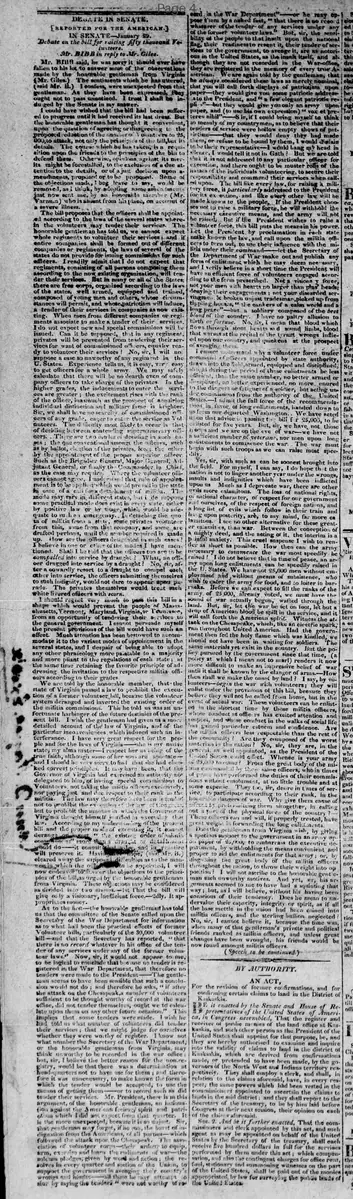
REPORTED FOR THE AMERICAN.
IN SENATE—January 29.
Debate on the bill for raising fifty thousand Volunteers.
Mr. Bibb, in reply to Mr. Giles.
Mr. Bibb said, he was sorry it should ever have fallen to his lot to answer some of the observations made by the honorable gentleman from Virginia (Mr. Giles). The sentiments which he had uttered (said Mr. B.) I confess, were unexpected from that gentleman. As they have been expressed, they ought not to pass unnoticed. I trust I shall not be judged by the Senate in my answer.
I could have wished that the bill had been suffered to progress until it had received its last dress. But the honorable gentleman has thought it convenient, upon the question of agreeing or disagreeing to the proposed reduction of the number of volunteers to 25,000, to attack, not only the principles of the bill, but its details. The course which he has taken, is a requisition upon the friends to the principles of the bill to defend them. Otherwise, opinions against its merits might be forestalled, to the exclusion of a due attention to the details, or of a just decision upon amendments, proposed or to be proposed. Some of the objections made, I beg leave to say, would be removed, as I think, by adopting some amendments just now sent me by an honorable member (Mr. Varnum) who is absent from his place, on account of a severe illness.
The bill proposes that the officers shall be appointed according to the laws of the several states wherein the volunteers may tender their services. The honorable gentleman has told us, we cannot expect whole regiments to volunteer their services; and if entire companies shall be formed out of different companies or regiments, the laws of several of the states do not provide for issuing commissions for such officers. I readily admit that I do not expect that regiments, consisting of all persons composing them according to the now existing organization, will tender their services. But in many or all of the States, there are free corps, organized according to the laws of the states, well armed, equipped and trained, composed of young men and others, whose circumstances will permit, and whose patriotism will induce a tender of their services in companies as now existing. When men from different companies or regiments associate to make a tender of their services, I do not expect new and special commissions will be issued. Can it be supposed, that in any regiment, privates will be prevented from tendering their services for want of commissioned officers, equally ready to volunteer their services? No, sir, I will not suppose a case so unworthy of any regiment in the U. States. Experience tells us, it is easy, very easy to get officers for a whole army. We may safely calculate that there will be no dearth even of company officers to take charge of the privates. In the higher grades, the inducements to enter the services are greater; the excitement rises with the rank of the officer, inasmuch as the prospect of acquiring individual distinction and military fame is brighter.
Sir, we shall have no scarcity of commissioned officers of any grade, eager to enter the service as Volunteers. The difficulty most likely to occur is that of deciding between contending supernumerary officers. There are two modes of deciding in such cases; the one conventional amongst the officers, such as by ballot, election of the privates, &c.; the other by the appointment of the proper superior officer, such as the Brigadier General, Major General, Adjutant General, or finally the Commander in Chief, as the case may require. Where the volunteer officers cannot agree, I understand that rule of appointment is to be applied which would prevail in the state in case of a call for detachment of militia. The mode may vary in different states, but I do suppose some practical mode does exist in every state, either by positive law or by usage, which would be adequate to such an emergency. In detaching the quota of militia from a state, some privates volunteer from this, some from that company, and some are drafted perhaps, until the number required is made up. How are the officers designated in such cases? I believe in one or other of the modes I have mentioned. Shall I be told that the officers too are to be compelled into service by draught? What, an officer dragged into service by a draught? No, sir, after a cowardly resort to a draught to compel each other into service, the officers submitting themselves to such indignity, would not dare to appear upon parade. The privates themselves would treat such white livered officers with scorn.
I should regret very much to pass this bill in a shape which would prevent the people of Massachusetts, Vermont, Maryland, Virginia, or Tennessee, from an opportunity of tendering their services to the general government. I cannot persuade myself the present provisions of the bill would have such an effect. Much attention has been bestowed to accommodate it to the variant modes of appointment in the several states, and I despair of being able to adopt any other phraseology more palatable to a majority and more pliant to the regulations of each state; at the same time retaining the favorite principle of addressing the invitation to the respective militia officers according to their grades.
We are told by the honorable member, that the state of Virginia passed a law to prohibit the execution of a former volunteer bill, because the volunteer system deranged and inverted the existing order of the militia commissions. This he told us was an unfortunate harbinger of the future destinies of the present bill. I wish the gentleman had given us a more detailed account of the law of Virginia, and of the particular inconveniences which induced such an interference. I have very great respect for the people and for the laws of Virginia—she is my native state, my alma mater—I respect her as being of the true faith, although some of her sons are apostate—and I should be very sorry to find that she had erred from correct principles. It may have been, that the Governor of Virginia had exercised an authority not delegated to him, of issuing special commissions to Volunteers, not taking the militia officers exclusively, nor paying just and due respect to their rank in the militia. The law may therefore have been intended not to prohibit the execution of the law of Congress but to prohibit the manner in which the Governor of Virginia thought himself justified in executing that law. According to my understanding of the present bill and the proper mode of executing it, it cannot derange or invert the existing order of militia commissions more than a draught or detachment would do—not consult that order, and in practice will preserve it. Having (said Mr. B.) cleared away the supposed difficulties as to the manner in which the officers are to be appointed, I will now endeavor to answer the objections to the principles of the bill, as urged by the honorable gentleman from Virginia. These objections may be considered as divided into two classes—1st, That the bill will give us only a visionary, inefficient force. 2dly. It appropriates money.
As to the first—the honorable gentleman has told us that the committee of the Senate called upon the Secretary of the War Department for information as to what had been the practical effects of former Volunteer bills, particularly of the 30,000 volunteer bill—and that the Secretary has reported, 'that there is no record whatever in his office of the tender of any services under any of the former volunteer laws.' Now, sir, it would not appear to me, to be logical to conclude that because no tender is registered in the War Department, that therefore no tenders were made to the President—'The gentleman seems to have been sensible that such a conclusion would not do; and therefore he asks, 'if after the attack on the Chesapeake, a number of volunteers sufficient to be thought worthy of record at the war office, did not tender themselves, ought we to calculate upon them on any other future occasion.' This implies that some tenders were made. I wish he had told us what number of volunteers did tender their services; that we might judge for ourselves whether they were worthy of register. I know not what number the Secretary of the War Department; or the honorable gentleman from Virginia, may think unworthy to be recorded in the war office; but, sir, I believe the better reason for the non-registry, would be that there was a determination at head-quarters not to have use for them; and therefore it was unnecessary, to make known the form in which the tender would be accepted, to use the means of getting them—or to record such as did tender their services. Mr. President, there is in this argument, of the honorable gentleman, an insinuation against the American feeling, spirit and patriotism which I did not expect from that quarter. It is the more unexpected, because it is so unjust. Sir, that gentleman may forget, if he can, the burst of indignation from the Americans, of all parties—which followed the attack upon the Chesapeake. The association of volunteer corps—their ardour to equip, arm, exercise and learn the rudiments of war—the solemn pledges, given by word and action; the resolves in every quarter and section of the Union, to support the government in avenging their country's wrongs and insults—all these he may attempt to disparage by saying the tenders 'were not worthy of record in the War Department—or he may oppose them by a naked fact, 'that there is no record whatever of the tender of any services under any of the former volunteer laws.' But, sir, the sensibility of the people to that insult upon the national flag, their readiness to resent it, their tender of services to the government, to avenge it, are as notorious in the United States, as the insult itself, and although they are not recorded in the War-office they are registered in the memory of every true American.
We are again told by the gentleman, that he always considered these laws as merely nominal—that you will call forth displays of patriotism upon paper—they would give you some patriotic addresses to the President, and a few elegant patriotic resolves—but they would give you only an army upon paper, and (to use his own expression) 'vox et preterea nihil.' Sir, if I could bring myself to think so meanly of my countrymen, as to believe that their tenders of service were hollow empty shows of patriotism—that they would deny they had made them, or refuse to be bound by them, I would disdain to be their representative—I would hang my head in silence. I would tell it not in Gath—but we are told that it is not addressed to any particular officer for execution, and there ought to be muster rolls of the names of the individuals volunteering, to secure their responsibility and command their services when called upon.
The bill like every law, for raising a military force, is particularly addressed to the President for its execution, and like every other law will be made known to the people. If the President chooses not to raise a military force, he will withhold the necessary executive means, and the army will not be raised. But if the President wishes to raise a volunteer force, this bill puts the means in his power. Let the President, by proclamation in each state make known the law, and call upon the militia officers to turn out, to use their influence with the militia under their command—let the Secretary of the Department of War make out and publish an form of enlistment which he may deem necessary and I verily believe in a short time the President will have an efficient force of volunteers engaged according to the form prescribed. Not a visionary force not your men with hearts no larger than pins heads; denying their engagements: not your discarded servingmen & broken unjust tradesman, picked up from tippling houses, 'the cankers of a calm world and a long peace'—but, a soldiery composed of the best blood of the country.
I have no paltry allusion to birth or fortune. No, sir. I mean that blood which flows through stout hearts and sound limbs, blood that warms at the recital of the tyrant's wrongs inflicted upon our country, and quickens at the prospect of avenging them. I cannot understand why a volunteer force under command of officers appointed by state authority, drawn into the field, armed, equipped and disciplined, should, during the period of these enlistments be less efficient, than the same number, no better armed or disciplined, no better experienced, no more enured to the dangers or fatigues of a soldier, but acting under commissions from the authority of the United States. I admit the full force of the recommendations in favor of long enlistments, handed down to us from our departed Washington. We have acted upon that advice in passing the bill for 25,000, to be enlisted for five years. But, sir, we have not those troops and we are on the eve of war—we have not a sufficient number of veterans, nor men upon long enlistments to commence the war. The war must begin with such troops as we can raise most speedily. Yes, sir, with such as can be soonest brought into the field. For myself, I can say, I do hope that the nation is not to linger another year under the wrongs, insults and indignities which have been inflicted upon us. Much as I deprecate war, there are other evils more calamitous. The loss of national rights, of national character, of respect for our government and ourselves, of the respect of foreign nations, and a long list of evils which follow in their train and hang upon posterity, are, to my mind, far more calamitous. I see no other alternative for these greater calamities, than war. Between the conception of a mighty deed, and the acting of it, the interim is a painful anxiety. This cruel suspense I wish to render as short as possible. How then can the army necessary to commence the war most speedily be raised? I do not believe that in time of peace, an army upon long enlistments can be speedily raised in the U. States. We have not 25,000 men without employment and without means of subsistence, who wish to enter the army for food, and to loiter in barracks. Before we can expect to fill the ranks of the army of 25,000, already voted, we must have the sound of war actually begun, wafted through the land. But, sir, let the war be set on foot, let but a drop of American blood be spilt in the service, and it will call forth the American spirit. Witness the attack on the Chesapeake, which, like an electric spark, ran throughout United America. Had the government then fed the holy flame which was kindled, we should not have been in waiting for soldiers. The same materials yet exist in the country. But the policy pursued by the government since that time, (a policy at which I mean not to snarl) renders it now more difficult to make an impressive belief of war until it shall be known by the clangor of arms. How then shall we make the onset by land? I say, by volunteers—begin the war with volunteers; they will enlist under the provisions of this bill, because they believe they will not be called from home, but in the event of actual war; These volunteers can be enlisted in the shortest time by those militia officers, whose conduct as officers has excited attention and respect, and whose conduct in the walks of social life has gained particular esteem and confidence. Are the militia officers less respectable than the rest of the community? Are they composed of the worst materials in the nation? No, sir, they are, in the general, as well appointed, as the President of the United States could effect. Whence is your army of 25,000 to come? From the great body of the militia commanded by these same officers; who in times of peace have performed the duties of their commissions without emolument, at no little trouble and at some expense. They too, sir, desire in times of service, to participate according to their rank, in the honorable dangers of war. Why give them cause of affront by pretermitting them altogether, in calling out a part of the physical force of the country?—These officers can and will, if properly treated, have great weight in forwarding the long enlistments.
Does the gentleman from Virginia wish, by giving a specious support to the government in an army upon paper of 25,000, to embarrass the executive department, by withholding the means convenient and proper to aid the enlistments for that army; or, by disgusting the great body of the militia officers throughout the nation, to throw their weight into opposition? I will not ascribe to the honorable gentleman such unworthy motives. And yet, sir, his arguments seemed to me to have had a squinting that way; but, as I will believe, without his having been conscious of their tendency. Does he mean to undervalue their capacity, integrity or spirit, as if all the base mettle in the union had been coined into militia officers, and the sterling bullion neglected? No, sir, I cannot believe it, because the time was, when many of that gentleman's private and political friends ranked as militia officers, and unless great changes have been wrought, his friends would be now found amongst militia officers.
(Speech to be continued.)
What sub-type of article is it?
What themes does it cover?
What keywords are associated?
What entities or persons were involved?
Where did it happen?
Story Details
Key Persons
Location
U.S. Senate
Event Date
January 29
Story Details
Mr. Bibb defends the volunteer bill against Mr. Giles' criticisms, arguing that volunteers and officers will readily enlist due to patriotism, especially in response to national insults like the Chesapeake attack, and that the bill enables swift military mobilization without deranging state militia structures.