Thank you for visiting SNEWPapers!
Sign up free
The Wheeling Daily Intelligencer
Wheeling, Ohio County, West Virginia
What is this article about?
On Feb. 15, 1870, in Washington, Congress's Reconstruction Committee advances a bill to restore citizenship rights to most Civil War disfranchised citizens via district court petitions, excluding certain officials, with loyalty oaths and opposition provisions; amendments proposed to broaden scope.
Clipping
OCR Quality
Full Text
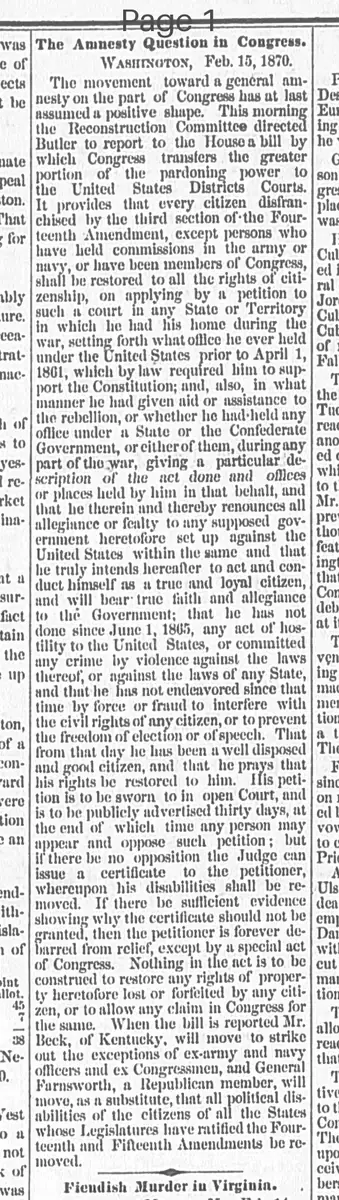
WASHINGTON, Feb. 15, 1870.
The movement toward a general amnesty on the part of Congress has at last assumed a positive shape. This morning the Reconstruction Committee directed Butler to report to the House a bill by which Congress transfers the greater portion of the pardoning power to the United States District Courts.
It provides that every citizen disfranchised by the third section of the Fourteenth Amendment, except persons who have held commissions in the army or navy, or have been members of Congress shall be restored to all the rights of citizenship, on applying by a petition to such a court in any State or Territory in which he had his home during the war, setting forth what office he ever held under the United States prior to April 1, 1861, which by law required him to support the Constitution; and, also, in what manner he had given aid or assistance to the rebellion, or whether he had held any office under a State or the Confederate Government, or either of them, during any part of the war, giving a particular description of the act done and offices or places held by him in that behalf, and that he therein and thereby renounces all allegiance or fealty to any supposed government heretofore set up against the United States within the same and that he truly intends hereafter to act and conduct himself as a true and loyal citizen, and will bear true faith and allegiance to the Government; that he has not done since June 1, 1865, any act of hostility to the United States, or committed any crime by violence against the laws thereof, or against the laws of any State and that he has not endeavored since that time by force or fraud to interfere with the civil rights of any citizen, or to prevent the freedom of election or of speech. That from that day he has been a well disposed and good citizen, and that he prays that his rights be restored to him. His petition is to be sworn to in open Court, and is to be publicly advertised thirty days, at the end of which time any person may appear and oppose such petition; but if there be no opposition the Judge can issue a certificate to the petitioner, whereupon his disabilities shall be removed.
If there be sufficient evidence showing why the certificate should not be granted, then the petitioner is forever debarred from relief, except by a special act of Congress. Nothing in the act is to be construed to restore any rights of property heretofore lost or forfeited by any citizen, or to allow any claim in Congress for the same. When the bill is reported Mr. Beck, of Kentucky, will move to strike out the exceptions of ex-army and navy officers and ex Congressmen, and General Farnsworth, a Republican member, will move, as a substitute, that all political disabilities of the citizens of all the States whose Legislatures have ratified the Fourteenth and Fifteenth Amendments be removed.
What sub-type of article is it?
What themes does it cover?
What keywords are associated?
What entities or persons were involved?
Where did it happen?
Story Details
Key Persons
Location
Washington
Event Date
Feb. 15, 1870
Story Details
The Reconstruction Committee directs Butler to report a bill transferring pardoning power to U.S. District Courts to restore citizenship rights to disfranchised persons under the Fourteenth Amendment, excluding ex-army/navy officers and ex-Congress members, via sworn petitions renouncing rebellion and affirming loyalty, with public advertisement and possible opposition; proposed amendments to remove exceptions or apply to states ratifying amendments.