Thank you for visiting SNEWPapers!
Sign up free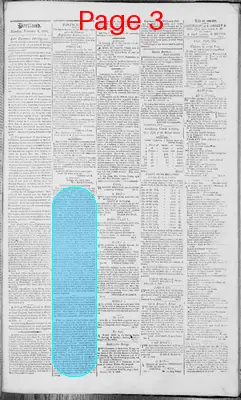
Editorial
February 8, 1808
Portland Gazette, And Maine Advertiser
Portland, Cumberland County, Maine
What is this article about?
Editorial criticizes supporters of the Embargo Act for dismissing opposition as mere partisanship, defends merchants' rights to protest economic ruin, accuses Jeffersonians of tyranny, warns against Democratic agitation for war with England, notes contradictory reports on negotiations with Mr. Rose, and highlights hypocrisy in Democrats' reactions to French actions in Denmark versus Portugal.
Clipping
OCR Quality
95%
Excellent
Full Text
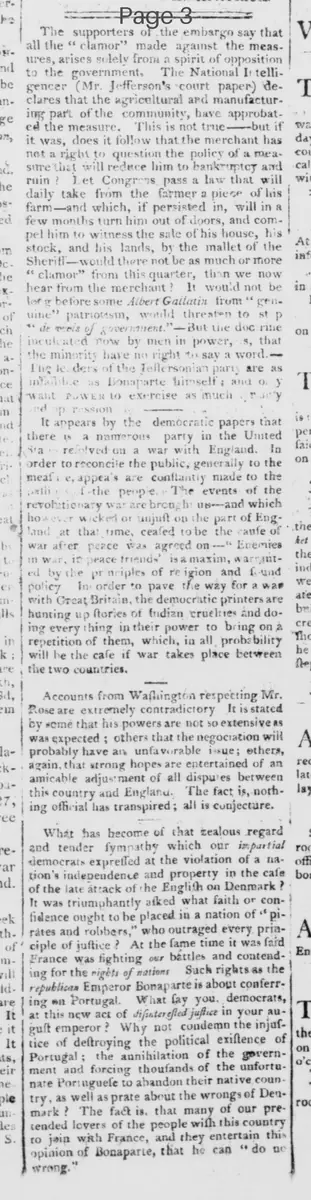
The supporters of the embargo say that all the "clamor" made against the measures, arises solely from a spirit of opposition to the government. The National Intelligencer (Mr. Jefferson's court paper) declares that the agricultural and manufacturing part of the community, have approbated the measure. This is not true—but if it was, does it follow that the merchant has not a right to question the policy of a measure that will reduce him to bankruptcy and ruin? Let Congress pass a law that will daily take from the farmer a piece of his farm—and which, if persisted in, will in a few months turn him out of doors, and compel him to witness the sale of his house, his stock, and his lands, by the mallet of the Sheriff—would there not be as much or more "clamor" from this quarter, than we now hear from the merchant? It would not be long before some Albert Gallatin from "genuine" patriotism, would threaten to stop "the wheels of government."—But the doctrine now acted upon by men in power, is, that the minority have no right to say a word.
The high priests of the Jeffersonian party are as tyrannical as Bonaparte himself; and only want power to exercise as much despotism.
It appears by the democratic papers that there is a numerous party in the United States in favor of a war with England. In order to reconcile the public, generally to the measure, appeals are constantly made to the passions of the people. The events of the revolutionary war are brought up—and which horrors were occasioned or unjust on the part of England at that time ceased to be the cause of war after peace was agreed on—"Enemies in war, in peace friends" is a maxim, warranted by the principles of religion and sound policy. In order to pave the way for a war with Great Britain, the democratic printers are hunting up stories of Indian cruelties and doing every thing in their power to bring on a repetition of them, which, in all probability will be the case if war takes place between the two countries.
Accounts from Washington respecting Mr. Rose are extremely contradictory. It is stated by some that his powers are not so extensive as was expected; others that the negociation will probably have an unfavorable issue; others, again, that strong hopes are entertained of an amicable adjustment of all disputes between this country and England. The fact is, nothing official has transpired; all is conjecture.
What has become of that zealous regard and tender sympathy which our impartial democrats expressed at the violation of a nation's independence and property in the case of the late attack of the English on Denmark? It was triumphantly asked what faith or confidence ought to be placed in a nation of "pirates and robbers," who outraged every principle of justice? At the same time it was said France was fighting our battles and contending for the rights of nations. Such rights as the republican Emperor Bonaparte is about conferring on Portugal. What say you, democrats, at this new act of disinterested justice in your august emperor? Why not condemn the injustice of destroying the political existence of Portugal; the annihilation of the government and forcing thousands of the unfortunate Portuguese to abandon their native country, as well as prate about the wrongs of Denmark? The fact is, that many of our pretended lovers of the people wish this country to join with France, and they entertain this opinion of Bonaparte, that he can "do no wrong."
The high priests of the Jeffersonian party are as tyrannical as Bonaparte himself; and only want power to exercise as much despotism.
It appears by the democratic papers that there is a numerous party in the United States in favor of a war with England. In order to reconcile the public, generally to the measure, appeals are constantly made to the passions of the people. The events of the revolutionary war are brought up—and which horrors were occasioned or unjust on the part of England at that time ceased to be the cause of war after peace was agreed on—"Enemies in war, in peace friends" is a maxim, warranted by the principles of religion and sound policy. In order to pave the way for a war with Great Britain, the democratic printers are hunting up stories of Indian cruelties and doing every thing in their power to bring on a repetition of them, which, in all probability will be the case if war takes place between the two countries.
Accounts from Washington respecting Mr. Rose are extremely contradictory. It is stated by some that his powers are not so extensive as was expected; others that the negociation will probably have an unfavorable issue; others, again, that strong hopes are entertained of an amicable adjustment of all disputes between this country and England. The fact is, nothing official has transpired; all is conjecture.
What has become of that zealous regard and tender sympathy which our impartial democrats expressed at the violation of a nation's independence and property in the case of the late attack of the English on Denmark? It was triumphantly asked what faith or confidence ought to be placed in a nation of "pirates and robbers," who outraged every principle of justice? At the same time it was said France was fighting our battles and contending for the rights of nations. Such rights as the republican Emperor Bonaparte is about conferring on Portugal. What say you, democrats, at this new act of disinterested justice in your august emperor? Why not condemn the injustice of destroying the political existence of Portugal; the annihilation of the government and forcing thousands of the unfortunate Portuguese to abandon their native country, as well as prate about the wrongs of Denmark? The fact is, that many of our pretended lovers of the people wish this country to join with France, and they entertain this opinion of Bonaparte, that he can "do no wrong."
What sub-type of article is it?
Economic Policy
Partisan Politics
Foreign Affairs
What keywords are associated?
Embargo Opposition
Jeffersonian Tyranny
War With England
Mr Rose Negotiations
Bonaparte Hypocrisy
Democratic Papers
Indian Cruelties
What entities or persons were involved?
Jefferson
National Intelligencer
Albert Gallatin
Jeffersonian Party
Bonaparte
Mr. Rose
England
France
Denmark
Portugal
Editorial Details
Primary Topic
Opposition To The Embargo And Jeffersonian Policies
Stance / Tone
Strongly Anti Jeffersonian And Anti Embargo
Key Figures
Jefferson
National Intelligencer
Albert Gallatin
Jeffersonian Party
Bonaparte
Mr. Rose
England
France
Denmark
Portugal
Key Arguments
Opposition To Embargo Arises From Legitimate Economic Concerns, Not Just Partisanship
Merchants Have Right To Protest Measures Leading To Bankruptcy
Farmers Would Clamor If Similarly Affected
Jeffersonians Suppress Minority Voices And Act Tyrannically
Democratic Papers Agitate For War With England By Appealing To Passions And Reviving Old Grievances
War Would Likely Lead To Indian Cruelties
Negotiations With Mr. Rose Are Conjectural With Contradictory Reports
Democrats Hypocritical In Condemning English Attack On Denmark But Ignoring French Actions In Portugal