Thank you for visiting SNEWPapers!
Sign up free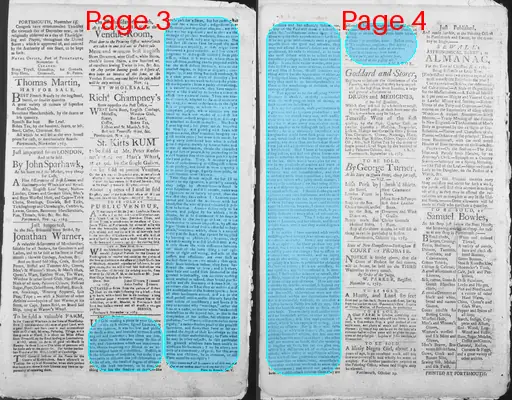
The New Hampshire Gazette And General Advertiser
Portsmouth, Exeter, Rockingham County, New Hampshire
What is this article about?
Amator responds to criticisms from Leonora and her associates in the newspaper, defending his views on true affection, sincerity, and moral propriety in relationships. He accuses them of ignorance, immorality, and misinterpreting love as mere sensuality, while upholding virtue and condemning their impudence.
Merged-components note: This is a single continuous letter to the editor split across pages 3 and 4, as the text flows directly from the end of the first component (ending with Plato quote) to the start of the second.
Clippings
1 of 2
OCR Quality
Full Text
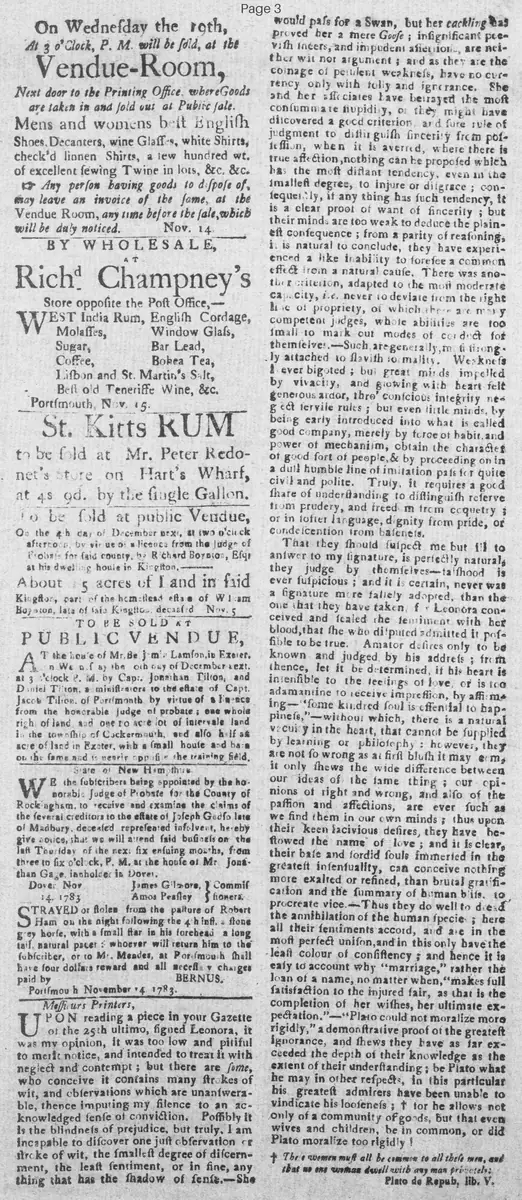
That they should suspect me but ill to answer to my signature, is perfectly natural—they judge by themselves falsehood is ever suspicious; and it is certain, never was a signature more falsely adopted than the one that they have taken, for Leonora conceived and sealed the sentiment with her blood, that she who disputed admitted it possible to be true. Amator desires only to be known and judged by his address: from thence let it be determined, if his heart is insensible to the feelings of love, or is too adamantine to receive impression, by asking—'some kindred soul is essential to happiness,'—without which, there is a natural vacancy in the heart, that cannot be supplied by learning or philosophy: however, they are not so wrong as at first blush it may seem, it only shews the wide difference between our ideas of the same thing; our opinions of right and wrong, and also of the passion and affections, are ever such as we find them in our own minds; thus upon their keen lascivious desires, they have bestowed the name of love; and it is clear, their base and sordid souls immersed in the greatest sensuality, can conceive nothing more exalted or refined than brutal gratification and the summary of human bliss to procreate vice. Thus they do well to dread the annihilation of the human specie; here all their sentiments accord and are in the most perfect union, and in this only have the least colour of consistency: and hence it is easy to account why "marriage," rather the loan of a name, no matter when, "makes full satisfaction to the injured fair, as that is the completion of her wishes, her ultimate expectation."—"Plato could not moralize more rigidly." a demonstrative proof of the greatest ignorance, and shews they have as far exceeded the depth of their knowledge as the extent of their understanding: be Plato what he may in other respects, in this particular his greatest admirers have been unable to vindicate his looseness; ↑ for he allows not only of a community of goods, but that even wives and children, be in common, or did Plato moralize too rigidly!
* These women must all be common to all these men, and that no woman dwell with any man privately: Plato de Repub. lib. V.
Leonora and her assembly inform me, that any of the Fair will dread a connection with. &c."—Whatever others may, I beg them to quiet their apprehensions; for should it be my great misfortune, to meet a general repulse from the good and amiable, they may rest assured Amator's desires are not so prostituted, his taste so vitiated, as to form the most distant wish to be united to such impudent profligacy, such bare-faced immodesty. It can little excite wonder, that persons so lost to any sense of virtue, so destitute of any idea of honor, should conceive anything which has the appearance of either, as "indigested ideas, whimseys, and vagaries;" truly they must be as incomprehensible to them as the wanderings of delirium, or the ravings of phrensy.
"You appear to be the offspring of Decency is asham'd, modesty confounded with the most pungent sense of shame, at such monstrous indelicacy!
It is my fixt opinion, their performance is a genuine, and not spurious production: and doubt not but almost every one, will readily close with me and give them the same credit: for it wears every conceivable mark, which enables us to distinguish fiction from reality; for it is absolutely impossible any imagination could form such gross conceptions, unless sunk to the same degree of depravity, any more than one born deaf should form just and adequate ideas of the music of a harpsichord. Had I been as incapable of doing justice, and had not given better reasons to entertain more favorable sentiments of the sex, there would be no plea for me; but in my plenitude of censure and want of candor, I was confident the number of the virtuous was not inconsiderable, and that confidence arose from conviction; but, that there are others who justly merit censure, I am equally confident; for they bring dishonor and disgrace upon, and expose the whole to unjust reflections. I should do the greatest violence to my own sentiments, and the most signal injustice to the sex, to suppose any one of them had any concern in, or could secretly approve Leonora, because, I cannot conceive female nature so consummately weak, so perfectly destitute of every idea of refinement, virtue or sentiment. Thus I take my final leave of Leonora, and her friends, and should despise them, was it not they would disgrace contempt.
I. in reality I have censured with unjust, undistinguished severity, it admits no apology, nor merits no sanity. Should any entertain such an opinion, let them produce any just reason, and I will most readily join issue, and candidly plead the charge: but to affirm to censure some, is uncandid, and an injury done to the whole, will apply with equal propriety if a knave is punished for violating the laws of society; but are necessary, in my opinion; and 'tis convinced it is erroneous, I shall neither disavow or retract, tho' possibly, opposed to the principles or practice of some of my acquaintance. How any can conceive themselves wounded, is beyond my comprehension, unless consciousness directs the shaft—My observations were not circumscribed within any determinate limits.
But it is uncandid; forsooth, to mention a Cyclop because Philip has so an eye, like him the blemish ought to be as little their own fault. True modesty must neither commit an immodest action, or utter an indelicate expression; it is like real greatness of mind, which is less capable of giving, than taking an offence. But it fares with false delicacy, as with false honor; the one can commit immodest actions, but has ears too nice to bear the mention of them; the other will not receive an insult, tho' the receiving it implies no fault, but yet can give one, which is a deliberate act of malice.—Such minds, when guilty of unjustifiable actions, have not sufficient greatness to confess them, by conviction or amendment, nevertheless, have that malicious weakness to avow them by resentment; and would not pardon me because consciousness informs them they are pointed at by some vague and general observations—Truly it is as easy to bleach an Ethiop as obtain forgiveness from irritated malice.
"Silence! ye wretches, hence! justice cries,
"Tis conscience, conscience, that applies;
"The virtuous mind takes no alarm—
"Secur'd by innocence from harm;
"While guilt, and his associate fear,
"Are startled at the passing air."
AMATOR
What sub-type of article is it?
What themes does it cover?
What keywords are associated?
What entities or persons were involved?
Letter to Editor Details
Author
Amator
Main Argument
amator defends his prior writings against leonora and her group's attacks, asserting that true affection avoids disgrace and requires moral sincerity, while condemning their views as ignorant, sensual, and lacking virtue.
Notable Details