Thank you for visiting SNEWPapers!
Sign up free
The Daily Spy
Worcester, Worcester County, Massachusetts
What is this article about?
US Senate in Washington adjourns to avoid debate on Mr. Allen's resolutions limiting foreign interference in North American affairs, referencing Monroe's 1823 message and potential notice to Britain over Oregon. Calhoun opposes risking war; Sevier supports as war measure. Resolution likely defeated.
Clipping
OCR Quality
Full Text
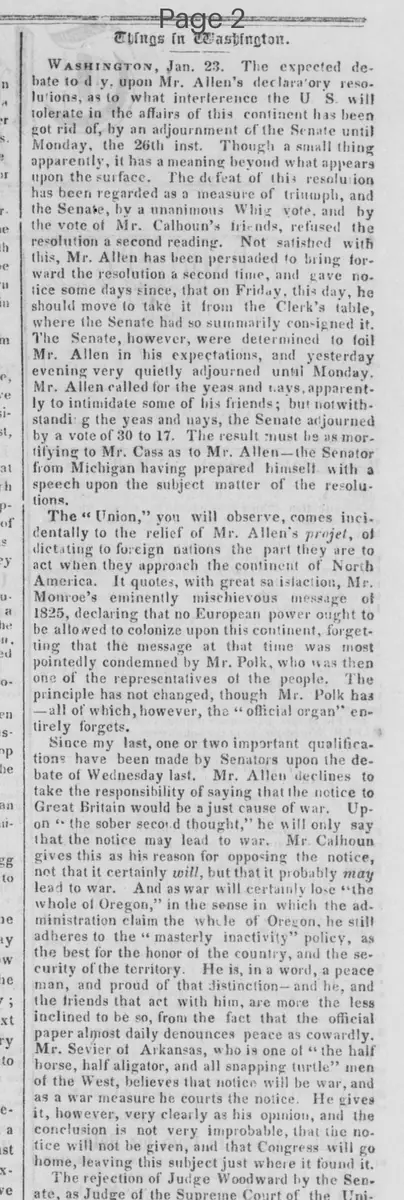
Washington, Jan. 23. The expected debate to-day upon Mr. Allen's declaratory resolutions, as to what interference the U. S. will tolerate in the affairs of this continent has been got rid of, by an adjournment of the Senate until Monday, the 26th inst. Though a small thing apparently, it has a meaning beyond what appears upon the surface. The defeat of this resolution has been regarded as a measure of triumph, and the Senate, by a unanimous Whig vote, and by the vote of Mr. Calhoun's friends, refused the resolution a second reading. Not satisfied with this, Mr. Allen has been persuaded to bring forward the resolution a second time, and gave notice some days since, that on Friday, this day, he should move to take it from the Clerk's table, where the Senate had so summarily consigned it.
The Senate, however, were determined to foil Mr. Allen in his expectations, and yesterday evening very quietly adjourned until Monday.
Mr. Allen called for the yeas and nays, apparently to intimidate some of his friends; but notwithstanding the yeas and nays, the Senate adjourned by a vote of 30 to 17. The result must be as mortifying to Mr. Cass as to Mr. Allen—the Senator from Michigan having prepared himself with a speech upon the subject matter of the resolutions.
The "Union," you will observe, comes incidentally to the relief of Mr. Allen's project, of dictating to foreign nations the part they are to act when they approach the continent of North America. It quotes, with great satisfaction, Mr. Monroe's eminently mischievous message of 1823, declaring that no European power ought to be allowed to colonize upon this continent, forgetting that the message at that time was most pointedly condemned by Mr. Polk, who was then one of the representatives of the people. The principle has not changed, though Mr. Polk has—all of which, however, the "official organ" entirely forgets.
Since my last, one or two important qualifications have been made by Senators upon the debate of Wednesday last. Mr. Allen declines to take the responsibility of saying that the notice to Great Britain would be a just cause of war. Upon "the sober second thought," he will only say that the notice may lead to war. Mr. Calhoun gives this as his reason for opposing the notice, not that it certainly will, but that it probably may lead to war. And as war will certainly lose the whole of Oregon, "in the sense in which the administration claim the whole of Oregon," he still adheres to the "masterly inactivity" policy, as the best for the honor of the country, and the security of the territory. He is, in a word, a peace man, and proud of that distinction—and he, and the friends that act with him, are more or less inclined to be so, from the fact that the official paper almost daily denounces peace as cowardly.
Mr. Sevier of Arkansas, who is one of "the half horse, half alligator, and all snapping turtle" men of the West, believes that notice will be war, and as a war measure he courts the notice. He gives it, however, very clearly as his opinion, and the conclusion is not very improbable, that the notice will not be given, and that Congress will go home, leaving this subject just where it found it.
What sub-type of article is it?
What keywords are associated?
What entities or persons were involved?
Where did it happen?
Foreign News Details
Primary Location
Washington
Event Date
Jan. 23
Key Persons
Outcome
senate adjourns by vote of 30 to 17 to avoid debate; resolution defeated earlier by unanimous whig vote and mr. calhoun's friends; notice to great britain likely not given, subject left unresolved.
Event Details
The US Senate adjourns until January 26 to prevent debate on Mr. Allen's resolutions declaring limits on foreign interference in North American affairs. The resolution was previously refused a second reading. Mr. Allen attempts to revive it but is foiled by adjournment. Discussion involves potential notice to Great Britain over Oregon, with differing views: Mr. Calhoun opposes due to war risk, favoring peace and inactivity; Mr. Sevier supports as a war measure. References Monroe's 1823 message and past condemnations by Mr. Polk.