Thank you for visiting SNEWPapers!
Sign up free
Phenix Gazette
Alexandria, Virginia
What is this article about?
Biographical sketch of Charles Carroll of Carrollton, detailing his education in Europe, marriage, writings against British policies, role in the American Revolution including the tea burning in Annapolis, mission to Canada, signing the Declaration of Independence, and later political career. Includes a letter from John Quincy Adams confirming the signing date.
Clipping
OCR Quality
Full Text
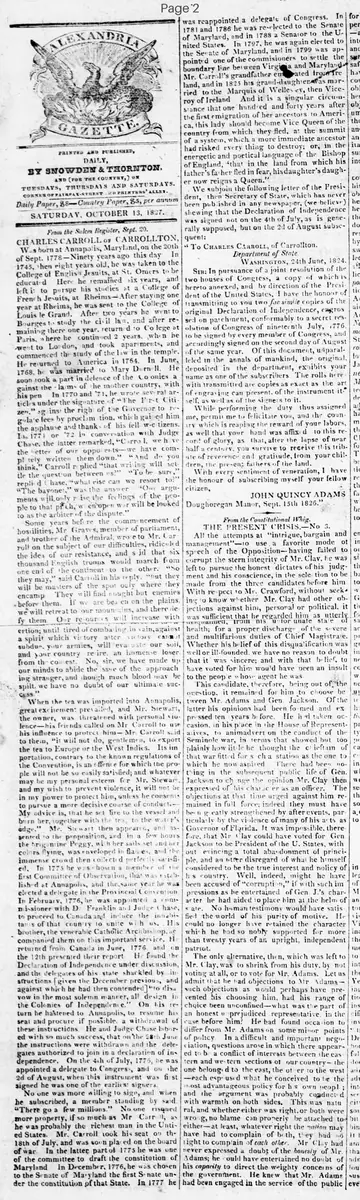
CHARLES CARROLL OF CARROLLTON.
On the 19th of Sept. 1774--Ninety years ago this day--was born at Annapolis, Maryland, on the 20th of that month. In 1745, when eight years old, he was taken to the College of English Jesuits, at St. Omer's to be educated. Here he remained six years, and left to pursue his studies at a college of French Jesuits, at Rheims. After staying one year at Rheims, he was sent to the College of Louis le Grand. After two years he went to Bourges, remaining there one year, returned to college at Paris, where he continued 2 years, when he commenced the study of the law in the Temple.
He returned to America in 1764. In June, soon took a part in defense of the Colonies against the acts of the mother country. In 1768, he was married to Mary Darnall. He soon took a part in defense of the Colonies against the acts of the mother country. In 1770 and '71, he wrote several articles against the laws of the mother country, with his pen. In 1770 and '71, he wrote several articles against the laws of the mother country, with his pen, against the right of the Governor to receive legal fees by proclamation, which gained him the applause and thanks of his fellow citizens.
In 1771 or 72 in conversation with Judge Chase, the latter remarked, "Carroll, we have the better of our opponents--we have completely written them down." "And do you think," Carroll replied, "that writing will settle the question between us?" "To be sure," replied Chase. "What else can we resort to?" "The bayonet," was the answer. "Our arguments will only rise the feelings of the people to that pitch, when open war will be looked to as the arbiter of the dispute."
Some years before the commencement of hostilities, Mr. Graves, member of Parliament, and brother of the Admiral, wrote to Mr. Carroll on the subject of our difficulties, ridiculed the idea of our resistance, and said that six thousand English troops would march from one end of the continent to the other.
"So they may," said Carroll in his reply, "but they will find rough but enemies before them. If we are beaten on the plains, we will retreat to our mountains, and there defy them. Our resources will increase with our exertion; until tired of combating in vain, against a spirit which victory after victory cannot subdue, your armies will evacuate our soil, and your country retire, an immense loser from the contest. No, sir, we have made up our minds to abide the issue of the approaching stranger, and though much blood may be spilt, we have no doubt of our ultimate success."
When the tea was imported into Annapolis, great excitement prevailed, and Mr. Stewart, the owner, was threatened with personal violence--his friends called on Mr. Carroll to use his influence to protect him. Mr. Carroll said to them, "It will not do, gentlemen, to export the tea to Europe or the West Indies. Its importation, contrary to the known regulations of the Convention, is an offense for which the people will not be so easily satisfied; and whatever may be my personal esteem for Mr. Stewart, and my wish to prevent violence, it will not be in my power to protect him, unless he consents to pursue a more decisive course of conduct. My advice is, that he set fire to the vessel and burn her, together with the tea, to the water's edge." Mr. Stewart then appeared, and assented to the proposition, and in a few hours the brigantine Peggy, with her sails set and colors flying, was enveloped in flames, and the immense crowd then collected perfectly satisfied.
In 1775 he was chosen a member of the first Committee of Observation, that was established at Annapolis, and the same year he was elected a delegate in the Provincial Convention. In February, 1776, he was appointed a commissioner with B. Franklin and Judge Chase, to proceed to Canada and induce the inhabitants of that country to unite with us. His brother, the venerable Catholic Archbishop, accompanied them on this important service. He returned from Canada in June, 1776 and on the 12th presented their report. He found the Declaration of Independence under discussion, and the delegates of his state shackled by instructions given the December previous, and against which he had then contended "to dissuade in the most solemn manner, all design in the Colonies of Independence." On his return he hastened to Annapolis, to resume his seat and procure if possible, a withdrawal of these instructions. He and Judge Chase labored with so much success, that on the 28th June the instructions were withdrawn and the delegates authorized to join in a declaration of independence. On the 4th of July, 1776, he was appointed a delegate to Congress, and on the 2d of August, when this instrument was first signed he was one of the earliest signers.
No one was more willing to sign, and when he subscribed, a member standing by said, "There go a few millions." No one risked more property, if so much as Mr. Carroll, as he was probably the richest man in the United States. Mr. Carroll took his seat on the 18th of July, and was soon placed on the board of war. In the latter part of 1775 he was one of the committee to draft the constitution of Maryland. In December, 1776, he was chosen to the Senate of Maryland the first Senate under the constitution of that State. In 1777 he was reappointed a delegate of Congress. In 1778 he was elected a delegate from the State of Maryland, and in 1789 a Senator to the U. States. In 1781 and 1786 he was re-elected to the Senate of Maryland, and in 1797 he was again elected to the Senate of the U. States. In 1799 he was appointed one of the commissioners to settle the boundary line between Virginia and Maryland.
Mr. Carroll's grandfather emigrated from King's County of Ireland. And it is a singular circumstance that one hundred and forty years after the first emigration of her ancestors to America, this lady should become Vice Queen of the country from which they fled, at the summit of a system, which a more immediate ancestor had risked every thing to destroy: or, in the energetic and poetical language of the Bishop of England, that in the land from which his father's father fled in fear, his daughter's daughter now reigns a Queen.
We subjoin the following letter of the President, then Secretary of State, which has never been published in any newspaper, (we believe) shewing that the Declaration of Independence was signed not on the 4th of July, as is generally supposed, but on the 2d of August subsequent:
To Charles Carroll, of Carrollton.
Department of State
Washington, 24th June, 1824.
Sir: In pursuance of a joint resolution of the two houses of Congress, a copy of which is hereto annexed, and by direction of the President of the United States, I have the honour of transmitting to you two fac simile copies of the original Declaration of Independence, engrossed on parchment, conformably to a secret resolution of Congress of nineteenth July, 1776, to be signed by every member of Congress, and accordingly signed on the second day of August of the same year. Of this document, unparalleled in the annals of mankind, the original deposited in the department, exhibits your name as one of the subscribers. The rolls herewith transmitted are copies as exact as the art of engraving can present, of the instrument itself, as well as of the signers to it.
While performing the duty thus assigned me, permit me to felicitate you, and the country which is reaping the reward of your labors, as well that your hand was affixed to this record of glory, as that, after the lapse of near half a century, you survive to receive this tribute of reverence and gratitude, from your children, the present fathers of the land.
With every sentiment of veneration, I have the honour of subscribing myself your fellow citizen,
JOHN QUINCY ADAMS
Doughoregan Manor, Sept. 15th 1826.
What sub-type of article is it?
What themes does it cover?
What keywords are associated?
What entities or persons were involved?
Where did it happen?
Story Details
Key Persons
Location
Annapolis, Maryland; St. Omer's; Rheims; Paris; Bourges; Canada
Event Date
Sept. 19, 1774 (Birth); 1745 1764 (Education); 1764 1826 (Life Events)
Story Details
Charles Carroll's education in Europe, return to America, marriage, writings and conversations advocating colonial resistance, advice to burn tea ship in Annapolis, mission to Canada, efforts to support Declaration of Independence which he signed on August 2, 1776, and subsequent political roles; includes letter confirming signing date.