Thank you for visiting SNEWPapers!
Sign up free
Story
April 20, 1959
The Key West Citizen
Key West, Monroe County, Florida
What is this article about?
Prime Minister Bandaranaike of Ceylon argues that multi-party Asian democracies like Ceylon's may not suit British or American two-party systems, citing instability, and proposes the Swiss model where government reflects parliament's will without frequent collapses.
Clipping
OCR Quality
98%
Excellent
Full Text
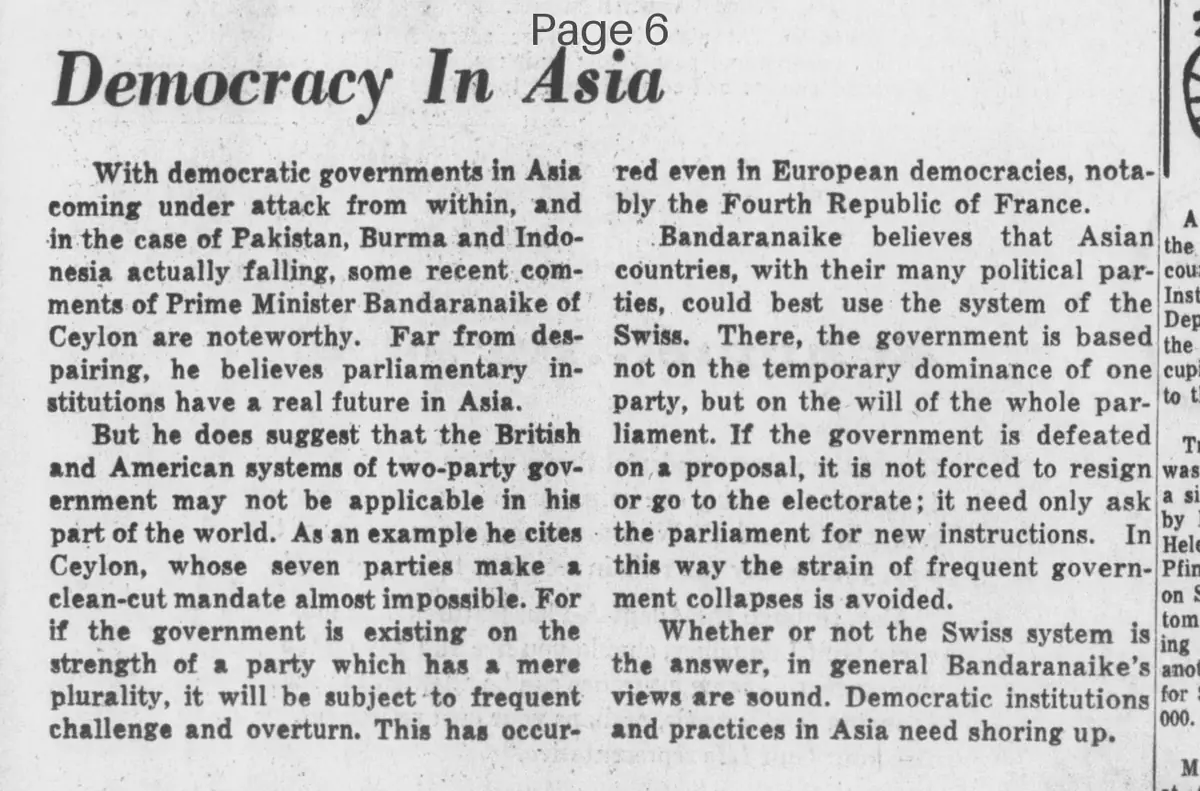
Democracy In Asia
With democratic governments in Asia coming under attack from within, and in the case of Pakistan, Burma and Indonesia actually falling, some recent comments of Prime Minister Bandaranaike of Ceylon are noteworthy. Far from despairing, he believes parliamentary institutions have a real future in Asia. But he does suggest that the British and American systems of two-party government may not be applicable in his part of the world. As an example he cites Ceylon, whose seven parties make a clean-cut mandate almost impossible. For if the government is existing on the strength of a party which has a mere plurality, it will be subject to frequent challenge and overturn. This has occurred red even in European democracies, notably the Fourth Republic of France.
Bandaranaike believes that Asian countries, with their many political parties, could best use the system of the Swiss. There the government is based not on the temporary dominance of one party, but on the will of the whole parliament. If the government is defeated on a proposal, it is not forced to resign or go to the electorate: it need only ask the parliament for new instructions. In this way the strain of frequent government collapses is avoided.
Whether or not the Swiss system is the answer, in general Bandaranaike's views are sound. Democratic institutions and practices in Asia need shoring up.
With democratic governments in Asia coming under attack from within, and in the case of Pakistan, Burma and Indonesia actually falling, some recent comments of Prime Minister Bandaranaike of Ceylon are noteworthy. Far from despairing, he believes parliamentary institutions have a real future in Asia. But he does suggest that the British and American systems of two-party government may not be applicable in his part of the world. As an example he cites Ceylon, whose seven parties make a clean-cut mandate almost impossible. For if the government is existing on the strength of a party which has a mere plurality, it will be subject to frequent challenge and overturn. This has occurred red even in European democracies, notably the Fourth Republic of France.
Bandaranaike believes that Asian countries, with their many political parties, could best use the system of the Swiss. There the government is based not on the temporary dominance of one party, but on the will of the whole parliament. If the government is defeated on a proposal, it is not forced to resign or go to the electorate: it need only ask the parliament for new instructions. In this way the strain of frequent government collapses is avoided.
Whether or not the Swiss system is the answer, in general Bandaranaike's views are sound. Democratic institutions and practices in Asia need shoring up.
What sub-type of article is it?
Historical Event
What themes does it cover?
Justice
Social Manners
What keywords are associated?
Democracy In Asia
Bandaranaike
Swiss System
Multi Party Government
Parliamentary Institutions
What entities or persons were involved?
Prime Minister Bandaranaike
Where did it happen?
Asia, Ceylon
Story Details
Key Persons
Prime Minister Bandaranaike
Location
Asia, Ceylon
Story Details
Bandaranaike comments on challenges to Asian democracies, suggests Swiss parliamentary system for multi-party contexts to avoid instability seen in Ceylon and France's Fourth Republic.