Thank you for visiting SNEWPapers!
Sign up free
Story
February 4, 1912
University Missourian
Columbia, Boone County, Missouri
What is this article about?
Opinion piece critiques the rise of commercialism in American universities, arguing it prioritizes technical expertise over fostering thoughtful, independent leaders who resist societal degradation and uphold culture and moral vision.
Clipping
OCR Quality
98%
Excellent
Full Text
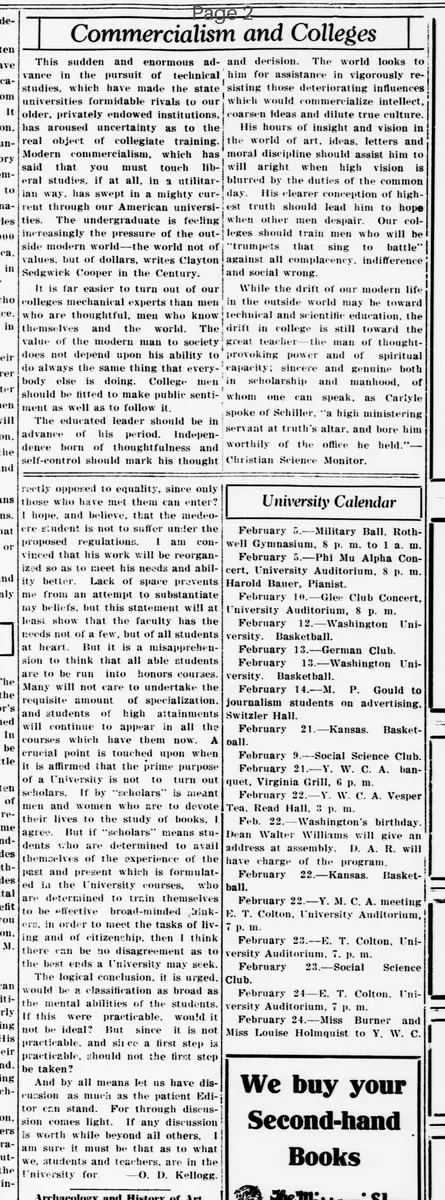
Commercialism and Colleges
This sudden and enormous advance in the pursuit of technical studies, which have made the state universities formidable rivals to our older, privately endowed institutions, has aroused uncertainty as to the real object of collegiate training.
Modern commercialism, which has said that you must touch liberal studies, if at all, in a utilitarian way, has swept in a mighty current through our American universities. The undergraduate is feeling increasingly the pressure of the outside modern world--the world not of values, but of dollars, writes Clayton Sedgwick Cooper in the Century.
It is far easier to turn out of our colleges mechanical experts than men who are thoughtful, men who know themselves and the world. The value of the modern man to society does not depend upon his ability to do always the same thing that everybody else is doing. College men should be fitted to make public sentiment as well as to follow it.
The educated leader should be in advance of his period. Independence born of thoughtfulness and self-control should mark his thought and decision.
The world looks to him for assistance in vigorously resisting those deteriorating influences which would commercialize intellect, coarsen ideas and dilute true culture.
His hours of insight and vision in the world of art, ideas, letters and moral discipline should assist him to will aright when high vision is blurred by the duties of the common day. His clearer conception of highest truth should lead him to hope when other men despair. Our colleges should train men who will be "trumpets that sing to battle" against all complacency, indifference and social wrong.
While the drift of our modern life in the outside world may be toward technical and scientific education, the drift in college is still toward the great teacher-the man of thought-provoking power and of spiritual capacity; sincere and genuine both in scholarship and manhood, of whom one can speak, as Carlyle spoke of Schiller, "a high ministering servant at truth's altar, and bore him worthily of the office he held."
Christian Science Monitor.
This sudden and enormous advance in the pursuit of technical studies, which have made the state universities formidable rivals to our older, privately endowed institutions, has aroused uncertainty as to the real object of collegiate training.
Modern commercialism, which has said that you must touch liberal studies, if at all, in a utilitarian way, has swept in a mighty current through our American universities. The undergraduate is feeling increasingly the pressure of the outside modern world--the world not of values, but of dollars, writes Clayton Sedgwick Cooper in the Century.
It is far easier to turn out of our colleges mechanical experts than men who are thoughtful, men who know themselves and the world. The value of the modern man to society does not depend upon his ability to do always the same thing that everybody else is doing. College men should be fitted to make public sentiment as well as to follow it.
The educated leader should be in advance of his period. Independence born of thoughtfulness and self-control should mark his thought and decision.
The world looks to him for assistance in vigorously resisting those deteriorating influences which would commercialize intellect, coarsen ideas and dilute true culture.
His hours of insight and vision in the world of art, ideas, letters and moral discipline should assist him to will aright when high vision is blurred by the duties of the common day. His clearer conception of highest truth should lead him to hope when other men despair. Our colleges should train men who will be "trumpets that sing to battle" against all complacency, indifference and social wrong.
While the drift of our modern life in the outside world may be toward technical and scientific education, the drift in college is still toward the great teacher-the man of thought-provoking power and of spiritual capacity; sincere and genuine both in scholarship and manhood, of whom one can speak, as Carlyle spoke of Schiller, "a high ministering servant at truth's altar, and bore him worthily of the office he held."
Christian Science Monitor.
What sub-type of article is it?
Editorial
Educational Essay
What themes does it cover?
Moral Virtue
Social Manners
What keywords are associated?
Commercialism
Colleges
Technical Studies
Liberal Education
Thoughtful Leaders
Moral Discipline
What entities or persons were involved?
Clayton Sedgwick Cooper
Carlyle
Where did it happen?
American Universities
Story Details
Key Persons
Clayton Sedgwick Cooper
Carlyle
Location
American Universities
Story Details
Critiques commercialism's influence on colleges, urging education for thoughtful leaders who resist intellectual commercialization and promote culture, art, and moral discipline against societal wrongs.