Thank you for visiting SNEWPapers!
Sign up free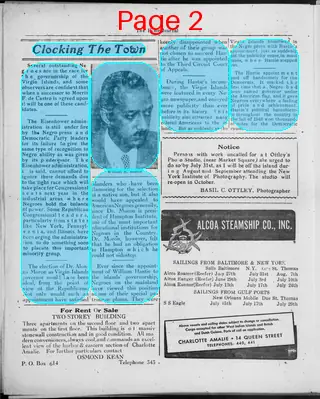
The Home Journal
Charlotte Amalie, Saint Thomas County, Virgin Islands
What is this article about?
Article discusses Negro candidates for Virgin Islands governorship amid criticism of Eisenhower administration for lacking recognition of Negro talent, contrasts with Democratic appointment of William Hastie in 1948, and notes political implications for upcoming elections.
Merged-components note: Image is spatially adjacent to the story text with nearly touching bounding boxes and likely illustrative for the 'Clocking The Town' article.
Clipping
OCR Quality
Full Text
Several outstanding Negroes are in the race for the governorship of the Virgin Islands, and some observers are confident that when a successor to Morris F. de Castro is agreed upon it will be one of these candidates.
The Eisenhower administration is still under fire by the Negro press and Democratic Party leaders for its failure to give the same type of recognition to Negro ability as was given by its predecessor. The Eisenhower administration, it is said, cannot afford to ignore these demands due to the tight race which will take place for Congressional seats next year in the industrial areas where Negroes hold the balance of power. Some Republican Congressional leaders, particularly from states like New York, Pennsylvania, and Illinois, have been urging the administration to do something soon to placate this important minority group.
The election of Dr. Alonzo Moron as Virgin Islands governor would have been ideal, from the point of view of the Republicans. Not only would such an appointment have satisfied islanders who have been clamoring for the selection of a native son, but it also would have appealed to American Negroes generally, since Dr. Moron is president of Hampton Institute, one of the most important educational institutions for Negroes in the country. Dr. Moron, however, felt that he had an obligation to Hampton which he could not sidestep.
Ever since the appointment of William Hastie to the islands' governorship, Negroes on the mainland have viewed this position as one of their special patronage plums. They were keenly disappointed when another of their group was not chosen to succeed Hastie after he was appointed to the Third Circuit Court of Appeals.
During Hastie's incumbency, the Virgin Islands were featured in every Negro newspaper, and enjoyed more publicity than ever before in its history. This publicity also attracted many colored Americans to the islands. But as suddenly as the Virgin Islands blossomed in the Negro press with Hastie's appointment, just as suddenly did the publicity cease, in most cases, when Hastie stepped out.
The Hastie appointment paid off handsomely for the Democrats. It marked the first time that a Negro had been named governor under the American flag, and it gave Negroes everywhere a feeling of pride and achievement. Hastie's political barnstorming throughout the country in the fall of 1948 won thousands of votes for the Democratic cause.
What sub-type of article is it?
What themes does it cover?
What keywords are associated?
What entities or persons were involved?
Where did it happen?
Story Details
Key Persons
Location
Virgin Islands
Event Date
Fall Of 1948
Story Details
Negro candidates vie for Virgin Islands governorship succeeding Morris F. de Castro; Eisenhower administration criticized for not appointing Negro like Dr. Alonzo Moron; contrasts with William Hastie's 1948 Democratic appointment, which boosted pride and votes.