Thank you for visiting SNEWPapers!
Sign up free
Alexandria Daily Advertiser
Alexandria, Virginia
What is this article about?
Outline of Persian history from Nadir Shah's death in 1787, through usurper conflicts, rise and fall of Aga Mohammad Khan, his war with Russia, assassination in 1797, ascension of Fath Ali Shah, ongoing Russo-Persian war, Wahabi threats, and diplomatic interactions with England and France.
Clipping
OCR Quality
Full Text
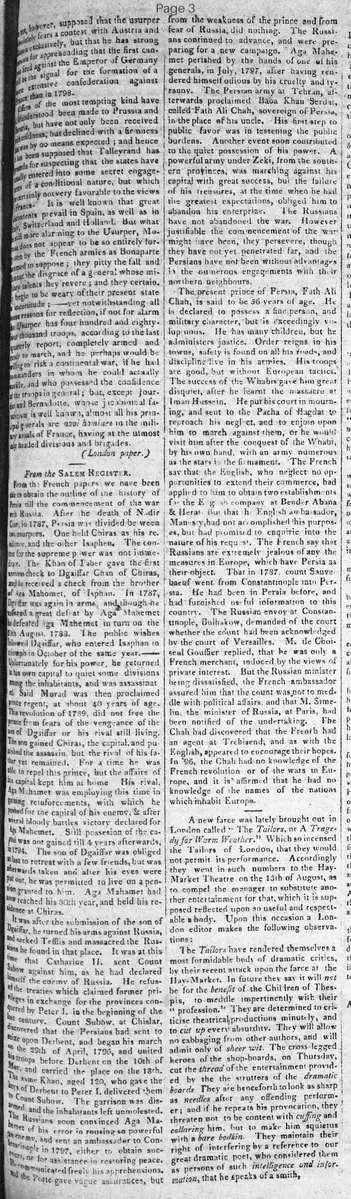
From the French papers we have been able to obtain the outline of the history of Persia till the commencement of the war with Russia. After the death of Nadir Shah, in 1787, Persia was divided between two usurpers. One held Shiraz as his residence, and the other Isfahan. The contest for the supreme power was not immediate. The Khan of Azer gave the first serious check to Agha Jafar Khan of Shiraz, and he received a check from the brother of Aga Mohammad, of Isfahan. In 1787, Jafar was again in arms, and though he suffered a great defeat by Aga Mohammad he defeated Aga Mohammad in turn on the 10th August, 1788. The public wishes followed Jafar, who entered Isfahan in triumph in October of the same year. Unfortunately for his power, he returned to his own capital to quiet some divisions among the inhabitants, and was assassinated. Sad Morad was then proclaimed prince regent, at about 40 years of age. This revolution of 1789, did not free the prince from fears of the vengeance of the son of Jafar or his rival still living. The son gained Shiraz, the capital, and punished the assassin, but the rival of his father yet remained. For a time he was able to repel this prince, but the affairs of his capital kept him at home. His rival, Aga Mohammad was employing this time in gaining reinforcements, with which he pushed for the capital of his enemy, & after several bloody battles victory declared for Aga Mohammad. Still possession of the capital was not gained till 4 years afterwards, in 1794. The son of Jafar was obliged at last to retreat with a few friends, but was afterwards taken and after his eyes were put out, he was permitted to live on a pension granted to him. Aga Mohammad had now reached his 60th year, and held his residence at Shiraz. It was after the submission of the son of Jafar, he turned his arms against Russia, and sacked Tiflis and massacred the Russians he found in that place. It was at this time that Catherine sent Count Suvorov against him, as he had declared himself the enemy of Russia. He refused the treaties which claimed former privileges in exchange for the provinces conquered by Peter I. in the beginning of the last century. Count Suvorov, at Chislar, discovered that the Persians had sent to seize upon Derbent, and began his march up the 29th of April, 1796, and united his troops before Derbent on the 10th of May, and carried the place on the 13th. The same Khan, aged 120, who gave the keys of Derbent to Peter I. delivered them to Count Suvorov. The garrison was disarmed and the inhabitants left unmolested. The Russians soon met with an enemy, and sent an ambassador to Constantinople in 1797 to cry for assistance in restoring peace either to obtain success. He communicated freely and the Porte gave value assurances, but from the weakness of the prince and from fear of Russia, did nothing. The Russians continued to advance, and were preparing for a new campaign. Aga Mohammad perished by the hands of one of his generals, in July, 1797, after having rendered himself odious by his cruelty and tyranny. The Persian army at Tehran, afterwards proclaimed Baba Khan Sardar, called Fath Ali Shah, sovereign of Persia, in the place of his uncle. His first step to public favor was in lessening the public burdens. Another event soon contributed to the quiet possession of his power. A powerful army under Zeki, from the southern provinces, was marching against his capital with great success, but the failure of his treasures, at the time when he had the greatest expectations, obliged him to abandon his enterprise. The Russians have not abandoned the war. However justifiable the commencement of the war might have been, they persevere, though they have not yet penetrated far, and the Persians have not been without advantages in the numerous engagements with their northern neighbours. The present prince of Persia, Fath Ali Shah, is said to be 56 years of age. He is declared to possess a fine person, and military character, but is exceedingly voluptuous. He has many children, but he administers justice. Order reigns in his towns, safety is found on all his roads, and discipline lives in his armies. His troops are good, but without European tactics. The success of the Wahabis gave him great disquiet, after he learnt the massacre at Imam Hussein. He put his court in mourning, and sent to the Pacha of Bagdad to reproach his neglect, and to enjoin upon him to march against them, or he would visit him after the conquest of the Wahabi, by his own hand, with an army numerous as the stars in the firmament. The French say that the English, who neglect no opportunities to extend their commerce, had applied to him to obtain two establishments for the English company at Bender Abbas & Herat. But the English ambassador, Manesty, had not accomplished his purposes, but had promised to inquire into the nature of his request. The French say that Russians are extremely jealous of any measures in Europe, which have Persia as their object. That in 1787, count Sauveboeuf went from Constantinople into Persia. He had been in Persia before, and had furnished useful information to this country. The Russian envoy at Constantinople, Bulhakow, demanded of the court whether the count had been acknowledged by the court of Versailles. M. de Choiseul-Gouffier replied, that he was only a French merchant, induced by the views of private interest. But the Russian minister being dissatisfied, the French ambassador assured him that the count was not to meddle with political affairs, and that M. Simelin, the minister of Russia, at Paris, had been notified of the undertaking. The Shah had discovered that the French had an agent at Trebizond, and as with the English, appeared to encourage their hopes. In '96, the Shah had no knowledge of the French revolution or of the wars in Europe, and it is affirmed that he had no knowledge of the names of the nations which inhabit Europe.
What sub-type of article is it?
What keywords are associated?
What entities or persons were involved?
Where did it happen?
Foreign News Details
Primary Location
Persia
Event Date
1787 1797 And Ongoing
Key Persons
Outcome
multiple battles with victories for aga mohammad; son of jafar blinded and pensioned; aga mohammad assassinated in july 1797; fath ali shah proclaimed sovereign; russians capture derbent in 1796; ongoing war with persian advantages in engagements; wahabi massacre at imam hussein; failed english commercial requests; russian jealousy of french activities.
Event Details
After Nadir Shah's death in 1787, Persia divided between usurpers in Shiraz and Isfahan. Conflicts led to Jafar Khan's assassination in 1788, Sad Morad's regency in 1789, and Aga Mohammad's eventual victory in 1794, blinding Jafar's son. Aga Mohammad sacked Tiflis, prompting Russian response under Suvorov who took Derbent in 1796. Aga Mohammad killed in 1797; Fath Ali Shah ascended, reduced burdens, repelled Zeki's army. Ongoing Russo-Persian war with Persian successes. Fath Ali Shah, 56, voluptuous but just ruler with disciplined troops lacking European tactics. Disturbed by Wahabi massacre, threatened Pacha of Bagdad. English sought establishments at Bender Abbas and Herat via Manesty, unmet. Russians jealous of French agent Sauveboeuf in 1787 and agent at Trebizond; Shah unaware of French Revolution in 1796.