Thank you for visiting SNEWPapers!
Sign up free
The New Hampshire Gazette
Portsmouth, Rockingham County, New Hampshire
What is this article about?
Proceedings of the U.S. House of Representatives from December 29, 1802, to January 7, 1803, including resolutions on disqualifying duel participants from office (rejected), petitions for relief and amendments to laws on patents, bankrupt acts, and military lands; reports on claims; and extensive confidential debates on Spanish obstructions to Mississippi navigation under the Louisiana cession, culminating in a resolution affirming U.S. rights.
Clipping
OCR Quality
Full Text
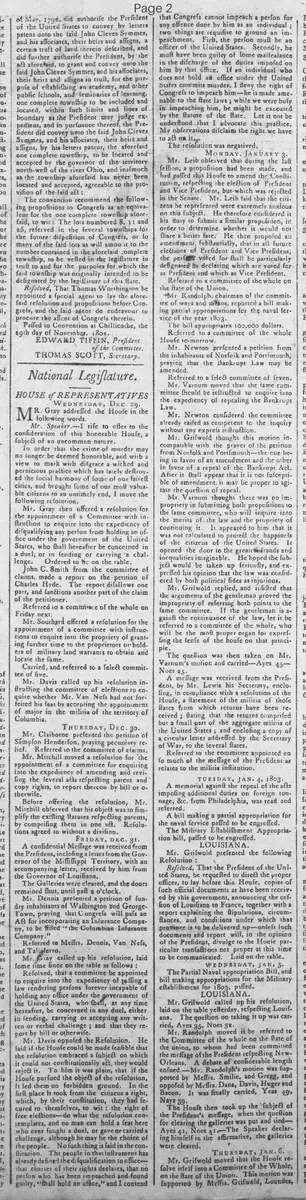
HOUSE of REPRESENTATIVES
Wednesday, Dec. 29.
MR. GRAY
Mr. Speaker,--I rise to offer to the consideration of this honorable House, a subject of an uncommon nature.
In order that the crime of murder may no longer be deemed honorable, and with a view to mark with disgrace a wicked and pernicious practice which has lately destroyed the social harmony of some of our fairest cities, and brought some of our most valuable citizens to an untimely end, I move the following resolution,
Mr. Gray then offered a resolution for the appointment of a Committee with instruction to enquire into the expediency of disqualifying any person from holding an office under the government of the United States, who shall hereafter be concerned in a duel, or in sending or carrying a challenge.
Ordered to lie on the table.
John C. Smith from the committee of claims, made a report on the petition of Charles Hyde. The report disallows one part, and sanctions another part of the claim of the petitioner.
Referred to a committee of the whole on Friday next.
Mr. Southard offered a resolution for the appointment of a committee with instructions to enquire into the propriety of granting further time to the proprietors or holders of military land warrants to obtain and locate the same.
Carried, and referred to a select committee of five.
Mr. Davis called up his resolution instructing the committee of elections to enquire whether Mr. Van Ness had not forfeited his seat by accepting the appointment of major in the militia of the territory of Columbia.
Thursday, Dec. 30.
Mr. Claiborne presented the petition of Sampson Henderson, praying pecuniary relief. Referred to the committee of claims.
Mr. Mitchill moved a resolution for the appointment of a committee for enquiring into the expediency of amending and revising the several acts respecting patents and copy rights, to report thereon by bill or otherwise.
Before offering the resolution, Mr. Mitchill observed that his object was to simplify the existing statutes respecting patents, by comprising them in one act. Resolutions agreed to without a division.
FRIDAY, DEC. 31.
A confidential Message was received from the President, enclosing a letter from the Governor of the Mississippi Territory, with an accompanying letter, received by him from the Governor of Louisiana.
The Galleries were cleared, and the doors remained shut, until past 3 o'clock.
Mr. Dennis presented a petition of sundry inhabitants of Washington and George-Town, praying that Congress will pass an Act for incorporating an Insurance Company, to be styled "the Columbian Insurance Company."
Referred to Messrs. Dennis, Van Ness, and Taliaferro.
Mr. Gray called up his resolution, laid some time since on the table as follows:
Resolved, that a committee be appointed to enquire into the expediency of passing a law rendering persons forever incapable of holding any office under the government of the United States, who shall, at any time hereafter, be concerned in any duel, either in sending, carrying or accepting any written or verbal challenge; and that they report by bill or otherwise.
Mr. Davis opposed the Resolution. He said if the House could be made sensible that the resolution embraced a subject on which it could not constitutionally act, they would reject it. To him it was plain, that if the House pursued the object of the resolution, it led them on forbidden ground. In the first place it took from the citizens a right, which, by their constitution, they had secured to themselves, to wit: the right of free elections-do what the resolution contemplates, and no man can hold a seat here who ever fought a duel, or gave or carried a challenge, although he may be the choice of the people. No such thing is said in the constitution. The people in that instrument has already defined the disqualification to office that charter of their rights declares, that no person who has been impeached and found guilty, "shall hold an office," and I contend that Congress cannot impeach a person for any offence done by him as an individual; two things are requisite to ground an impeachment. First, the person must be an officer of the United States. Secondly, he must have been guilty of some malfeasance in the discharge of the duties imposed on him by that office. If an individual who does not hold an office under the United States commits murder, I deny the right of Congress to impeach him—he is amenable to the state laws; while we were busy in impeaching him, he might be executed by the statute of the state. Let it not be understood that I advocate this practice. My observations disclaim the right we have to act on it.
The resolution was negatived.
Monday, January 3.
Mr. Leib observed that during the last session, a proposition had been made, and had passed this House to amend the Constitution, respecting the election of President and Vice President, but which was rejected in the Senate. Mr. Leib said that the citizens he represented were extremely anxious on this subject. He therefore considered it his duty to submit a similar proposition, in order to determine whether it would not share a better fate. He then proposed an amendment, substantially, that in all future elections of President and Vice President, the person voted for shall be particularly designated by declaring which are voted for as President and which as Vice President.
Referred to a committee of the whole on the state of the Union.
Mr. Randolph, chairman of the committee of ways and means, reported a bill making partial appropriations for the naval service of the year 1803.
The bill appropriates 100,000 dollars.
Referred to a committee of the whole House to-morrow.
Mr. Newton presented a petition from the inhabitants of Norfolk and Portsmouth, praying that the Bankrupt Law may be amended.
Referred to a select committee of seven.
Mr. Varnum moved that the same committee should be instructed to enquire into the expediency of repealing the Bankrupt Law.
Mr. Newton considered the committee already raised as competent to the inquiry without any express instruction.
Mr. Griswold thought this motion incompatible with the prayer of the petition from Norfolk and Portsmouth-the one being in favor of an amendment and the other in favor of a repeal of the Bankrupt Act. After it shall appear that it is not susceptible of amendment, it may be proper to agitate the question of repeal.
Mr. Varnum thought there was no impropriety in submitting both propositions to the same committee, who will inquire into the merits of the law and the propriety of continuing it. It appeared to him that it was not calculated to protect the happiness of the citizens of the United States. It opened the door to the greatest frauds and inequalities imaginable. He hoped the subject would be taken up seriously, and expressed his opinion that the law was considered by both political sides as injurious.
Mr. Griswold replied, and insisted that the arguments of the gentleman proved the impropriety of referring both points to the same committee. If the gentleman is against the continuance of the law, let it be referred to a committee of the whole, who will be the most proper organ for expressing the sense of the house on that principle.
The question was then taken on Mr. Varnum's motion and carried-Ayes 45-Noes 25.
A message was received from the President, by Mr. Lewis his Secretary, enclosing, in compliance with a resolution of the House, a statement of the militia of those states from which returns have been received; stating that the returns comprised but a small part of the aggregate militia of the United States; and enclosing a copy of a circular letter addressed by the Secretary of War, to the several states.
Referred to the committee appointed on so much of the message of the President as relates to the militia institution.
TUESDAY, JAN. 4, 1803
A memorial against the repeal of the acts imposing additional duties on foreign tonnage, &c. from Philadelphia, was read and referred,
A bill making a partial appropriation for the naval service passed to be engrossed.
The Military Establishment Appropriation bill, passed to be engrossed.
LOUISIANA.
Mr. Griswold presented the following Resolution:
Resolved, That the President of the United States, be requested to direct the proper officer, to lay before this House, copies of such official documents as have been received by this government, announcing the cession of Louisiana to France, together with a report explaining the stipulations, circumstances, and conditions under which that province is to be delivered up-unless such documents and report will, in the opinion of the President, divulge to the House particular transactions not proper at this time to be communicated. Laid on the table.
WEDNESDAY, JAN. 5
The Partial Naval appropriation Bill, and bill making appropriations for the Military establishment for 1803, passed.
LOUISIANA.
Mr. Griswold called up his resolution, laid on the table yesterday, respecting Louisiana. The question on taking it up was carried, Ayes 35, Noes 32.
Mr. Randolph moved it be referred to the Committee of the whole on the state of the union, to whom had been committed the message of the President respecting New-Orleans, A debate of considerable length ensued. -Mr. Randolph's motion was supported by Messrs. Smilie, and Gregg, and opposed by Messrs. Dana, Davis, Huger and Bacon. It was finally carried, Yeas 49, Nays 39
The House then took up the subject of the President's message, when the question for clearing the galleries was put and tied—Ayes 41, Noes 41.--The Speaker declaring himself in the affirmative, the galleries were cleared.
THURSDAY, JAN. 6.
Mr. Griswold moved that the House resolve itself into a Committee of the Whole, on the state of the Union. This motion was supported by Messrs. Griswold, Lowndes, Hemphill, Goddard and Dana, and opposed by Messrs. S. Smith, Bacon, Dawson and Randolph, in an animated debate, which continued two hours-when the question on Mr. G's motion was taken as follows, Yeas 38. Nays 48.
Immediately on this decision, Messrs. Griswold and Randolph both contended for the floor. The Speaker giving the preference to Mr. G. he moved the following Resolutions, with a view to refer them to the committee of the whole.
1. Resolved, That the people of the United States are entitled to the free navigation of the Mississippi.
2. Resolved, That the navigation of that river has been obstructed by recent irregular measures at New-Orleans.
3. Resolved, That the right of the people of the United States to the free navigation of that river ought never to be abandoned.
4. Resolved, That a committee be appointed to enquire whether any, and what Legislative measures are necessary to be taken to secure the free navigation of that river.
The question was put on taking these resolutions into consideration and lost--Ayes 32, Noes 50.
Mr. Randolph then called for the order of the day on the Confidential Message of the President respecting New-Orleans, on which the Galleries were cleared at about half past 3 o'clock, and the doors remained closed during the remainder of the day.
FRIDAY, JAN. 7.
The Galleries of the House were cleared, and continued closed until near 5 o'clock; when they were opened, and the result of the secret business disclosed in the following Resolution:
Resolved, That this House receive with great sensibility the information of a disposition in certain officers of the Spanish government at New-Orleans to obstruct the navigation of the river Mississippi, as secured to the United States by the most solemn stipulations.
"That adhering to that humane and wise policy which ought ever to characterize a free people, and by which the United States have always professed to be governed; willing, at the same time, to ascribe this breach of compact to the unauthorized misconduct of certain individuals, rather than to a want of good faith on the part of his Catholic Majesty; and relying with perfect confidence, on the vigilance and wisdom of the Executive, they will wait the issue of such measures as that department of the government shall have pursued for asserting the rights and vindicating the injuries of the United States:--Holding it to be their duty at the same time, to express their unalterable determination to maintain the boundaries, and the rights of navigation and commerce through the river Mississippi, as established by existing treaties.
What sub-type of article is it?
What keywords are associated?
What entities or persons were involved?
Where did it happen?
Domestic News Details
Primary Location
Washington
Event Date
December 29, 1802 January 7, 1803
Key Persons
Outcome
various resolutions passed or rejected; bills on appropriations passed; duel disqualification resolution negatived; louisiana-related resolution adopted affirming u.s. rights to mississippi navigation.
Event Details
The House considered resolutions on disqualifying duel participants from office (opposed and negatived), extending military land warrants, amending patent and copyright laws, constitutional amendments for presidential elections, bankrupt law amendments or repeal, and insurance company incorporation. Confidential sessions addressed Spanish obstructions at New Orleans under Louisiana cession, leading to a resolution supporting executive measures while affirming navigation rights.