Thank you for visiting SNEWPapers!
Sign up free
Editorial
July 27, 1943
The Wilmington Morning Star
Wilmington, New Hanover County, North Carolina
What is this article about?
Editorial criticizes potential U.S. government plans under Roosevelt to combat wartime inflation by buying and reselling food at a loss, arguing it threatens free enterprise more than inflation itself and equates the danger to the military threat, citing Princeton professor Dr. John F. Sly.
Clipping
OCR Quality
98%
Excellent
Full Text
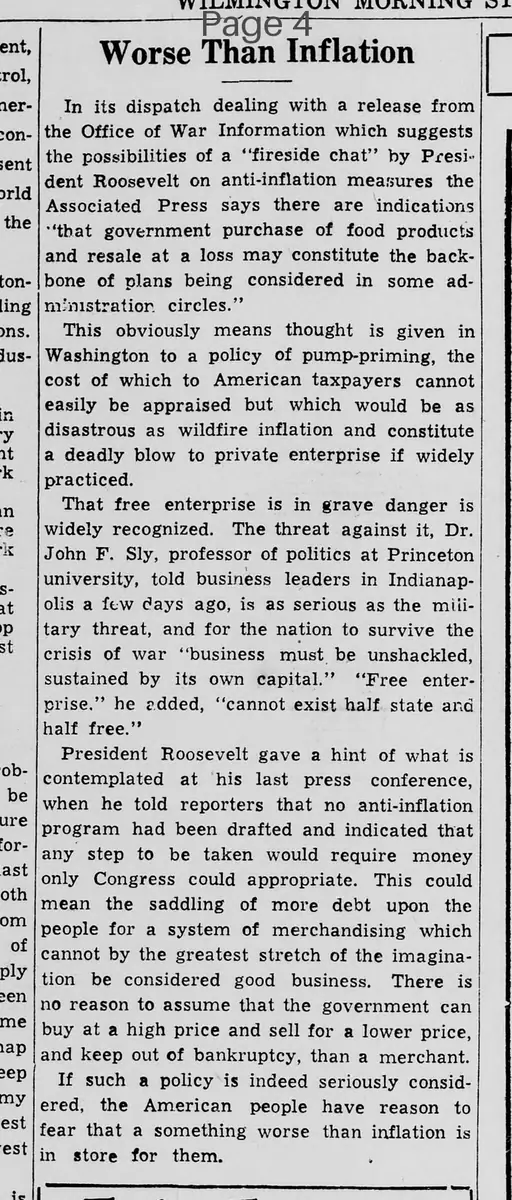
Worse Than Inflation
In its dispatch dealing with a release from the Office of War Information which suggests the possibilities of a fireside chat by President Roosevelt on anti-inflation measures the Associated Press says there are indications "that government purchase of food products and resale at a loss may constitute the backbone of plans being considered in some administration circles."
This obviously means thought is given in Washington to a policy of pump-priming, the cost of which to American taxpayers cannot easily be appraised but which would be as disastrous as wildfire inflation and constitute a deadly blow to private enterprise if widely practiced.
That free enterprise is in grave danger is widely recognized. The threat against it, Dr. John F. Sly, professor of politics at Princeton university, told business leaders in Indianapolis a few days ago, is as serious as the military threat, and for the nation to survive the crisis of war "business must be unshackled, sustained by its own capital." "Free enterprise," he added, "cannot exist half state and half free."
President Roosevelt gave a hint of what is contemplated at his last press conference, when he told reporters that no anti-inflation program had been drafted and indicated that any step to be taken would require money only Congress could appropriate. This could mean the saddling of more debt upon the people for a system of merchandising which cannot by the greatest stretch of the imagination be considered good business. There is no reason to assume that the government can buy at a high price and sell for a lower price, and keep out of bankruptcy, than a merchant.
If such a policy is indeed seriously considered, the American people have reason to fear that a something worse than inflation is in store for them.
In its dispatch dealing with a release from the Office of War Information which suggests the possibilities of a fireside chat by President Roosevelt on anti-inflation measures the Associated Press says there are indications "that government purchase of food products and resale at a loss may constitute the backbone of plans being considered in some administration circles."
This obviously means thought is given in Washington to a policy of pump-priming, the cost of which to American taxpayers cannot easily be appraised but which would be as disastrous as wildfire inflation and constitute a deadly blow to private enterprise if widely practiced.
That free enterprise is in grave danger is widely recognized. The threat against it, Dr. John F. Sly, professor of politics at Princeton university, told business leaders in Indianapolis a few days ago, is as serious as the military threat, and for the nation to survive the crisis of war "business must be unshackled, sustained by its own capital." "Free enterprise," he added, "cannot exist half state and half free."
President Roosevelt gave a hint of what is contemplated at his last press conference, when he told reporters that no anti-inflation program had been drafted and indicated that any step to be taken would require money only Congress could appropriate. This could mean the saddling of more debt upon the people for a system of merchandising which cannot by the greatest stretch of the imagination be considered good business. There is no reason to assume that the government can buy at a high price and sell for a lower price, and keep out of bankruptcy, than a merchant.
If such a policy is indeed seriously considered, the American people have reason to fear that a something worse than inflation is in store for them.
What sub-type of article is it?
Economic Policy
What keywords are associated?
Inflation
Free Enterprise
Government Intervention
Wartime Economy
Pump Priming
Roosevelt Administration
What entities or persons were involved?
President Roosevelt
Office Of War Information
Dr. John F. Sly
Princeton University
Associated Press
Editorial Details
Primary Topic
Criticism Of Proposed Government Anti Inflation Measures
Stance / Tone
Strongly Opposed To Government Intervention
Key Figures
President Roosevelt
Office Of War Information
Dr. John F. Sly
Princeton University
Associated Press
Key Arguments
Government Purchase Of Food And Resale At A Loss Would Be Pump Priming Disastrous To Taxpayers And Private Enterprise
Free Enterprise Is In Grave Danger Comparable To Military Threat
Business Must Be Unshackled And Sustained By Its Own Capital
Free Enterprise Cannot Exist Half State And Half Free
No Anti Inflation Program Drafted, But Steps Would Require Congressional Appropriation Leading To More Debt
Government Cannot Buy High And Sell Low Without Bankruptcy Like A Merchant
Such Policy Worse Than Inflation