Thank you for visiting SNEWPapers!
Sign up free
The New Hampshire Gazette
Portsmouth, Rockingham County, New Hampshire
What is this article about?
A man presents his steam-powered invention for artificially hatching chickens and ducks to the Lord Mayor in London, seeking endorsement for a 100-guinea reward from the Society of Arts. The Lord Mayor signs an affidavit after viewing the healthy birds, which lay eggs year-round.
Clipping
OCR Quality
Full Text
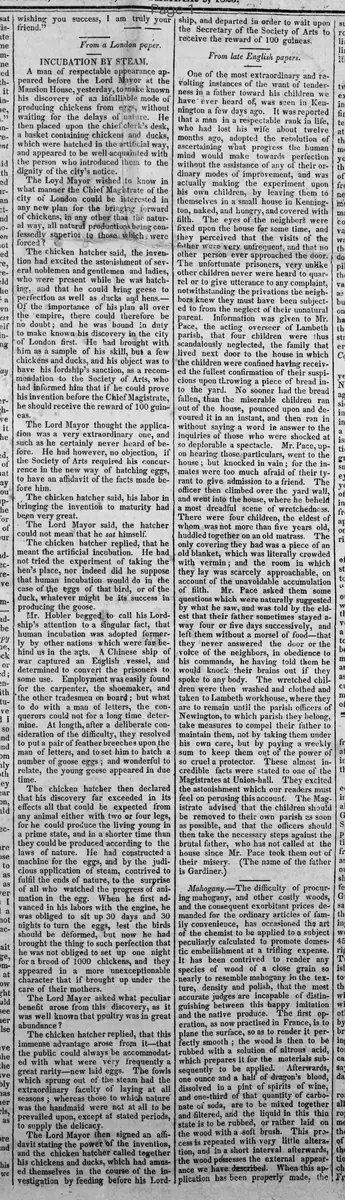
INCUBATION BY STEAM.
A man of respectable appearance appeared before the Lord Mayor at the Mansion House, yesterday, to make known his discovery of an infallible mode of producing chickens from eggs, without waiting for the delays of nature. He then placed upon the chief clerk's desk, a basket containing chickens and ducks, which were hatched in the artificial way, and appeared to be well acquainted with the person who introduced them to the dignity of the city's notice.
The Lord Mayor wished to know in what manner the Chief Magistrate of the city of London could be interested in any new plan for the bringing forward of chickens, in any other than the natural way, all natural productions being confessedly superior to those which were forced?
The chicken hatcher said, the invention had excited the astonishment of several noblemen and gentlemen and ladies, who were present while he was hatching, and that he could bring geese to perfection as well as ducks and hens.—Of the importance of his plan all over the empire, there could therefore be no doubt; and he was bound in duty to make known his discovery in the city of London first. He had brought with him as a sample of his skill, but a few chickens and ducks, and his object was to have his lordship's sanction, as a recommendation to the Society of Arts, who had informed him that if he could prove his invention before the Chief Magistrate, he should receive the reward of 100 guineas.
The Lord Mayor thought the application was a very extraordinary one, and such as he certainly never heard of before. He had however, no objection, if the Society of Arts required his concurrence in the new way of hatching eggs, to have an affidavit of the facts made before him.
The chicken hatcher said, his labor in bringing the invention to maturity had been very great.
The Lord Mayor said, the hatcher could not mean that he sat himself.
The chicken hatcher replied, that he meant the artificial incubation. He had not tried the experiment of taking the hen's place, nor indeed did he suppose that human incubation would do in the case of the eggs of that bird, or of the duck, whatever might be its success in producing the goose.
Mr. Hobler begged to call his Lordship's attention to a singular fact, that human incubation was adopted formerly by other nations which were far behind us in the arts. A Chinese ship of war captured an English vessel, and determined to convert the prisoners to some use. Employment was easily found for the carpenter, the shoemaker, and the other tradesmen on board; but what to do with a man of letters, the conquerors could not for a long time determine. At length, after a deliberate consideration of the difficulty, they resolved to put a pair of feather breeches upon the man of letters, and to set him to hatch a number of goose eggs; and wonderful to relate, the young geese appeared in due time.
The chicken hatcher then declared that his discovery far exceeded in its effects all that could be expected from any animal either with two or four legs, for he could produce the living young in a prime state, and in a shorter time than they could be produced according to the laws of nature. He had constructed a machine for the eggs, and by the judicious application of steam, contrived to fulfil the ends of nature, to the surprise of all who watched the progress of animation in the egg. When he first advanced in his labors with the engine, he was obliged to sit up 30 days and 30 nights to turn the eggs, lest the birds should be deformed, but now he had brought the thing to such perfection that he was not obliged to set up one night for a brood of 1000 chickens, and they appeared in a more unexceptionable character that if brought up under the care of their mothers.
The Lord Mayor asked what peculiar benefit arose from this discovery, as it was well known that poultry was in great abundance?
The chicken hatcher replied, that this immense advantage arose from it—that the public could always be accommodated with what were very frequently a great rarity—new laid eggs. The fowls which sprung out of the steam had the extraordinary faculty of laying at all seasons; whereas those to which nature was the handmaid were not at all to be prevailed upon, except at stated periods, to supply the delicacy.
The Lord Mayor then signed an affidavit stating the power of the invention, and the chicken hatcher called together his chickens and ducks, which had amused themselves in the course of the investigation by feeding before his Lordship, and departed in order to wait upon the Secretary of the Society of Arts to receive the reward of 100 guineas.
What sub-type of article is it?
What themes does it cover?
What keywords are associated?
What entities or persons were involved?
Where did it happen?
Story Details
Key Persons
Location
Mansion House, London
Event Date
Yesterday
Story Details
An inventor demonstrates steam-based artificial incubation of eggs to the Lord Mayor, producing healthy chickens and ducks that lay year-round. After witty exchanges including a tale of human incubation by Chinese captors, the Lord Mayor endorses the invention via affidavit for a Society of Arts reward.