Thank you for visiting SNEWPapers!
Sign up free
Albuquerque Morning Journal
Albuquerque, Bernalillo County, New Mexico
What is this article about?
Historical overview of the Honorable Corps of Gentlemen at Arms, founded by Henry VIII in 1509, detailing its origins, key figures, military involvements from the Battle of the Spurs to the 1848 Chartist threat, and evolution from military to ceremonial role.
Clipping
OCR Quality
Full Text
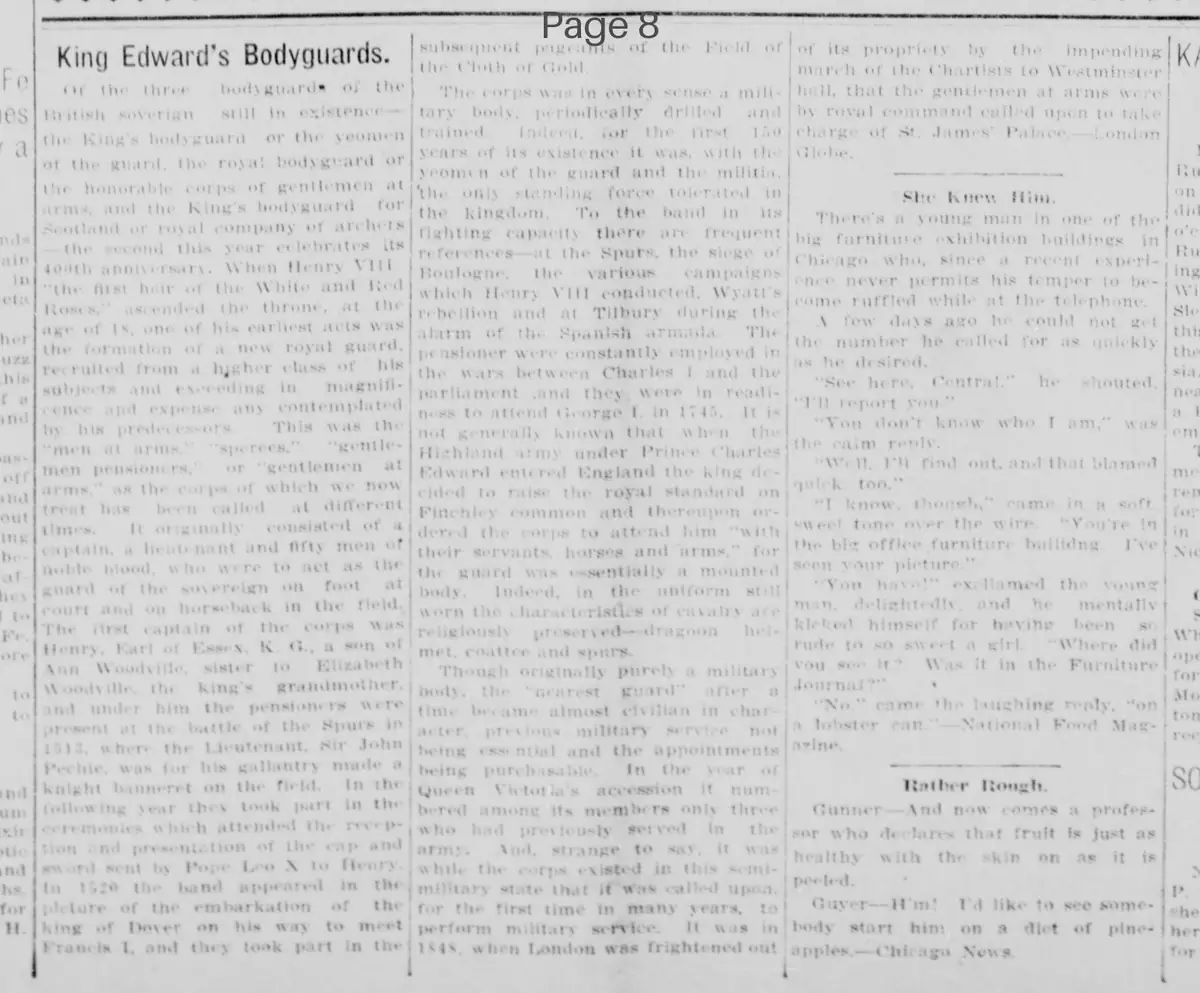
Of the three bodies still in existence on the throne of the British sovereign: the King's bodyguard or the Yeomen of the Guard, the royal bodyguard or the Honorable Corps of Gentlemen at Arms, and the King's bodyguard for Scotland or Royal Company of Archers.
The one which has this distinction celebrates its fourth centenary. When Henry VIII ascended the throne at the age of 18, one of his earliest acts was the commission of a new royal guard recruited from a higher class of his subjects and exceeding in magnificence and expense any contemplated in his predecessors. This was the
Men at Arms,
Gentlemen Pensioners or Gentlemen at Arms, as the force has been called at different times. It originally consisted of a captain, a lieutenant, and fifty men of noble blood who were to act as the guard of the sovereign on foot at court, on horseback in the field.
The first captain of the corps was Henry Patt, Esq. K.G., a son of Ann Washitle, sister to Elizabeth Washitle, the king's grandmother, and under him the pensioners were created of the Battle of the Spurs in 1513, and the lieutenant, Sir John Pelham, was for his gallantry made a knight banneret on the field. In the following year they took part in the ceremonies which attended the expedition and presentation of the cap and sword to Henry VIII by Pope Leo X. In 1520 the band appeared in the picture of the embarkation of the king of England on his way to meet Francis I, and they took part in the
Field of the Cloth of Gold.
The corps has been a closely drilled and trained military body during the years of its existence. It was, with the connection of the guard and the militia, the only standing force tolerated in the kingdom. To the band in its fighting capacity there are frequent references at the siege of
Boulogne, the various campaigns which Henry VIII conducted, and at Tilbury during the alarm of the Spanish Armada. The pensioners were constantly employed during the wars between Charles I and the Parliament, and they were in attendance on the scaffold of Charles I in 1649. It is so generally shown that when the Highland army under Prince Charles Edward invaded England, the king decided to raise the royal standard on Finchley Common, and the Gentlemen at Arms were to attend him with their servants, horses, and arms, for the guard was essentially a mounted body. In the uniform still worn, the characteristics of every age are religiously preserved—harness, and tasse, and spurs.
Though originally purely a military body, the
corps became
almost civilian in character, present military duties not
being essential, and the appointments have been political. In the year of
Queen Victoria's accession it numbered among its members only three who had previously served in the army. And, strange to say, it was while the corps existed in this semi-
military state that it was called upon for the first time in many years to perform military service. It was in 1848, when London was threatened
by the impending march of the Chartists to Westminster Hall, that the Gentlemen at Arms were by royal command called upon to take charge of St. James Palace and
ilode
What sub-type of article is it?
What themes does it cover?
What keywords are associated?
What entities or persons were involved?
Where did it happen?
Story Details
Key Persons
Location
England, London, St. James Palace
Event Date
When Henry Viii Ascended The Throne At The Age Of 18 (1509), Fourth Centenary (1909), Events To 1848
Story Details
The Honorable Corps of Gentlemen at Arms, founded by Henry VIII in 1509 as a prestigious royal guard, participated in key historical events including the Battle of the Spurs (1513), Field of the Cloth of Gold (1520), Spanish Armada defense (1588), Civil Wars, and Charles I's execution (1649); evolved to ceremonial role but mobilized in 1848 against Chartists.