Thank you for visiting SNEWPapers!
Sign up free
Jenks' Portland Gazette. Maine Advertiser
Portland, Cumberland County, Maine
What is this article about?
Article from New-York Herald, datelined Boston Dec. 24, defends U.S. trade policies against British countervailing duties, arguing they favor American commerce with an annual balance of about $382,657 in U.S. benefit. Discusses impacts on shipping, tonnage, and labor costs.
Clipping
OCR Quality
Full Text
Boston, Dec. 24.
From the New-York Herald.
No. III. President's Message.
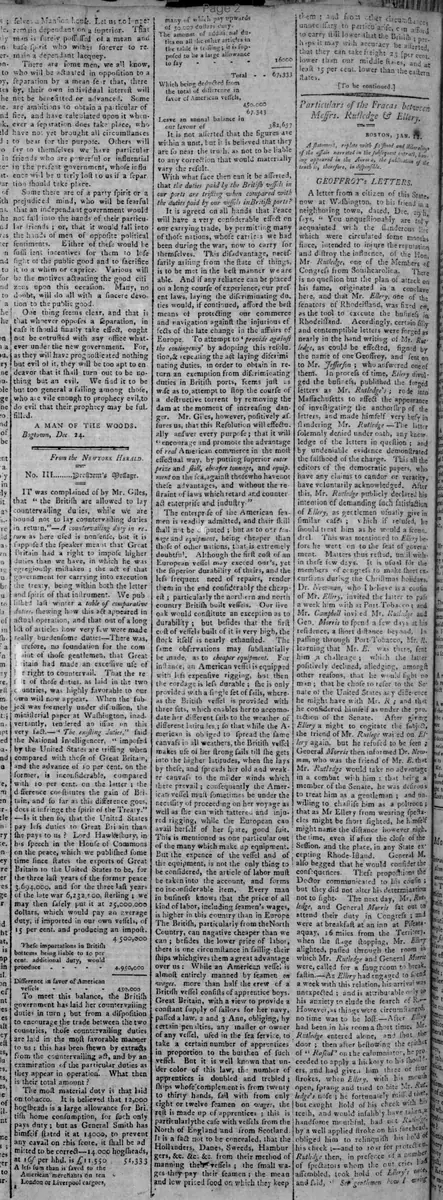
It was complained of by Mr. Giles, that "the British are allowed to lay countervailing duties, while we are bound not to lay countervailing duties in return."—A countervailing duty in return as here used is nonsense, but it is supposed the speaker meant that Great Britain had a right to impose higher duties than we have, in which he was egregiously mistaken; the act of that government for carrying into execution the treaty, being within both the letter and spirit of that instrument. We published last winter a table of comparative duties, showing how this act appeared in actual operation, and that out of a long list of articles how very few were made really burdensome duties—There was, therefore, no foundation for the complaint of those gentlemen, that Great Britain had made an excessive use of her right to countervail. That the result of those duties, as laid in the two countries, was highly favorable to our own will now appear. When the subject was formerly under discussion, the ministerial paper at Washington, inadvertently, tendered an issue on this very act.—"The existing duties," said the National Intelligencer, "imposed by the United States are trifling when compared with those of Great Britain, and the advance of 10 per cent. on the former, is inconsiderable, compared with 10 per cent. on the latter: the difference constitutes the gain of Britain, and so far as this difference goes, does it infringe the spirit of the Treaty."
—Is it then so, that the United States pay less duties to Great Britain than she pays to us? Lord Hawkesbury, in his speech in the House of Commons on the peace, which we published some time since states the exports of Great Britain to the United States to be, for the three last years of the former peace 3,694,000, and for the three last years of the late war 6,232,000, sterling: we may then safely put it at 2,500,000 dollars, which would pay an average duty, if imported in our own vessels, of 15 per cent. and producing an import 3,750,000.
These importations in British bottoms being liable to 10 per cent. additional duty, would produce 4,125,000.
Difference in favor of American vessels 375,000.
To meet this balance, the British government has laid her countervailing duties in turn; but from a disposition to encourage the trade between the two countries, those countervailing duties are laid in the most favorable manner to us; this has been shown by extracts from the countervailing act, and by an examination of the particular duties as they appear in operation. What then is their total amount?
The most material duty is that laid on tobacco. It is believed that 12,000 hogsheads is a large allowance for British home consumption, for such only pays duty; but as General Smith has himself stated it at 14,000, to prevent any cavil on this score, it shall be admitted to be correct—14,000 hogsheads, at 16s per hhd. is 11,200.
A less sum than is saved to the American merchants on ten London or Liverpool cargoes, many of which pay upwards of 50,000 dollars duty.
The amount of additional duties on all the other articles in the table is trifling: it is supposed to be a large allowance in any 16,000.
Total. 67,200.
Which being deducted from the total of difference in favor of American vessels, 450,000 382,800.
Leave an annual balance in our favour of 382,657.
It is not asserted that the figures are within a unit, but it is believed that they are so near the truth, as not to be liable to any correction that would materially vary the result.
With what face then can it be asserted, that the duties paid by the British vessels in our ports are trifling when compared with the duties paid by our vessels in British ports?
It is agreed on all hands that Peace will have a very considerable effect on our carrying trade, by permitting many of those nations, whose carriers we had been during the war, now to carry for themselves. This disadvantage, necessarily arising from the state of things, is to be met in the best manner we are able. And if any reliance can be placed on a long course of experience, our present laws, laying the discriminating duties would, if continued, afford the best means of protecting our commerce and navigation against the injurious effects of the late change in the affairs of Europe. To attempt to provide against the contingency' by adopting this resolution, & repealing the act laying discriminating duties, in order to obtain in return an exemption from discriminating duties in British ports, seems just as wise as to,attempt to stop the course of a destructive torrent by removing the dam at the moment of increasing danger. Mr. Giles, however, positively assures us, that this Resolution will effectually answer every purpose: that it will "encourage and promote the advantage of real American commerce in the most effectual way, by putting superior enterprise and skill, cheaper tonnage, and equipment on the sea,against those who have not these advantages, and without the restraint of laws which retard and counter-act enterprise and industry."
The enterprise of the American seamen is readily admitted, and their skill shall not be disputed: but as to our tonnage and equipment, being cheaper than those of other nations, that is extremely doubtful. Although the first cost of an European vessel may exceed ours, yet the superior durability of theirs, and the less frequent need of repairs, render them in the end considerably the cheapest: particularly the northern and north country British built vessels. Our live oak would constitute an exception as to durability; but besides that the first cost of vessels built of it is very high, the stock itself is nearly exhausted. The same observations may substantially be made, as to cheaper equipment. For instance, an American vessel is equipped with less expensive rigging, but then the cordage is less durable; she is only provided with a single set of sails, whereas the British vessel is provided with three sets, which enables her to accommodate her different sails to the weather of different latitudes.; so that while the American is obliged to spread the same canvas in all weathers, the British vessel makes use of her strong sails till she gets into the higher latitudes, when she lays by these, and spreads her old and weaker canvas to the milder winds which there prevail: consequently the American vessel must sometimes be under the necessity of proceeding on her voyage as well as she can with tattered and injured rigging, while the European can avail herself of her spare, good suit.
This is mentioned as one particular out of the many which make up equipment. But the expence of the vessel and of the equipment, is not the only thing to be considered, the article of labor must be taken into the account, and forms no inconsiderable item, Every man in business knows that the price of all kind of labor, including seamen's wages, is higher in this country than in Europe. The British, particularly from the North Country, can navigate cheaper than we can: besides the lower price of labor, there is one circumstance in manning their ships which gives them a great advantage over us: While an American vessel is almost entirely manned by seamen on wages, more than half the crew of a British vessel consists of apprentice boys.
Great Britain, with a view to provide a constant supply of sailors for her navy, passed a law, 2 and 3 Ann, obliging, by certain penalties, any master or owner of any vessel, used in the sea service, to take a certain number of apprentices in proportion to the burthen of such vessel. But it is well known that under color of this law, the number of apprentices is doubled and trebled; ships whose complement is from twenty to thirty hands, sail with from only eight or twelve seamen on wages, the rest is made up of apprentices ; this is particularly the case with vessels from the North of England and from Scotland.
It is a fact not to be concealed, that the Hollanders. Danes, Swedes, Hamburgers, &c. &c. &c. from their method of manning their vessels ; the small wages—they pay their seamen : the mean and low priced food on which they keep them ; and from other circumstances unnecessary to particularize, can afford to carry still lower than the British ; per-haps it may with accuracy be asserted, that they can take freight 25 per cent. lower than our middle states, and at least 15 per cent. lower than the eastern states.
[To be continued.]
What sub-type of article is it?
What keywords are associated?
What entities or persons were involved?
Where did it happen?
Domestic News Details
Primary Location
Boston
Event Date
Dec. 24.
Key Persons
Outcome
annual balance in favor of u.s. commerce estimated at 382,657 dollars after countervailing duties.
Event Details
Article critiques complaints about British countervailing duties on U.S. goods, presents calculations showing U.S. advantage in trade duties, discusses impacts of peace on carrying trade, and argues for retaining discriminating duties to protect American shipping against European competitors, including comparisons of vessel costs, equipment, and labor.