Thank you for visiting SNEWPapers!
Sign up free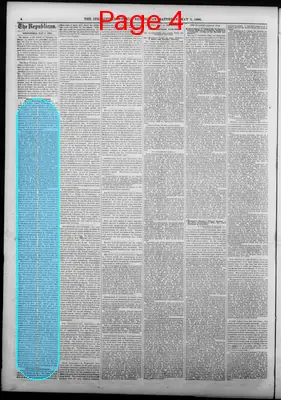
Editorial
May 5, 1866
Springfield Weekly Republican
Springfield, Hampden County, Massachusetts
What is this article about?
Editorial supports Sen. Sumner's call for delaying action on the joint committee's reconstruction plan, criticizing its lack of equal suffrage guarantees and harsh disfranchisement measures. Advocates for better consideration of voting rights and representation basis before Southern readmission. Mentions Fessenden's debate remarks.
Clipping

OCR Quality
98%
Excellent
Full Text
Better Wait than Do Worse.
In the Senate debate, Wednesday, on the scheme of the joint committee, Mr. Dixon of Connecticut reproached Mr. Sumner with having forgotten his own words in denunciation of the proposed Blaine amendment to the constitution, the repetition of which, he said, was the only guaranty for equal suffrage in the committee's scheme. Mr. Sumner denied that he had forgotten, and intimated that he should decidedly oppose the scheme of the committee, because of its omission of the chief guaranty needed. Mr. Sumner said his present purpose was to obtain delay in action on the subject:—
"I do not believe that Congress at this moment is in a condition to give the country the best proposition on this question. I am afraid that excellent committee has listened too much to the voices from without, insisting that there must be an issue presented to the country. For myself I have always thought that call was premature. There is no occasion now for an issue to be presented. There are no elections now pending in any of the states. The election in Connecticut is over; the election in New Hampshire is over: there are to be no elections before next autumn. And what is the occasion now for an issue to be presented to the country. I see none, unless Congress, after the most mature and careful discussion of the whole subject, is about to present an issue in which we can all honestly, and as one phalanx, go forward to battle. Now, sir, I do not intend to be drawn into any premature discussion of the issue presented by the report of the committee on reconstruction. I merely speak now to the question of time. I am sure that that report could not have been made in the last week of March, and I am equally sure that if the committee had postponed that report until the last week of May they would have made a better one than they have made in the last week of April. I hope, therefore, following out that idea, that the decision of this question will be postponed as far as possible, to the end that all just influences may be allowed to come to Congress from the country, and that Congress itself may be inspired by the fullest and amplest consideration of the whole question."
With this view of the matter we agree in the main with Mr. Sumner. The people have been impatient for the production of some definite plan by Congress, but now that we have the plan the general feeling is that it is either too late or too early, or so crude and impossible in itself that no plan at all would have been better. Yet it was the intention of the committee to force this scheme through Congress by stress of party discipline, and the experiment will be tried next week. It ought to fail. If the scheme cannot be essentially modified, or rejected altogether, action upon it ought at least to be deferred. And since delay is the real object of the scheme, why not let things drift on as they are? It will make the political situation vastly easier and more hopeful than to attempt to carry the lead of the committee's scheme. The country can be told with some show of reason that Congress has the responsibility of completing the work of reconstruction, and thus has the right to take time to do the work in the safest and best way. If we cannot give reasons for delay, we can at least assume that Congress does not delay to act without cause. And indeed the mere fact that such a report has been presented as is now before the country demonstrates that Congress is not ready for final action on the subject. Better that it should wait six months or a year longer than throw such an issue into the elections. By all means let Congress take all the time it needs. The people will be patient.
Meanwhile it will be well carefully to go over the ground again and inquire precisely what we do need in the way of guaranties before the southern states shall be permitted to renew their relations with the government. Whatever can be shown to be necessary we have the power to exact. The liberty and civil rights of the freedmen are now as fully secured as they can be by any governmental machinery. For security against future machinations of the authors of the rebellion, the bill to exclude them from office under the general government is right and proper. Some think it includes too many, and that certain exceptions should be made, but in scope and purpose the bill is right and ought to pass. The disfranchisement of all connected with the rebellion until 1870 is a very harsh measure, and would be unjust to the masses of the South, who are disposed to be loyal, and should be encouraged in their loyalty rather than repelled. It is impossible to doubt that so proscriptive a measure would irritate the southern people and increase the disaffection towards the government, and the result would be that at the expiration of the four years the South would be more unfit for restoration than now. To unite just severity towards the rebel leaders a conciliatory disposition towards the misled people is so clearly the true policy that we are astonished that the committee should have proposed universal disfranchisement—a punishment not before so much as suggested since the close of the war. In truth the only further guarantee really needed is the establishment of equal suffrage in national elections; or, if Congress has not the courage to propose that to the country, then the establishment of the voting population as the basis of representation, so that the South may not retain power through the citizens it disfranchises. This at least the South should yield in justice, and the states now holding the power should require it. If Congress will devote itself to the consideration of this vital point, and find the legitimate method for accomplishing it, they will not only do what the people desire and expect, and what the country needs, but they will have prepared a better "issue for the fall elections," than if they make the getting up of such an issue their prime object.
Senator Fessenden's small pox did not take all the bad blood out of him. He pitted himself against the newspapers in the reconstruction debate on Wednesday, and sneeringly said the committee ought to know more about the subject
In the Senate debate, Wednesday, on the scheme of the joint committee, Mr. Dixon of Connecticut reproached Mr. Sumner with having forgotten his own words in denunciation of the proposed Blaine amendment to the constitution, the repetition of which, he said, was the only guaranty for equal suffrage in the committee's scheme. Mr. Sumner denied that he had forgotten, and intimated that he should decidedly oppose the scheme of the committee, because of its omission of the chief guaranty needed. Mr. Sumner said his present purpose was to obtain delay in action on the subject:—
"I do not believe that Congress at this moment is in a condition to give the country the best proposition on this question. I am afraid that excellent committee has listened too much to the voices from without, insisting that there must be an issue presented to the country. For myself I have always thought that call was premature. There is no occasion now for an issue to be presented. There are no elections now pending in any of the states. The election in Connecticut is over; the election in New Hampshire is over: there are to be no elections before next autumn. And what is the occasion now for an issue to be presented to the country. I see none, unless Congress, after the most mature and careful discussion of the whole subject, is about to present an issue in which we can all honestly, and as one phalanx, go forward to battle. Now, sir, I do not intend to be drawn into any premature discussion of the issue presented by the report of the committee on reconstruction. I merely speak now to the question of time. I am sure that that report could not have been made in the last week of March, and I am equally sure that if the committee had postponed that report until the last week of May they would have made a better one than they have made in the last week of April. I hope, therefore, following out that idea, that the decision of this question will be postponed as far as possible, to the end that all just influences may be allowed to come to Congress from the country, and that Congress itself may be inspired by the fullest and amplest consideration of the whole question."
With this view of the matter we agree in the main with Mr. Sumner. The people have been impatient for the production of some definite plan by Congress, but now that we have the plan the general feeling is that it is either too late or too early, or so crude and impossible in itself that no plan at all would have been better. Yet it was the intention of the committee to force this scheme through Congress by stress of party discipline, and the experiment will be tried next week. It ought to fail. If the scheme cannot be essentially modified, or rejected altogether, action upon it ought at least to be deferred. And since delay is the real object of the scheme, why not let things drift on as they are? It will make the political situation vastly easier and more hopeful than to attempt to carry the lead of the committee's scheme. The country can be told with some show of reason that Congress has the responsibility of completing the work of reconstruction, and thus has the right to take time to do the work in the safest and best way. If we cannot give reasons for delay, we can at least assume that Congress does not delay to act without cause. And indeed the mere fact that such a report has been presented as is now before the country demonstrates that Congress is not ready for final action on the subject. Better that it should wait six months or a year longer than throw such an issue into the elections. By all means let Congress take all the time it needs. The people will be patient.
Meanwhile it will be well carefully to go over the ground again and inquire precisely what we do need in the way of guaranties before the southern states shall be permitted to renew their relations with the government. Whatever can be shown to be necessary we have the power to exact. The liberty and civil rights of the freedmen are now as fully secured as they can be by any governmental machinery. For security against future machinations of the authors of the rebellion, the bill to exclude them from office under the general government is right and proper. Some think it includes too many, and that certain exceptions should be made, but in scope and purpose the bill is right and ought to pass. The disfranchisement of all connected with the rebellion until 1870 is a very harsh measure, and would be unjust to the masses of the South, who are disposed to be loyal, and should be encouraged in their loyalty rather than repelled. It is impossible to doubt that so proscriptive a measure would irritate the southern people and increase the disaffection towards the government, and the result would be that at the expiration of the four years the South would be more unfit for restoration than now. To unite just severity towards the rebel leaders a conciliatory disposition towards the misled people is so clearly the true policy that we are astonished that the committee should have proposed universal disfranchisement—a punishment not before so much as suggested since the close of the war. In truth the only further guarantee really needed is the establishment of equal suffrage in national elections; or, if Congress has not the courage to propose that to the country, then the establishment of the voting population as the basis of representation, so that the South may not retain power through the citizens it disfranchises. This at least the South should yield in justice, and the states now holding the power should require it. If Congress will devote itself to the consideration of this vital point, and find the legitimate method for accomplishing it, they will not only do what the people desire and expect, and what the country needs, but they will have prepared a better "issue for the fall elections," than if they make the getting up of such an issue their prime object.
Senator Fessenden's small pox did not take all the bad blood out of him. He pitted himself against the newspapers in the reconstruction debate on Wednesday, and sneeringly said the committee ought to know more about the subject
What sub-type of article is it?
Suffrage
Constitutional
Partisan Politics
What keywords are associated?
Reconstruction
Equal Suffrage
Delay
Congress
Senate Debate
Disfranchisement
Southern States
Blaine Amendment
What entities or persons were involved?
Mr. Sumner
Mr. Dixon Of Connecticut
Joint Committee
Blaine Amendment
Senator Fessenden
Congress
Southern States
Editorial Details
Primary Topic
Delay In Reconstruction Legislation And Equal Suffrage Guarantees
Stance / Tone
Support For Delay And Modification Of Committee's Scheme
Key Figures
Mr. Sumner
Mr. Dixon Of Connecticut
Joint Committee
Blaine Amendment
Senator Fessenden
Congress
Southern States
Key Arguments
Congress Is Not Ready For Best Proposition On Reconstruction
Delay Allows Fuller Consideration And Better Plan
No Immediate Elections Necessitate Premature Issue
Committee's Scheme Lacks Equal Suffrage Guaranty
Universal Disfranchisement Until 1870 Is Harsh And Counterproductive
Encourage Loyalty In Southern Masses With Conciliation
Establish Equal Suffrage Or Voting Based Representation
Exclude Rebel Leaders From Office But Not Broadly Proscribe
Better To Wait Than Force Crude Plan Through Party Discipline
People Will Be Patient With Delay For Proper Reconstruction