Thank you for visiting SNEWPapers!
Sign up free
Story
April 11, 1842
Daily Cincinnati Republican
Cincinnati, Hamilton County, Ohio
What is this article about?
Professor Olmsted of Yale College observes Encke's Comet, visible again since 1829, through a telescope on the evening of the 28th, describing its round shape, brightness surpassing Sirius, and position south of stars in Taurus and Gemini.
Clipping
OCR Quality
95%
Excellent
Full Text
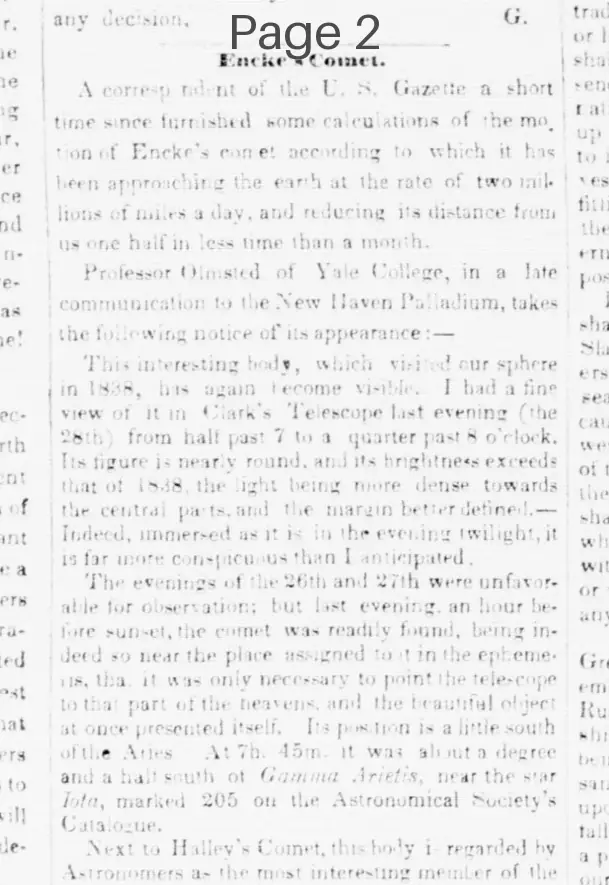
Encke's Comet.
A correspondent of the U. S. Gazette a short time since furnished some calculations of the motions of Encke's comet according to which it has been approaching the earth at the rate of two millions of miles a day, and reducing its distance from us one half in less time than a month. Professor Olmsted of Yale College, in a late communication to the New Haven Palladium, takes the following notice of its appearance—
This interesting body, which visited our sphere in 1829, has again become visible. I had a fine view of it in Mark's telescope last evening (the 28th) from half past 7 to a quarter past 8 o'clock. Its figure is nearly round, and its brightness exceeds that of Sirius the light being more intense towards the central part, and the margin better defined—Indeed, immersed as it is in the evening twilight, it is far more eligible to us than I anticipated. The evenings of the 27th and 28th were unfavorable for observation: but last evening, an hour before sunset, the comet was readily found, being indeed so near the place assigned to it on the ephemeris, that it was only necessary to point the telescope to that part of the heavens about the triangle of Aries and it at once presented itself. Its place is a little south of the star 5 Tauri, and it was about a degree and a half south of 70 Geminorum, according to the Astronomical Society's Catalogue.
A correspondent of the U. S. Gazette a short time since furnished some calculations of the motions of Encke's comet according to which it has been approaching the earth at the rate of two millions of miles a day, and reducing its distance from us one half in less time than a month. Professor Olmsted of Yale College, in a late communication to the New Haven Palladium, takes the following notice of its appearance—
This interesting body, which visited our sphere in 1829, has again become visible. I had a fine view of it in Mark's telescope last evening (the 28th) from half past 7 to a quarter past 8 o'clock. Its figure is nearly round, and its brightness exceeds that of Sirius the light being more intense towards the central part, and the margin better defined—Indeed, immersed as it is in the evening twilight, it is far more eligible to us than I anticipated. The evenings of the 27th and 28th were unfavorable for observation: but last evening, an hour before sunset, the comet was readily found, being indeed so near the place assigned to it on the ephemeris, that it was only necessary to point the telescope to that part of the heavens about the triangle of Aries and it at once presented itself. Its place is a little south of the star 5 Tauri, and it was about a degree and a half south of 70 Geminorum, according to the Astronomical Society's Catalogue.
What sub-type of article is it?
Curiosity
Extraordinary Event
What themes does it cover?
Nature
What keywords are associated?
Encke's Comet
Astronomical Observation
Professor Olmsted
Yale College
New Haven Palladium
What entities or persons were involved?
Professor Olmsted
Where did it happen?
New Haven
Story Details
Key Persons
Professor Olmsted
Location
New Haven
Event Date
Evenings Of The 27th And 28th
Story Details
Encke's Comet, previously visible in 1829, is observed again; Professor Olmsted views it through Mark's telescope on the 28th, noting its round shape, intense central brightness exceeding Sirius, and position near the triangle of Aries, south of 5 Tauri and 70 Geminorum.