Thank you for visiting SNEWPapers!
Sign up free
Editorial
November 25, 1846
Morning Star
Limerick, York County, Maine
What is this article about?
Editorial criticizes racial prejudice in Boston churches against seating colored people equally, praises Rev. Noyes' stance, condemns anti-slavery hypocrisy, shares school experience showing minimal issues with integration, and urges overcoming prejudice through love and equality.
Clipping
OCR Quality
98%
Excellent
Full Text
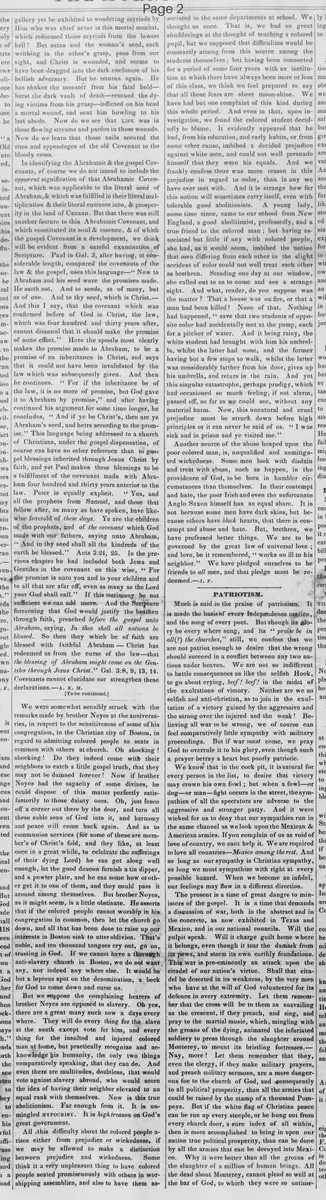
We were somewhat sensibly struck with the remarks made by brother Noyes at the anniversaries, in respect to the sensitiveness of some of his congregation, in the Christian city of Boston, in regard to admitting colored people to seats in common with others at church. Oh shocking! shocking! Do they indeed come with their neighbors to catch a little gospel truth, that they may not be damned forever! Now if brother Noyes had the sagacity of some divines, he could dispose of this matter perfectly satisfactorily to those dainty ones. Oh, just fence off a corner out there by the door, and turn all these sable sons of God into it, and harmony and peace will come back again. And as to communion services (for some of these are members of Christ's fold, and they like, at least once in a great while, to celebrate the sufferings of their dying Lord) he can get along well enough, let the good deacon furnish a tin dipper, and a pewter plate, and he can some how or other get it to one of them, and they could pass it around among themselves. But brother Noyes, as it might seem, is a little obstinate. He asserts that if the colored people cannot worship in his congregation in common, then let the church go down, and all that has been done to raise up our interests in Boston sink to utter oblivion. That's noble, and ten thousand tongues cry out, go on, trusting in God, If we cannot have a thorough anti-slavery church in Boston, we do not want any, nor indeed any where else. It would be but a leprous spot on the denomination, a beck for God to come down and curse us.
But we suppose the complaining hearers of brother Noyes are opposed to slavery. Oh yes, there are a great many such now a days everywhere. They will do every thing for the slave at the south except vote for him, and every thing for the insulted and injured colored man at home, but practically recognize and acknowledge his humanity, the only two things comparatively speaking, that they can do. And even there are multitudes, doubtless, that would vote against slavery abroad, who would scorn the idea of having their neighbor elevated to an equal rank with themselves. Now is this true abolitionism. Far enough from it. It is unmingled hypocrisy. It is high treason on God's great government.
All this difficulty about the colored people arises either from prejudice or wickedness, if we may be allowed to make a distinction between prejudice and wickedness. Some think it a very unpleasant thing to have colored people seated promiscuously with others in worshiping assemblies, and also to have them associated in the same departments at school. We thought so once. That is, we had no great shudderings at the thought of teaching a colored pupil, but we supposed that difficulties would be constantly arising from this source among the students themselves; but having been connected for a period of some four years with an institution at which there have always been more or less of this class, we think we feel prepared to say that all these fears are sheer moon-shine. We have had but one complaint of this kind during this whole period. And even in that, upon investigation, we found the colored student decidedly to blame. It evidently appeared that he had, from his education, and early habits, or from some other cause, imbibed a decided prejudice against white men, and could not well persuade himself that they were his equals. And we frankly confess there was more reason in this prejudice in regard to color, than in any we have ever met with. And it is strange how far this notion will sometimes carry itself, even with tolerable good abolitionists. A young lady, some time since, came to our school from New England, a good abolitionist, professedly, and a true friend to the colored man; but having associated but little if any with colored people, she had, as it would seem, imbibed the notion that men differing from each other in the slight accident of color could not well treat each other as brethren. Standing one day at our window, she called out to us to come and see a strange sight. And what, reader, do you suppose was the matter? That a house was on fire, or that a man had been killed? None of that. Nothing had happened, save that two students of opposite color had accidentally met at the pump, each for a pitcher of water. And it being rainy, the white student had brought with him his umbrella, whilst the latter had none, and the former having but a few steps to walk, whilst the latter was considerably farther from his door, gives up his umbrella, and returns in the rain. And yet this singular catastrophe, perhaps prodigy, which had occasioned so much feeling, if not alarm, passed off, so far as we could see, without any material harm. Now, this unnatural and cruel prejudice must be struck down before high principles or it can never be said of us. "I was sick and in prison and ye visited me."
Another source of the abuse heaped upon the poor colored man, is, unqualified and unmitigated wickedness. Some men look with disdain and treat with abuse, such as happen, in the providence of God, to be born in humbler circumstances than themselves. In their contempt and hate, the poor Irish and even the unfortunate Anglo Saxon himself has an equal share. It is not because some men have dark skins, but because others have black hearts, that there is contempt and abuse and hate. But, brethren, we have professed better things. We are to be governed by the great law of universal love; and love, be it remembered, "works no ill to his neighbor." We have pledged ourselves to be friends to all men, and that pledge must be redeemed.—J. F.
But we suppose the complaining hearers of brother Noyes are opposed to slavery. Oh yes, there are a great many such now a days everywhere. They will do every thing for the slave at the south except vote for him, and every thing for the insulted and injured colored man at home, but practically recognize and acknowledge his humanity, the only two things comparatively speaking, that they can do. And even there are multitudes, doubtless, that would vote against slavery abroad, who would scorn the idea of having their neighbor elevated to an equal rank with themselves. Now is this true abolitionism. Far enough from it. It is unmingled hypocrisy. It is high treason on God's great government.
All this difficulty about the colored people arises either from prejudice or wickedness, if we may be allowed to make a distinction between prejudice and wickedness. Some think it a very unpleasant thing to have colored people seated promiscuously with others in worshiping assemblies, and also to have them associated in the same departments at school. We thought so once. That is, we had no great shudderings at the thought of teaching a colored pupil, but we supposed that difficulties would be constantly arising from this source among the students themselves; but having been connected for a period of some four years with an institution at which there have always been more or less of this class, we think we feel prepared to say that all these fears are sheer moon-shine. We have had but one complaint of this kind during this whole period. And even in that, upon investigation, we found the colored student decidedly to blame. It evidently appeared that he had, from his education, and early habits, or from some other cause, imbibed a decided prejudice against white men, and could not well persuade himself that they were his equals. And we frankly confess there was more reason in this prejudice in regard to color, than in any we have ever met with. And it is strange how far this notion will sometimes carry itself, even with tolerable good abolitionists. A young lady, some time since, came to our school from New England, a good abolitionist, professedly, and a true friend to the colored man; but having associated but little if any with colored people, she had, as it would seem, imbibed the notion that men differing from each other in the slight accident of color could not well treat each other as brethren. Standing one day at our window, she called out to us to come and see a strange sight. And what, reader, do you suppose was the matter? That a house was on fire, or that a man had been killed? None of that. Nothing had happened, save that two students of opposite color had accidentally met at the pump, each for a pitcher of water. And it being rainy, the white student had brought with him his umbrella, whilst the latter had none, and the former having but a few steps to walk, whilst the latter was considerably farther from his door, gives up his umbrella, and returns in the rain. And yet this singular catastrophe, perhaps prodigy, which had occasioned so much feeling, if not alarm, passed off, so far as we could see, without any material harm. Now, this unnatural and cruel prejudice must be struck down before high principles or it can never be said of us. "I was sick and in prison and ye visited me."
Another source of the abuse heaped upon the poor colored man, is, unqualified and unmitigated wickedness. Some men look with disdain and treat with abuse, such as happen, in the providence of God, to be born in humbler circumstances than themselves. In their contempt and hate, the poor Irish and even the unfortunate Anglo Saxon himself has an equal share. It is not because some men have dark skins, but because others have black hearts, that there is contempt and abuse and hate. But, brethren, we have professed better things. We are to be governed by the great law of universal love; and love, be it remembered, "works no ill to his neighbor." We have pledged ourselves to be friends to all men, and that pledge must be redeemed.—J. F.
What sub-type of article is it?
Slavery Abolition
Moral Or Religious
Social Reform
What keywords are associated?
Racial Prejudice
Church Integration
Anti Slavery Hypocrisy
School Desegregation
Universal Love
What entities or persons were involved?
Brother Noyes
Colored People
Boston Congregation
Editorial Details
Primary Topic
Racial Prejudice In Churches And Schools
Stance / Tone
Strongly Anti Prejudice And Pro Equality
Key Figures
Brother Noyes
Colored People
Boston Congregation
Key Arguments
Opposition To Segregating Colored People In Church Seating And Communion
Hypocrisy Of Anti Slavery Advocates Who Refuse Social Equality
Personal Experience Shows Integration In Schools Causes No Issues
Prejudice Stems From Either Ignorance Or Wickedness
True Christianity Requires Universal Love And Equality