Thank you for visiting SNEWPapers!
Sign up free
The Virginia Gazette
Richmond, Williamsburg, Richmond County, Virginia
What is this article about?
General Charles Lee writes to General John Burgoyne from Prospect Hill on December 1, 1775, urging him to convince Britain to rescind oppressive policies against the American colonies to prevent independence and preserve the empire.
Clipping
OCR Quality
Full Text
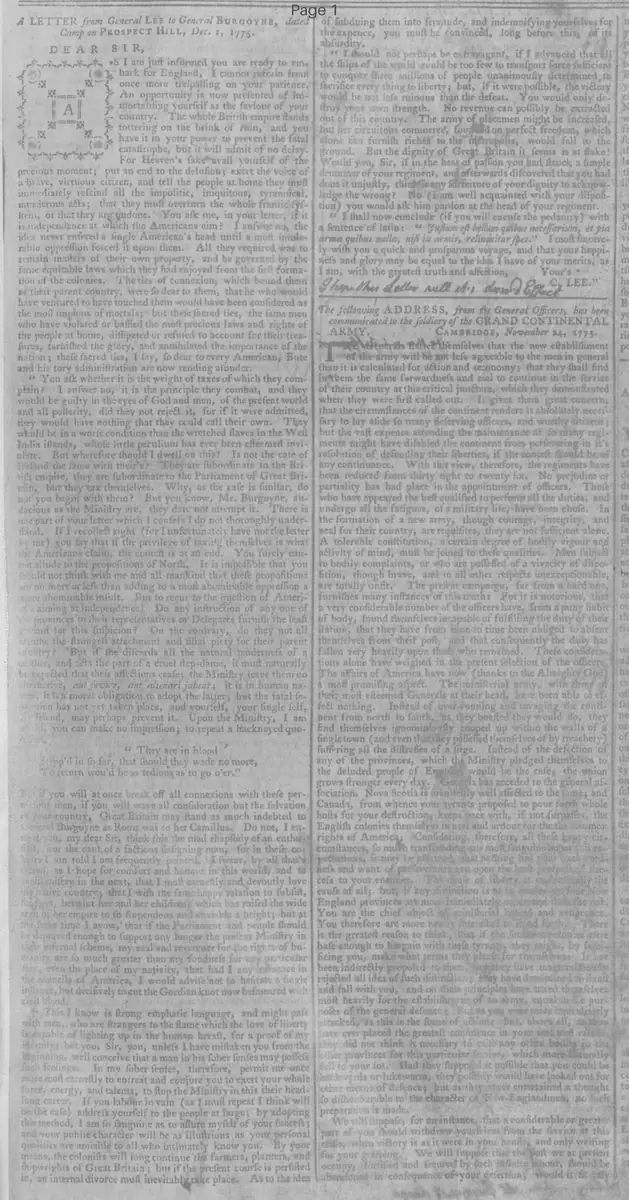
Camp on PROSPECT HILL, Dec. 1, 1775.
DEAR SIR,
I am just informed you are ready to embark for England, I cannot refrain from once more trespassing on your patience.
An opportunity is now presented of immortalizing yourself as the saviour of your country. The whole British empire stands tottering on the brink of ruin, and you have it in your power to prevent the fatal catastrophe, but it will admit of no delay.
For Heaven's sake avail yourself of the precious moment; put an end to the delusion; exert the voice of a brave, virtuous citizen, and tell the people at home they must immediately rescind all the impolitic, iniquitous, tyrannical, murderous acts; that they must overturn the whole frantic system, or that they are undone. You ask me, in your letter, if it is independence at which the Americans aim? I answer no; the idea never entered a single American's head until a most intolerable oppression forced it upon them. All they required was to remain masters of their own property, and be governed by the same equitable laws which they had enjoyed from the first formation of the colonies. The ties of connexion, which bound them to their parent country, were so dear to them, that he who would have ventured to have touched them would have been considered as the most impious of mortals; but these sacred ties, the same men who have violated or baffled the most precious laws and rights of the people at home, dissipated or refused to account for their treasures, tarnished the glory, and annihilated the importance of the nation; these sacred ties, I say, so dear to every American, Bute and his history administration are now rending asunder.
You ask whether it is the weight of taxes of which they complain? I answer no, it is the principle they combat, and they would be guilty in the eyes of God and men, of the present world and all posterity, did they not reject it, for if it were admitted, they would have nothing that they could call their own. They would be in a worse condition than the wretched slaves in the West India islands, whose little peculium has ever been esteemed inviolate. But wherefore should I dwell on this? Is not the case of Ireland the same with theirs? They are subordinate to the British empire, they are subordinate to the Parliament of Great Britain, but they tax themselves. Why, as the case is similar, do not you begin with them? But you know, Mr. Burgoyne, audacious as the Ministry are, they dare not attempt it. There is one part of your letter which I confess I do not thoroughly understand. If I recollect right (for I unfortunately have not the letter by me) you say that if the privilege of taxing themselves is what the Americans claim, the contest is at an end. You surely cannot allude to the propositions of North. It is impossible that you did not think with me and all mankind that these propositions were no more or less than adding to a most abominable oppression a more abominable insult. But to recur to the question of America aiming at independence! Do any instructions of any one of the provinces to their representatives or Delegates furnish the least ground for this suspicion? On the contrary, do they not all avow the strongest attachment and filial piety for their parent country?
But if she discards all the natural tenderness of a mother, and acts the part of a cruel step-dame, it must naturally be expected that their affections cease; the Ministry leave them no alternative, aut sufferre, aut alienari jubent; it is in human nature, it is a moral obligation to adopt the latter; but the fatal election has not yet taken place, and yourself, your single self, friend, may perhaps prevent it. Upon the Ministry, I am sure, you can make no impression; to repeat a hackneyed quotation:
"They are in blood
Stepp'd in so far, that should they wade no more,
Returning were as tedious as to go o'er."
If you will at once break off all connexions with these perjurers, if you will wave all consideration but the salvation of your country, Great Britain may stand as much indebted to Gen. Burgoyne as Rome was to her Camillus. Do not, I entreat you, my dear Sir, think this the mad rhapsody of an enthusiast, or the cant of a factious designing man, for in these countries I am told I am frequently painted. I swear, by all that's sacred, as I hope for comfort and honour in this world, and felicity in the next, that I most earnestly and devoutly love my native country; that I wish the same happy relation to subsist, betwixt her and her children which has raised the wide arch of her empire to so stupendous and enviable a height; but at the same time I avow, that if the Parliament and people should be depraved enough to support any longer the present Ministry in their infernal scheme, my zeal and reverence for the rights of humanity are so much greater than my fondness for any particular country, even the place of my nativity, that had I any influence in the councils of America, I would advise not to hesitate a single moment, but decisively to cut the Gordian knot now besmeared with civil blood.
This I know is strong emphatical language, and might pass with men, who are strangers to the flame which the love of liberty is capable of lighting up in the human breast, for a proof of my frenzy; but you, Sir, you, unless I have mistaken you from the beginning, well conceive that a man in his sober senses may possess such feelings. In my sober senses, therefore, permit me once more most earnestly to entreat and conjure you to exert your whole force, energy, and talents, to stop the Ministry in this their headlong career. If you labour in vain (as I must repeat I think will be the case) address yourself to the people at large; by adopting this method, I am so sanguine as to assure myself of your success; and your public character will be as illustrious as your personal qualities are amiable to all who intimately know you. By your means, the colonists will long continue the farmers, planters, and manufacturers of Great Britain; but if the present course is persisted in, an internal divorce must inevitably take place. As to the idea
What sub-type of article is it?
What keywords are associated?
What entities or persons were involved?
Where did it happen?
Domestic News Details
Primary Location
Camp On Prospect Hill
Event Date
Dec. 1, 1775
Key Persons
Event Details
General Lee writes to General Burgoyne, urging him to use his influence in England to convince the British to rescind oppressive policies against the American colonies, arguing that the colonists seek only to retain their rights and property under equitable laws, not independence, and warning of inevitable separation if the current course continues.