Thank you for visiting SNEWPapers!
Sign up free
Editorial
October 12, 1954
Atlanta Daily World
Atlanta, Fulton County, Georgia
What is this article about?
Editorial discusses ongoing drought's impact on crops and how farmers are adapting by irrigating fields with nearby creeks and ponds, echoing Mark Twain's quip on weather talk while praising proactive measures for water use.
Clipping
OCR Quality
100%
Excellent
Full Text
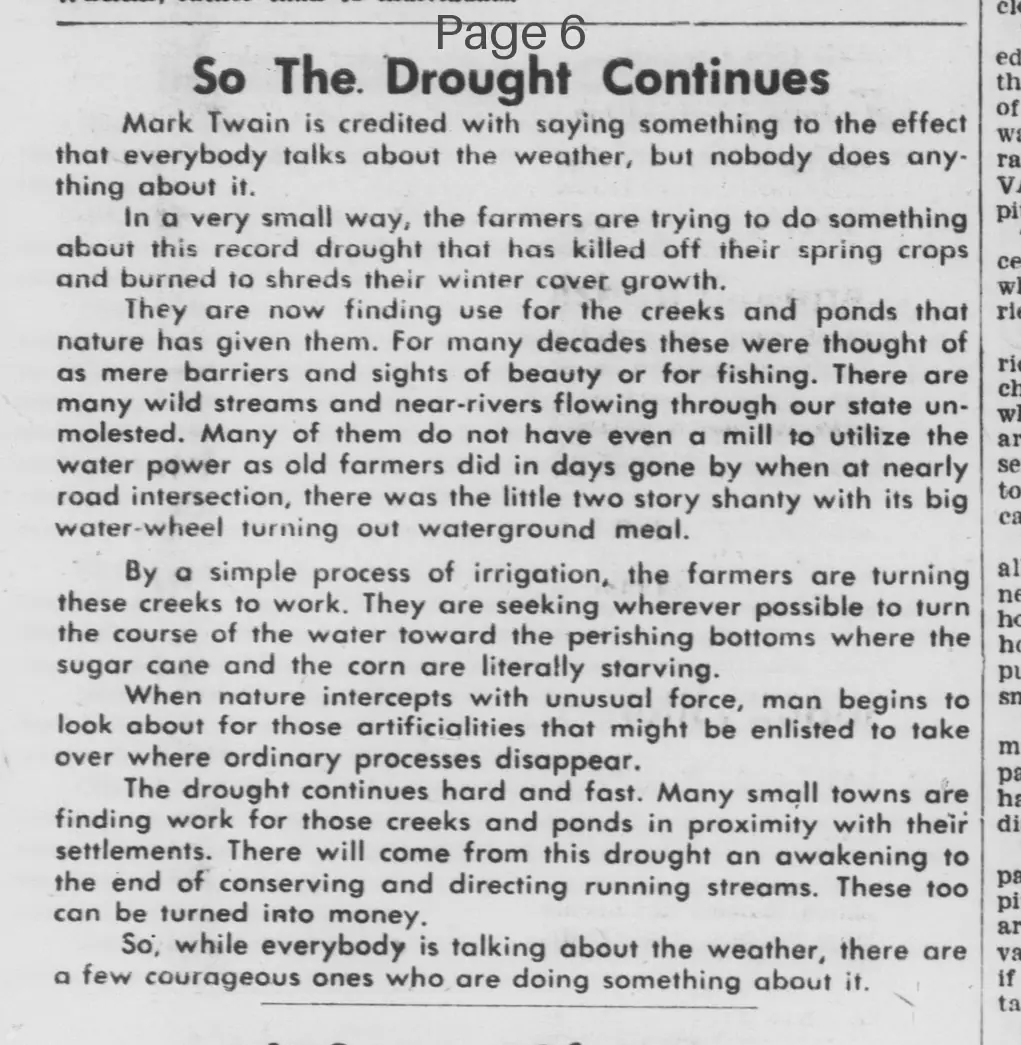
So The Drought Continues
Mark Twain is credited with saying something to the effect that everybody talks about the weather, but nobody does anything about it.
In a very small way, the farmers are trying to do something about this record drought that has killed off their spring crops and burned to shreds their winter cover growth.
They are now finding use for the creeks and ponds that nature has given them. For many decades these were thought of as mere barriers and sights of beauty or for fishing. There are many wild streams and near-rivers flowing through our state unmolested. Many of them do not have even a mill to utilize the water power as old farmers did in days gone by when at nearly road intersection, there was the little two story shanty with its big water-wheel turning out waterground meal.
By a simple process of irrigation, the farmers are turning these creeks to work. They are seeking wherever possible to turn the course of the water toward the perishing bottoms where the sugar cane and the corn are literally starving.
When nature intercepts with unusual force, man begins to look about for those artificialities that might be enlisted to take over where ordinary processes disappear.
The drought continues hard and fast. Many small towns are finding work for those creeks and ponds in proximity with their settlements. There will come from this drought an awakening to the end of conserving and directing running streams. These too can be turned into money.
So, while everybody is talking about the weather, there are a few courageous ones who are doing something about it.
Mark Twain is credited with saying something to the effect that everybody talks about the weather, but nobody does anything about it.
In a very small way, the farmers are trying to do something about this record drought that has killed off their spring crops and burned to shreds their winter cover growth.
They are now finding use for the creeks and ponds that nature has given them. For many decades these were thought of as mere barriers and sights of beauty or for fishing. There are many wild streams and near-rivers flowing through our state unmolested. Many of them do not have even a mill to utilize the water power as old farmers did in days gone by when at nearly road intersection, there was the little two story shanty with its big water-wheel turning out waterground meal.
By a simple process of irrigation, the farmers are turning these creeks to work. They are seeking wherever possible to turn the course of the water toward the perishing bottoms where the sugar cane and the corn are literally starving.
When nature intercepts with unusual force, man begins to look about for those artificialities that might be enlisted to take over where ordinary processes disappear.
The drought continues hard and fast. Many small towns are finding work for those creeks and ponds in proximity with their settlements. There will come from this drought an awakening to the end of conserving and directing running streams. These too can be turned into money.
So, while everybody is talking about the weather, there are a few courageous ones who are doing something about it.
What sub-type of article is it?
Agriculture
What keywords are associated?
Drought
Irrigation
Farmers
Creeks
Water Conservation
What entities or persons were involved?
Farmers
Mark Twain
Editorial Details
Primary Topic
Farmers Using Irrigation To Combat Drought
Stance / Tone
Encouraging And Optimistic About Human Adaptation
Key Figures
Farmers
Mark Twain
Key Arguments
- drought has destroyed crops and cover growth
- farmers are irrigating using creeks and ponds
- historical underuse of water resources for power and now for irrigation
- need to conserve and direct streams for economic benefit