Thank you for visiting SNEWPapers!
Sign up free
Editorial
November 29, 1787
The New York Journal, And Daily Patriotic Register
New York, New York County, New York
What is this article about?
In Brutus No. IV, the author argues that the proposed U.S. Constitution lacks equal and full representation, making it prone to corruption, undue influence, and tyranny rather than serving the public good. It critiques the small legislature's vulnerability to bribery and lack of public confidence.
Clipping
OCR Quality
95%
Excellent
Full Text
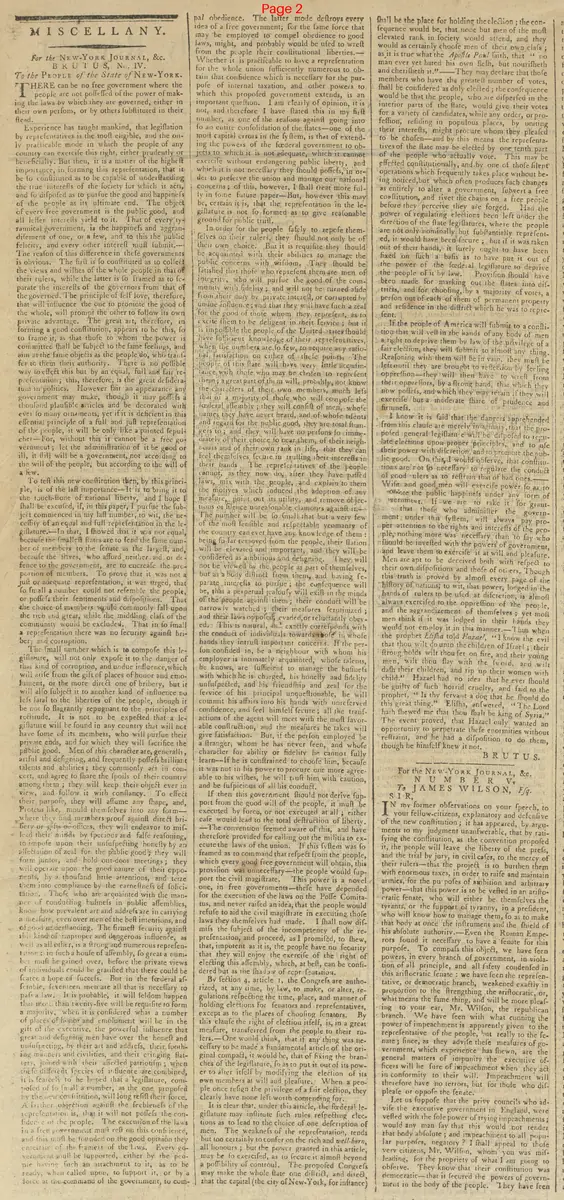
MISCELLANY.
For the New-York Journal, &c.
BRUTUS, No. IV.
To the People of the State of New-York.
There can be no free government where the people are not possessed of the power of making the laws by which they are governed, either in their own persons, or by others substituted in their stead.
Experience has taught mankind, that legislation by representatives is the most eligible, and the only practicable mode in which the people of any country can exercise this right, either prudently or beneficially. But then, it is a matter of the highest importance, in forming this representation, that it be so constituted as to be capable of understanding the true interests of the society for which it acts, and so disposed as to pursue the good and happiness of the people as its ultimate end. The object of every free government is the public good, and all lesser interests yield to it. That of every tyrannical government, is the happiness and aggrandizement of one, or a few, and to this the public felicity, and every other interest must submit.
The reason of this difference in these governments is obvious. The spirit is so constituted as to collect the views and wishes of the whole people in that of their rulers, while the latter is so framed as to separate the interests of the governors from that of the governed. The principle of self love, therefore, that will influence the one to promote the good of the whole, will prompt the other to follow its own private advantage. The great art, therefore, in forming a good constitution, appears to be this, so to frame it, as that those to whom the power is committed shall be subject to the same feelings, and aim at the same objects as the people do, who transfer to them their authority. There is no possible way to effect this but by an equal, full and fair representation; this, therefore, is the great desideratum in politics. However fair an appearance any government may make, though it may possess a thousand plausible articles and be decorated with ever so many ornaments, yet if it is deficient in this essential principle of a full and just representation of the people, it will be only like a painted sepulcher—For, without this it cannot be a free government; let the administration of it be good or ill, it still will be a government, not according to the will of the people, but according to the will of a few.
To test this new constitution then, by this principle, is of the last importance—It is to bring it to the touch-stone of national liberty, and I hope I shall be excused, if, in this paper, I pursue the subject commenced in my last number, to wit, the necessity of an equal and full representation in the legislature. In that, I showed that it was not equal, because the smallest states are to send the same number of members to the senate as the largest, and, because the slaves, who afford neither aid nor defence to the government, are to increase the proportion of members. To prove that it was not a just or adequate representation, it was urged, that so small a number could not resemble the people, or possess their sentiments and dispositions. That the choice of members would commonly fall upon the rich and great, while the middling class of the community would be excluded. That in so small a representation there was no security against bribery and corruption.
The small number which is to compose this legislature, will not only expose it to the danger of that kind of corruption, and undue influence, which will arise from the gift of places of honor and emolument, or the more direct one of bribery, but it will also subject it to another kind of influence no less fatal to the liberties of the people, though it be not so flagrantly repugnant to the principles of rectitude. It is not to be expected that a legislature will be found in any country that will not have some of its members, who will pursue their private ends, and for which they will sacrifice the public good. Men of this character are, generally, artful and designing, and frequently possess brilliant talents and abilities; they commonly act in concert, and agree to share the spoils of their country among them; they will keep their object ever in view, and follow it with constancy. To effect their purpose, they will assume any shape, and, Proteus like, mould themselves into any form—where they find members proof against direct bribery or gifts or offices, they will endeavor to mislead their minds by specious and false reasoning, to impose upon their unsuspecting honesty by an affectation of zeal for the public good; they will form juntas, and hold out-door meetings; they will operate upon the good nature of their opponents, by a thousand little attentions, and tease them into compliance by the earnestness of solicitation. Those who are acquainted with the manner of conducting business in public assemblies, know how prevalent art and address are in carrying a measure, even over men of the best intentions, and of good understanding. The firmest security against this kind of improper and dangerous influence, as well as all other, is a strong and numerous representation: in such a house of assembly, so great a number must be gained over, before the private views of individuals could be gratified that there could be scarce a hope of success. But in the federal assembly, seventeen men are all that is necessary to pass a law. It is probable, it will seldom happen that more than twenty-five will be requisite to form a majority, when it is considered what a number of places of honor and emolument will be in the gift of the executive, the powerful influence that great and designing men have over the honest and unsuspecting, by their art and address, their soothing manners and civilities, and their cringing flattery, joined with their affected patriotism; when these different species of influence are combined, it is scarcely to be hoped that a legislature, composed of so small a number, as the one proposed by the new constitution, will long resist their force.
A further objection against the feebleness of the representation is, that it will not possess the confidence of the people. The execution of the laws in a free government must rest on this confidence, and this must be founded on the good opinion they entertain of the framers of the laws. Every government must be supported, either by the people having such an attachment to it, as to be ready, when called upon, to support it, or by a force at the command of the government, to compel obedience. The latter mode destroys every
For the New-York Journal, &c.
BRUTUS, No. IV.
To the People of the State of New-York.
There can be no free government where the people are not possessed of the power of making the laws by which they are governed, either in their own persons, or by others substituted in their stead.
Experience has taught mankind, that legislation by representatives is the most eligible, and the only practicable mode in which the people of any country can exercise this right, either prudently or beneficially. But then, it is a matter of the highest importance, in forming this representation, that it be so constituted as to be capable of understanding the true interests of the society for which it acts, and so disposed as to pursue the good and happiness of the people as its ultimate end. The object of every free government is the public good, and all lesser interests yield to it. That of every tyrannical government, is the happiness and aggrandizement of one, or a few, and to this the public felicity, and every other interest must submit.
The reason of this difference in these governments is obvious. The spirit is so constituted as to collect the views and wishes of the whole people in that of their rulers, while the latter is so framed as to separate the interests of the governors from that of the governed. The principle of self love, therefore, that will influence the one to promote the good of the whole, will prompt the other to follow its own private advantage. The great art, therefore, in forming a good constitution, appears to be this, so to frame it, as that those to whom the power is committed shall be subject to the same feelings, and aim at the same objects as the people do, who transfer to them their authority. There is no possible way to effect this but by an equal, full and fair representation; this, therefore, is the great desideratum in politics. However fair an appearance any government may make, though it may possess a thousand plausible articles and be decorated with ever so many ornaments, yet if it is deficient in this essential principle of a full and just representation of the people, it will be only like a painted sepulcher—For, without this it cannot be a free government; let the administration of it be good or ill, it still will be a government, not according to the will of the people, but according to the will of a few.
To test this new constitution then, by this principle, is of the last importance—It is to bring it to the touch-stone of national liberty, and I hope I shall be excused, if, in this paper, I pursue the subject commenced in my last number, to wit, the necessity of an equal and full representation in the legislature. In that, I showed that it was not equal, because the smallest states are to send the same number of members to the senate as the largest, and, because the slaves, who afford neither aid nor defence to the government, are to increase the proportion of members. To prove that it was not a just or adequate representation, it was urged, that so small a number could not resemble the people, or possess their sentiments and dispositions. That the choice of members would commonly fall upon the rich and great, while the middling class of the community would be excluded. That in so small a representation there was no security against bribery and corruption.
The small number which is to compose this legislature, will not only expose it to the danger of that kind of corruption, and undue influence, which will arise from the gift of places of honor and emolument, or the more direct one of bribery, but it will also subject it to another kind of influence no less fatal to the liberties of the people, though it be not so flagrantly repugnant to the principles of rectitude. It is not to be expected that a legislature will be found in any country that will not have some of its members, who will pursue their private ends, and for which they will sacrifice the public good. Men of this character are, generally, artful and designing, and frequently possess brilliant talents and abilities; they commonly act in concert, and agree to share the spoils of their country among them; they will keep their object ever in view, and follow it with constancy. To effect their purpose, they will assume any shape, and, Proteus like, mould themselves into any form—where they find members proof against direct bribery or gifts or offices, they will endeavor to mislead their minds by specious and false reasoning, to impose upon their unsuspecting honesty by an affectation of zeal for the public good; they will form juntas, and hold out-door meetings; they will operate upon the good nature of their opponents, by a thousand little attentions, and tease them into compliance by the earnestness of solicitation. Those who are acquainted with the manner of conducting business in public assemblies, know how prevalent art and address are in carrying a measure, even over men of the best intentions, and of good understanding. The firmest security against this kind of improper and dangerous influence, as well as all other, is a strong and numerous representation: in such a house of assembly, so great a number must be gained over, before the private views of individuals could be gratified that there could be scarce a hope of success. But in the federal assembly, seventeen men are all that is necessary to pass a law. It is probable, it will seldom happen that more than twenty-five will be requisite to form a majority, when it is considered what a number of places of honor and emolument will be in the gift of the executive, the powerful influence that great and designing men have over the honest and unsuspecting, by their art and address, their soothing manners and civilities, and their cringing flattery, joined with their affected patriotism; when these different species of influence are combined, it is scarcely to be hoped that a legislature, composed of so small a number, as the one proposed by the new constitution, will long resist their force.
A further objection against the feebleness of the representation is, that it will not possess the confidence of the people. The execution of the laws in a free government must rest on this confidence, and this must be founded on the good opinion they entertain of the framers of the laws. Every government must be supported, either by the people having such an attachment to it, as to be ready, when called upon, to support it, or by a force at the command of the government, to compel obedience. The latter mode destroys every
What sub-type of article is it?
Constitutional
Partisan Politics
What keywords are associated?
Federal Constitution
Representation
Equal Representation
Corruption
Bribery
Tyranny
Public Good
Legislature Size
What entities or persons were involved?
People Of The State Of New York
Framers Of The New Constitution
Editorial Details
Primary Topic
Necessity Of Equal And Full Representation In The Federal Legislature
Stance / Tone
Strongly Opposed To The Proposed Constitution Due To Inadequate Representation
Key Figures
People Of The State Of New York
Framers Of The New Constitution
Key Arguments
No Free Government Without Power To Make Laws Via Representatives
Representation Must Understand And Pursue Public Good To Avoid Tyranny
Equal And Full Representation Is Essential To Align Rulers' Interests With People's
New Constitution Unequal: Small States Equal To Large In Senate, Slaves Count For Representation
Small Legislature Cannot Reflect People's Sentiments, Favors Rich, Vulnerable To Bribery
Small Number Enables Corruption Via Gifts, Influence, And Artful Persuasion
Only 17 25 Members Needed For Majority, Easily Swayed By Executive Patronage And Flattery
Weak Representation Erodes Public Confidence, Leading To Coercive Governance