Thank you for visiting SNEWPapers!
Sign up free
Editorial
December 5, 1792
National Gazette
Philadelphia, Philadelphia County, Pennsylvania
What is this article about?
Monongahela defends the western Pennsylvania counties' opposition to the federal excise law against accusations of insurgency by Supervisor George Clymer. He cites precedents like the Philadelphia association, denies disaffection to the government, and criticizes Clymer's conduct and memorial for inflaming tensions.
Clipping
OCR Quality
95%
Excellent
Full Text
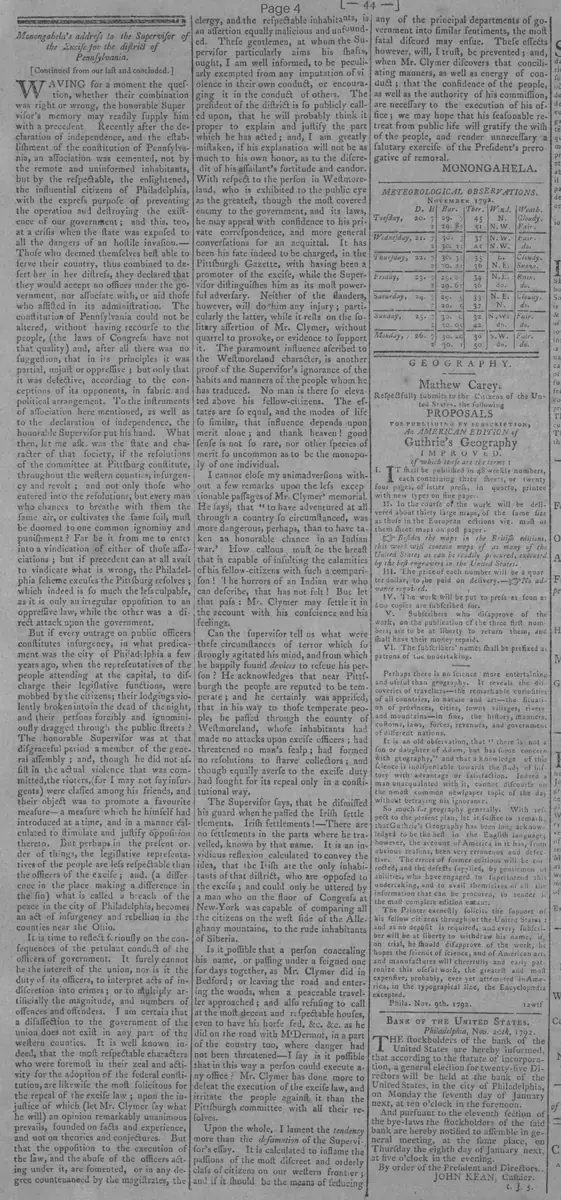
Monongahela's address to the Supervisor of the Excise for the district of Pennsylvania.
Continued from our last and concluded.
Having for a moment the question, whether their combination was right or wrong, the honorable Supervisor's memory may readily supply him with a precedent. Recently after the declaration of independence, and the establishment of the constitution of Pennsylvania, an association was cemented, not by the remote and uninformed inhabitants, but by the respectable, the enlightened, the influential citizens of Philadelphia, with the express purpose of preventing the operation and destroying the existence of our government; and this, too, at a crisis when the state was exposed to all the dangers of a hostile invasion.
Those who deemed themselves best able to serve their country, thus combined to desert her in her distress, they declared that they would accept no offices under the government, nor associate with, or aid those who assisted in its administration. The constitution of Pennsylvania could not be altered without having recourse to the people, (the laws of Congress have not that quality) and, after all there was no suggestion, that in its principles it was partial, unjust or oppressive; but only that it was defective, according to the conceptions of its opponents, in fabric and political arrangement. To the instruments of association here mentioned, as well as to the declaration of independence, the honorable Supervisor put his hand. What then, let me ask, was the state and character of that society, if the resolutions of the committee at Pittsburgh constitute, throughout the western counties, insurgency and revolt; and not only those who entered into the resolutions, but every man who chances to breathe with them the same air, or cultivates the same soil, must be doomed to one common ignominy and punishment? Far be it from me to enter into a vindication of either of those associations: but if precedent can at all avail to vindicate what is wrong, the Philadelphia scheme excuses the Pittsburgh resolves; which indeed is so much the less culpable, as it is only an irregular opposition to an oppressive law, while the other was a direct attack upon the government.
But if every outrage on public officers constitutes insurgency, in what predicament was the city of Philadelphia a few years ago, when the representatives of the people attending at the capital, to discharge their legislative functions, were mobbed by the citizens; their lodgings violently broken into in the dead of the night, and their persons forcibly and ignominiously dragged through the public streets? The honorable Supervisor was at that disgraceful period a member of the general assembly; and, though he did not assist in the actual violence that was committed, the rioters, (for I may not say insurgents) were classed among his friends, and their object was to promote a favourite measure which he himself had introduced at a time, and in a manner calculated to stimulate and justify opposition thereto. But perhaps in the present order of things, the legislative representatives of the people are less respectable than the officers of the excise; and, (a difference in the place making a difference in the sin) what is called a breach of the peace in the city of Philadelphia, becomes an act of insurgency and rebellion in the counties near the Ohio.
It is time to reflect seriously on the consequences of the petulant conduct of the officers of government. It surely cannot be the interest of the union, nor is it the duty of its officers, to interpret acts of indiscretion into crimes; or to multiply artificially the magnitude, and numbers of offences and offenders. I am certain that a disaffection to the government of the union does not exist in any part of the western counties. It is well known indeed, that the most respectable characters who were foremost in their zeal and activity for the adoption of the federal constitution, are likewise the most solicitous for the repeal of the excise law; upon the injustice of which (let Mr. Clymer say what he will) an opinion remarkably unanimous prevails, founded on facts and experience, and not on theories and conjectures. But that the opposition to the execution of the law, and the abuse of the officers acting under it, are fomented, or in any degree countenanced by the magistrates, the clergy, and the respectable inhabitants, is an assertion equally malicious and unfounded. These gentlemen, at whom the Supervisor particularly aims his shafts, ought, I am well informed, to be peculiarly exempted from any imputation of violence in their own conduct, or encouraging it in the conduct of others. The president of the district is so publicly called upon, that he will probably think it proper to explain and justify the part which he has acted; and, I am greatly mistaken, if his explanation will not be as much to his own honor, as to the discredit of his assailant's fortitude and candor.
With respect to the person in Westmoreland, who is exhibited to the public eye as the greatest, though the most covered enemy to the government, and its laws, he may appeal with confidence to his private correspondence, and more general conversations for an acquittal. It has been his fate indeed to be charged, in the Pittsburgh Gazette, with having been a promoter of the excise, while the Supervisor distinguishes him as its most powerful adversary. Neither of the aspersions, however, will do him any injury; particularly the latter, while it rests on the solitary assertion of Mr. Clymer, without quarrel to provoke, or evidence to support it. The paramount influence ascribed to the Westmoreland character, is another proof of the Supervisor's ignorance of the habits and manners of the people whom he has traduced. No man is there so elevated above his fellow-citizens. The estates are so equal, and the modes of life so similar, that influence depends upon merit alone; and thank heaven! good sense is not so rare, nor other species of merit so uncommon as to be the monopoly of one individual.
I cannot close my animadversions without a few remarks upon the less exceptionable passages of Mr. Clymer's memorial. He says, that "to have adventured at all through a country so circumstanced, was more dangerous, perhaps, than to have taken an honorable chance in an Indian war." How callous must be the breast that is capable of insulting the calamities of his fellow-citizens with such a comparison! The horrors of an Indian war who can describe, that has not felt! But let that pass: Mr. Clymer may settle it in the account with his conscience and his feelings.
Can the Supervisor tell us what were these circumstances of terror which so strongly agitated his mind, and from which he happily found devices to rescue his person? He acknowledges that near Pittsburgh the people are reputed to be temperate; and he certainly was apprised, that in his way to those temperate people, he passed through the county of Westmoreland, whose inhabitants had made no attacks upon excise officers: had threatened no man's scalp; had formed no resolutions to tarve collectors; and though equally averse to the excise duty had sought for its repeal only in a constitutional way.
The Supervisor says, that he dismissed his guard when he passed the Irish settlements. Irish settlements! There are no settlements in the parts where he travelled, known by that name. It is an invidious reflection calculated to convey the idea, that the Irish are the only inhabitants of that district, who are opposed to the excise; and could only be uttered by a man who on the floor of Congress at New-York was capable of comparing all the citizens on the west side of the Alleghany mountains, to the rude inhabitants of Siberia.
Is it possible that a person concealing his name, or passing under a feigned one for days together, as Mr. Clymer did in Bedford; or leaving the road and entering the woods, when a peaceable traveller approached; and also refusing to call at the most decent and respectable houses, even to have his horse fed, &c. &c. as he did on the road with M'Dermot, in a part of the country too, where danger had not been threatened—I say is it possible that in this way a person could execute any office? Mr. Clymer has done more to defeat the execution of the excise law, and irritate the people against it than the Pittsburgh committee with all their resolves.
Upon the whole, I lament the tendency more than the defamation of the Supervisor's essay. It is calculated to inflame the passions of the most discreet and orderly class of citizens on our western frontier; and if it should be the means of seducing any of the principal departments of government into similar sentiments, the most fatal discord may ensue. These effects however, will, I trust, be prevented; and, when Mr. Clymer discovers that conciliating manners, as well as energy of conduct; that the confidence of the people, as well as the authority of his commission, are necessary to the execution of his office; we may hope that his seasonable retreat from public life will gratify the wish of the people, and render unnecessary a salutary exercise of the President's prerogative of removal.
MONONGAHELA.
Continued from our last and concluded.
Having for a moment the question, whether their combination was right or wrong, the honorable Supervisor's memory may readily supply him with a precedent. Recently after the declaration of independence, and the establishment of the constitution of Pennsylvania, an association was cemented, not by the remote and uninformed inhabitants, but by the respectable, the enlightened, the influential citizens of Philadelphia, with the express purpose of preventing the operation and destroying the existence of our government; and this, too, at a crisis when the state was exposed to all the dangers of a hostile invasion.
Those who deemed themselves best able to serve their country, thus combined to desert her in her distress, they declared that they would accept no offices under the government, nor associate with, or aid those who assisted in its administration. The constitution of Pennsylvania could not be altered without having recourse to the people, (the laws of Congress have not that quality) and, after all there was no suggestion, that in its principles it was partial, unjust or oppressive; but only that it was defective, according to the conceptions of its opponents, in fabric and political arrangement. To the instruments of association here mentioned, as well as to the declaration of independence, the honorable Supervisor put his hand. What then, let me ask, was the state and character of that society, if the resolutions of the committee at Pittsburgh constitute, throughout the western counties, insurgency and revolt; and not only those who entered into the resolutions, but every man who chances to breathe with them the same air, or cultivates the same soil, must be doomed to one common ignominy and punishment? Far be it from me to enter into a vindication of either of those associations: but if precedent can at all avail to vindicate what is wrong, the Philadelphia scheme excuses the Pittsburgh resolves; which indeed is so much the less culpable, as it is only an irregular opposition to an oppressive law, while the other was a direct attack upon the government.
But if every outrage on public officers constitutes insurgency, in what predicament was the city of Philadelphia a few years ago, when the representatives of the people attending at the capital, to discharge their legislative functions, were mobbed by the citizens; their lodgings violently broken into in the dead of the night, and their persons forcibly and ignominiously dragged through the public streets? The honorable Supervisor was at that disgraceful period a member of the general assembly; and, though he did not assist in the actual violence that was committed, the rioters, (for I may not say insurgents) were classed among his friends, and their object was to promote a favourite measure which he himself had introduced at a time, and in a manner calculated to stimulate and justify opposition thereto. But perhaps in the present order of things, the legislative representatives of the people are less respectable than the officers of the excise; and, (a difference in the place making a difference in the sin) what is called a breach of the peace in the city of Philadelphia, becomes an act of insurgency and rebellion in the counties near the Ohio.
It is time to reflect seriously on the consequences of the petulant conduct of the officers of government. It surely cannot be the interest of the union, nor is it the duty of its officers, to interpret acts of indiscretion into crimes; or to multiply artificially the magnitude, and numbers of offences and offenders. I am certain that a disaffection to the government of the union does not exist in any part of the western counties. It is well known indeed, that the most respectable characters who were foremost in their zeal and activity for the adoption of the federal constitution, are likewise the most solicitous for the repeal of the excise law; upon the injustice of which (let Mr. Clymer say what he will) an opinion remarkably unanimous prevails, founded on facts and experience, and not on theories and conjectures. But that the opposition to the execution of the law, and the abuse of the officers acting under it, are fomented, or in any degree countenanced by the magistrates, the clergy, and the respectable inhabitants, is an assertion equally malicious and unfounded. These gentlemen, at whom the Supervisor particularly aims his shafts, ought, I am well informed, to be peculiarly exempted from any imputation of violence in their own conduct, or encouraging it in the conduct of others. The president of the district is so publicly called upon, that he will probably think it proper to explain and justify the part which he has acted; and, I am greatly mistaken, if his explanation will not be as much to his own honor, as to the discredit of his assailant's fortitude and candor.
With respect to the person in Westmoreland, who is exhibited to the public eye as the greatest, though the most covered enemy to the government, and its laws, he may appeal with confidence to his private correspondence, and more general conversations for an acquittal. It has been his fate indeed to be charged, in the Pittsburgh Gazette, with having been a promoter of the excise, while the Supervisor distinguishes him as its most powerful adversary. Neither of the aspersions, however, will do him any injury; particularly the latter, while it rests on the solitary assertion of Mr. Clymer, without quarrel to provoke, or evidence to support it. The paramount influence ascribed to the Westmoreland character, is another proof of the Supervisor's ignorance of the habits and manners of the people whom he has traduced. No man is there so elevated above his fellow-citizens. The estates are so equal, and the modes of life so similar, that influence depends upon merit alone; and thank heaven! good sense is not so rare, nor other species of merit so uncommon as to be the monopoly of one individual.
I cannot close my animadversions without a few remarks upon the less exceptionable passages of Mr. Clymer's memorial. He says, that "to have adventured at all through a country so circumstanced, was more dangerous, perhaps, than to have taken an honorable chance in an Indian war." How callous must be the breast that is capable of insulting the calamities of his fellow-citizens with such a comparison! The horrors of an Indian war who can describe, that has not felt! But let that pass: Mr. Clymer may settle it in the account with his conscience and his feelings.
Can the Supervisor tell us what were these circumstances of terror which so strongly agitated his mind, and from which he happily found devices to rescue his person? He acknowledges that near Pittsburgh the people are reputed to be temperate; and he certainly was apprised, that in his way to those temperate people, he passed through the county of Westmoreland, whose inhabitants had made no attacks upon excise officers: had threatened no man's scalp; had formed no resolutions to tarve collectors; and though equally averse to the excise duty had sought for its repeal only in a constitutional way.
The Supervisor says, that he dismissed his guard when he passed the Irish settlements. Irish settlements! There are no settlements in the parts where he travelled, known by that name. It is an invidious reflection calculated to convey the idea, that the Irish are the only inhabitants of that district, who are opposed to the excise; and could only be uttered by a man who on the floor of Congress at New-York was capable of comparing all the citizens on the west side of the Alleghany mountains, to the rude inhabitants of Siberia.
Is it possible that a person concealing his name, or passing under a feigned one for days together, as Mr. Clymer did in Bedford; or leaving the road and entering the woods, when a peaceable traveller approached; and also refusing to call at the most decent and respectable houses, even to have his horse fed, &c. &c. as he did on the road with M'Dermot, in a part of the country too, where danger had not been threatened—I say is it possible that in this way a person could execute any office? Mr. Clymer has done more to defeat the execution of the excise law, and irritate the people against it than the Pittsburgh committee with all their resolves.
Upon the whole, I lament the tendency more than the defamation of the Supervisor's essay. It is calculated to inflame the passions of the most discreet and orderly class of citizens on our western frontier; and if it should be the means of seducing any of the principal departments of government into similar sentiments, the most fatal discord may ensue. These effects however, will, I trust, be prevented; and, when Mr. Clymer discovers that conciliating manners, as well as energy of conduct; that the confidence of the people, as well as the authority of his commission, are necessary to the execution of his office; we may hope that his seasonable retreat from public life will gratify the wish of the people, and render unnecessary a salutary exercise of the President's prerogative of removal.
MONONGAHELA.
What sub-type of article is it?
Taxation
Constitutional
Partisan Politics
What keywords are associated?
Excise Law
Tax Opposition
Insurgency Accusations
Western Counties
Pittsburgh Resolves
Supervisor Clymer
Constitutional Opposition
What entities or persons were involved?
Supervisor Of The Excise (Mr. Clymer)
Monongahela
Pittsburgh Committee
Philadelphia Association
President Of The District
Westmoreland Character
M'dermot
Editorial Details
Primary Topic
Defense Against Accusations Of Insurgency In Opposition To Excise Law
Stance / Tone
Strongly Critical Of Supervisor Clymer And Supportive Of Western Opposition
Key Figures
Supervisor Of The Excise (Mr. Clymer)
Monongahela
Pittsburgh Committee
Philadelphia Association
President Of The District
Westmoreland Character
M'dermot
Key Arguments
Philadelphia Association Precedent Excuses Pittsburgh Resolves As Less Culpable Opposition To Oppressive Law
No Disaffection To Federal Government, Only To Unjust Excise Law
Supervisor's Memorial Inflames Passions And Defeats Law Execution More Than Opposition
Accusations Against Magistrates, Clergy, And Inhabitants Are Malicious And Unfounded
Clymer's Conduct Shows Fear And Ignorance Of Western People
Calls For Repeal Of Excise Through Constitutional Means