Thank you for visiting SNEWPapers!
Sign up free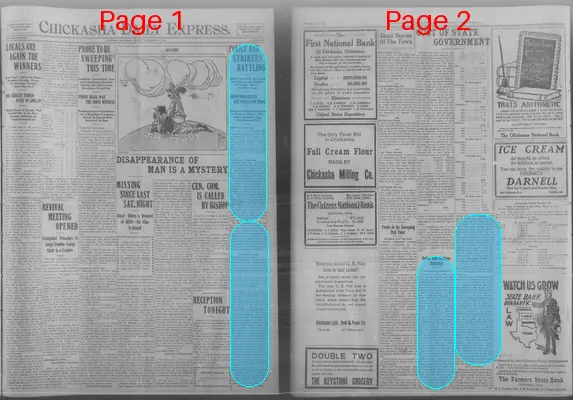
The Chickasha Daily Express
Chickasha, Grady County, Oklahoma
What is this article about?
In Lawrence, Mass., on Sept. 30, 1912, violent clashes between police and striking mill workers lead to injuries, arrests, and one fatality. IWW organizers Ettor and Giovanitti, plus Caruso, face trial for the January murder of striker Annie Lopizza amid the ongoing strike over wage cuts.
Merged-components note: Continuation of labor strike story across pages; changed label to story for narrative focus.
Clippings

1 of 2
OCR Quality
Full Text
Rioting Starts Early and Clash Sends Many to the Hospital with Broken Heads-
One Man Dying
LABOR ORGANIZERS ARE PLACED ON TRIAL
Charged with Being Accessories to Murder of Woman-Two Judges Assigned to Case
—Great Interest in Trial
Telegram by United Press.
Lawrence, Sept. 30.-Fresh riots, the bloodiest of the day, occurred when the workers started to return to the mills at lunch time. The police charged several hundred strikers armed with wagon tongues and black jacks. Five were arrested. The police are ordered to break up any mob at any cost, except by the use of firearms.
Telegram by United Press
Lawrence, Mass., Sept. 30.-Serious rioting occurred this morning as a result of clashes between the police and the Ettor protest strikers. Several are in hospitals with broken heads and the police station is crowded. One man is dying at the hospital, five women were arrested and all will be arraigned later. Municipal and state police charged a crowd of a thousand. A squad of newspaper men following the strikers were set upon by officers and a Boston photographer was clubbed to the ground, his camera being smashed. The others escaped.
Strike pickets surrounded the mills before daylight and rioting started soon. The police rushed upon the scene wielding sticks and wagon tongues with deadly effect. A pitched battle occurred at Union and Essex streets and it was three hours before order was restored.
The Ettor Giovanitti case may last only a few days. It is known that Prosecutor Attwell feels heavily the burden of being forced to attempt to convict the men. The prisoners were brought into court handcuffed and locked in an iron barred cage in the center of the room, facing the bench. The talesmen were old, young, rich and poor, some representing the most prominent families in New England.
TROUBLE AT LYNN.
Telegram by United Press.
Lynn, Mass., Sept. 30.-Three were arrested and several heads broken during the Ettor protest parade. Trouble was started by policemen trying to arrest a striker carrying a red I. W. W. flag. Order was soon restored.
Lawrence, Sept. 30.-At noon the leaders estimated that fifteen thousand workers were out and the number was hourly increasing.
Salem, Mass., Sept. 30.-Joseph J. Ettor, Arturo Giovanitti and Antonio Caruso, after lying in jail at Lawrence, Mass., since January 30, bail having been refused by the courts during the seven months of their incarceration, were brought to trial today in the superior court. Ettor and Giovanitti, both of New York, are organizers for the Industrial Workers of the World. They are charged with being accessories before the fact to the murder of Annie Lopizza, the woman striker, shot during a clash between police and mill operatives in Lawrence on Monday, January 27. Caruso is charged with murder in the first degree in connection with the woman's death.
Because of the great importance of the case two justices were assigned to preside. They are John B. Quinn and Parley Hall. The district attorney of Essex county, Henry C. Attwill, was in charge of the prosecution. John P. S. Mahoney of Lawrence represented Ettor and Giovanitti, and George S. Moore of Los Angeles represented Caruso. They were aided in the defense by Attorney George E. Roever, Jr., who acted as defense attorney for the scores of arrested Lawrence strikers.
Through arrangements decided upon weeks ago only relatives of the defendants, lawyers, state officials and newspaper men who had cards were admitted to the court room.
(Continued on Page Two.)
Police and Strikers Battling
(Continued from Page One.)
No trial of a labor leader in the United States, excepting the McNamara and the famous Moyer-Haywood-Pettibone trial in Idaho, had attracted such attention as today's. The history of the case dates back to the passage by the legislature of Massachusetts the law limiting the working week in industrial institutions to 54 hours. Mill owners and other big employers of labor throughout the state had fought the passage of such a law bitterly and with every possible weapon. It was finally passed, however, to go into effect on January 1, 1912. For months, prior to the first of the year, organizers for Industrial Workers of the World had been quietly organizing the unskilled labor of Lawrence's great mill system, which include the American Woolen company. On the first pay day after the 54-hour a week law had gone into effect, the men, women, boys and girls who worked in the mills found that in every instance they had been docked two hours pay. That night meetings of the various nationalities-there are some 40 working in the Lawrence mills -were hurriedly called and the word went forth to strike the next morning.
The workers went to their looms and spindles, as usual. Suddenly, in every mill, before the wheels had made a complete revolution, the various leaders gave the signal and the strike was on. Some violence attended the opening of the strike, and at the outset, public sentiment was unfavorable to "the foreigners," as they were called.
The mill owners flatly refused to treat in any way with the strikers, declaring that there was no strike. However, within a week 10,000 of Lawrence's 32,000 mill operatives were out, and Joseph Ettor and Arturo Giovannitti were sent from New York to take charge, Ettor's fiery addresses before huge mass meetings on the Common aroused the workers, and the 10,000 grew to over 20,000 in a few days. Picket lines of from 5000 to 12,000 men and women every morning at 4 and 5 o'clock formed about the mills and tramped back and forth in the snow and slush to persuade non-strikers to join common cause and fight for better wages. It was then that city officials, acting for the mill officials, began the tactics which ended in a congressional investigation, following the clubbing of women and the tearing of their children from them while sending the little ones to be cared for in other cities to keep them from starving while the strike was on.
Then came the riot between soldiers and strikers in the down town section of the town on Monday, January 27.
That morning a patrol of police had been stoned in front of one of the branch meeting places of the strikers.
All day long scores of municipal and state police had clashes at this point.
Toward 4 o'clock in the afternoon, one of the many parades which the strikers occasionally held was broken up.
A portion of the crowd turned toward the headquarters, which had been the scene of trouble all day. Extra guards were rushed to the place and a pitched battle in which shots were fired began. Annie Lopizza, who was standing near the edge of the crowd, with several other women, jeering the police, fell to the ground shot through the heart. Then the crowd dispersed.
Caruso was arrested on the spot and held the next morning without bail, charged with murdering the Lopizza woman. Three days later Ettor and Giovannitti were locked up charged with instigating the crime through their speeches and through literature.
Three witnesses for the defense testified at the preliminary hearing before Police Court Judge Mahoney that they had positively seen a policeman shoot the Lopizza woman, and they identified the policeman.
What sub-type of article is it?
What themes does it cover?
What keywords are associated?
What entities or persons were involved?
Where did it happen?
Story Details
Key Persons
Location
Lawrence, Mass.
Event Date
Sept. 30, 1912; January 27, 1912
Story Details
Riots erupt between police and striking mill workers in Lawrence, Mass., resulting in injuries, arrests, and one death. Labor organizers Ettor and Giovanitti, along with Caruso, go on trial for the murder of striker Annie Lopizza during a January clash. Background details the 1912 strike over reduced wages after a 54-hour law implementation.