Thank you for visiting SNEWPapers!
Sign up free
Editorial
January 18, 1798
Gazette Of The United States, & Philadelphia Daily Advertiser
Philadelphia, Philadelphia County, Pennsylvania
What is this article about?
In this 'Scipio' series installment, the author criticizes U.S. Minister James Monroe's actions in France, including improperly encouraging a loan to aid France's war efforts amid British negotiations, and neglecting to vigorously defend the Jay Treaty against French objections, portraying it as partisan bias favoring France over U.S. neutrality.
Clipping
OCR Quality
95%
Excellent
Full Text
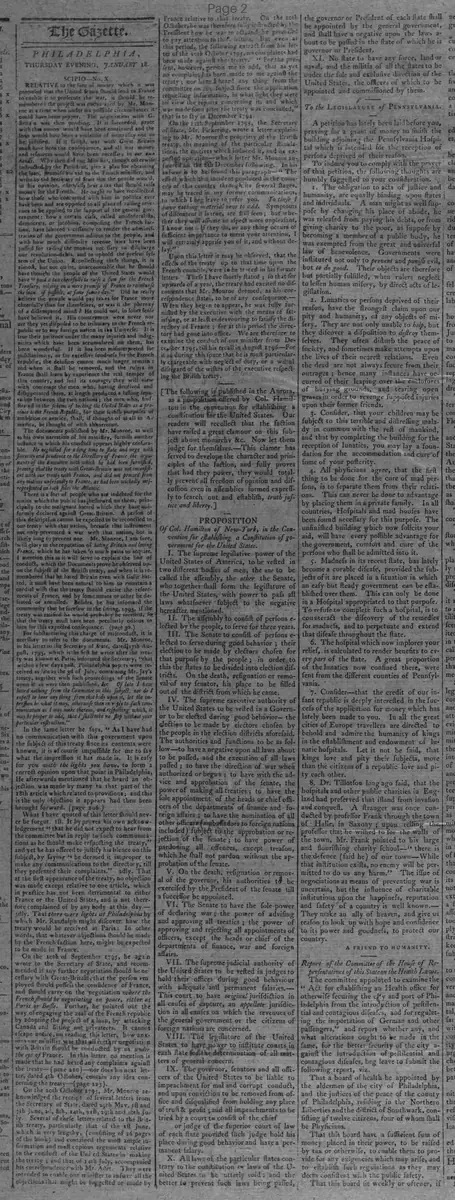
The Gazette.
PHILADELPHIA
THURSDAY EVENING, JANUARY 18.
SCIPIO—No. X.
RELATIVE to the sum of money which it was
proposed that the United States should lend to France
to enable it to prosecute the war, it should be remembered that the project was encouraged by Mr. Monroe at a time when under no possible circumstances it
could have been proper. The negotiation with Great
Britain was then pending. If it succeeded, peace
with that nation would have been continued and the
loan would have been a violation of neutrality not to
be justified. If it failed, war with Great Britain
must have been the consequence, and all our money
and resources would have been necessary in our own
hands. Why then did our Minister, though otherwise
instructed by the President, give a plan for obtaining
the loan, promise his aid to the French minister, and
write to the Secretary of State that the people would,
in his opinion, cheerfully bear a tax that should raise
money for the French. He ought to have recollected
how those who concurred with him in politics ever
have been and are opposed to all plans of raising revenues to be applied to the support of the general government: how a certain class, called antifederalists,
democrats, or jacobins, composing the French faction,
have labored incessantly to render the administration
of the government odious to the people, and with how much difficulty revenue laws have been
passed for raising the monies necessary to discharge
our revolution-debts, and to uphold the present system
of the Union. Recollecting these things, it is
almost, but not quite, unaccountable that he should
have thought the people of the United States would
have "paid a tax cheerfully to raise a sum for the French
Treasury, relying on a mere promise of France to reimburse
the loan, if possible, at some future day." Did he really
believe the people would pay taxes for France more
cheerfully than for themselves, or was it the phrenzy
of a distempered mind? He could not, in sober sense
have believed it. His countrymen were never nor
are they yet disposed to be tributary to the French republic or to any foreign nation in the Universe. It is
true their patience under the many injuries and indignities which have been accumulated on them, has
been wonderful. If it has been misinterpreted for
pusillanimity, or for excessive fondness for the French
republic, the delusion cannot much longer remain:
and when it shall be removed, and the rulers in
France shall learn by experience the real temper of
this country, and feel its courage, they will view
with contempt the men who, having deceived and
disappointed them, at length produced a lasting separation between the two nations: the men who, frustrated in the scheme of attaching the United States as a province to the French Republic, for their selfish purposes of
ambition or avarice, shall, if thought of at all in America, be thought of with abhorrence.
The documents published by Mr. Monroe, as well
as his own narration of his ministry, furnish another
instance in which his conduct appears highly censurable. He neglected for a long time to state and urge with
sincerity and prudence to the Directory of France the arguments of the Executive with which he had been furnished,
proving that the treaty with Great-Britain was not inconsistent
with our treaty with France, and did not proceed from
any motives unfriendly to France, as had been wickedly misrepresented on both sides the Atlantic.
There is a sort of people who are indebted for the
notice which the public has bestowed on them, principally to the malignant hatred which they have uniformly declared against Great-Britain. A person of
this description cannot be expected to be reconciled to
our treaty with that nation, because that instrument
not only prevented a war with that nation, but is
likely long to prevent one. Mr. Monroe, I am sure,
will glory in the reputation of hating Britain and loving
France, which he has taken so much pains to acquire.
I mention this as it will serve to explain the line of
conduct, which the Documents prove he observed upon the subject of the British treaty, and when it is remembered that he hated Britain even with Gallic hatred, it must have been natural to him to entertain a
cordial wish that the treaty should excite the resentments of France, and by some means or other be defeated or annulled. Besides, he has informed the
community that he foresaw in the spring, 1795, if the
treaty was ratified he would probably be recalled, so
that the treaty must have been peculiarly odious to
him for this expected consequence. (page 90.)
For substantiating this charge of misconduct, it is
necessary to refer to the documents. Mr. Monroe,
in his letter to the Secretary of State, dated 19th August, 1795, which is the first he wrote after the treaty was known at Paris, informed the Secretary, "that
within a few days past, Philadelphia papers were received as late as the 3d of July, containing Mr. Jay's
treaty, together with such proceedings of the Senate
upon it as were then published, &c. Of late I have
heard nothing from the Committee on this subject, nor do I
expect to hear any thing from that body upon it, let the impression be what it may, otherwise than in reply to such communication as I may make thereon, and respecting which, it
may be proper to add, that I shall take no step without your
particular instruction."
In the same letter he says, "As I have had
no communication with this government upon
the subject of this treaty since its contents were
known, it is of course impossible for me to say
what the impression it has made is. It is easy
for you with the lights you have, to form a
correct opinion upon that point in Philadelphia."
He afterwards mentioned that he heard an objection was made by many to that part of the
18th article which related to provisions; and this
is the only objection it appears had then been
brought forward. (page 206.)
What I have quoted of this letter should never be forgot. It fully proves his own acknowledgement "that he did not expect to hear from
the committee but in reply to such communications as he should make respecting the treaty,"
and yet he has offered to justify his silence on this
subject, by saying he deemed it improper to
make any communications to the directory, till
they presented their complaints." 2dly. That
at the first appearance of the treaty, no objection
was made except relative to one article, which
in practice has not been detrimental to either
France or the United States, and is not therefore complained of by any body at this day.
3dly. That there were lights at Philadelphia by
which Mr. Randolph might discover how the
treaty would be received at Paris: In other
words, that whatever objections should be made
by the French faction here, might be expected
to be made in France.
On the 10th of September 1795, he again
wrote to the Secretary of State, and recommended if any further negotiation should be necessary with Great-Britain, that the person employed should possess the confidence of France,
and should carry on the negotiation where the
French should be negotiating on peace, either at
Paris or Basle. Further, he pointed out the
way of engaging the zeal of the French republic
by adopting the project of a loan, by attacking
Canada and fitting out privateers. It cannot
escape notice, on reading this letter, how anxious our minister was that all further negotiation
with Britain should be conducted by us under
the eye of France. In this letter no mention is
made that he had heard any complaints against
the treaty—(page 210)—nor does his next letter, dated 4th October, contain any idea concerning the treaty—(page 223).
On the 20th October 1795, Mr. Monroe acknowledged the receipt of several letters from
the Secretary of State, dated 29th May, 1st and
th June, 2d, 8th, 14th, 21st, 29th and 30th July. Several of these letters related to the British treaty, particularly that of the 1st June,
which is very lengthy. (consisting of 26 pages
of the book) and contained the most ample information and most copious arguments relative
to the conduct of the United States in making
the treaty; and that of 4th July, accompanied
his correspondence with Mr. Adet. They were
intended to enable our minister to answer all the
objections that might be suggested or made by
France relative to that treaty. On the 20th
October, he was therefore fully instructed by the
President how he was to act and he promised
to pay attention to those letters. But even at
this period, the following extract from his letter of the 20th October, 1795, no complaints had
been made against the treaty. "For the present, however, permit me to add, that as yet
no formal complaint has been made to me against the
treaty; nor have I heard any thing from the
committee on the subject since the application
requesting information, in what light they were
to view the reports concerning it, and which
was made soon after the treaty was concluded,"
that is to say in December 1794.
On the 12th September 1795, the Secretary
of State, Mr. Pickering, wrote a letter explaining to Mr. Monroe the propriety of the British
treaty, the meaning of the particular stipulations, the motives which induced it, and its expected operation—which letter Mr. Monroe answered on the 6th December following. In his
answer is to be found this paragraph—"The
effect which this incident produced in the councils of this country through its several stages,
may be traced in my former communications,
to which I beg leave to refer you. To these I
have nothing material new to add. Symptoms
of discontent it is true, are still seen; but whether they will assume an aspect more unpleasant,
I know not: If they do, or any thing occurs of
sufficient importance to merit your attention, I
will certainly apprise you of it, and without delay."
Upon this letter it may be observed, that the
effects of the treaty up to that time upon the
French councils, were to be traced in his former
letters. These I have shortly stated; so that for
upwards of a year, the treaty had excited no discontents that Mr. Monroe deemed, as his correspondence states, to be of any consequence.
When they began to appear, he was fully furnished by the executive with the means of satisfying, or at least endeavouring to satisfy the directory of France; for at this period the directory had gone into office. We are therefore to
examine the conduct of our minister from December 1795, till his recall in August 1796—For
it is during this space that he is most particularly chargeable with neglect of duty, or a wilful
disregard of the wishes of the executive respecting the British treaty.
PHILADELPHIA
THURSDAY EVENING, JANUARY 18.
SCIPIO—No. X.
RELATIVE to the sum of money which it was
proposed that the United States should lend to France
to enable it to prosecute the war, it should be remembered that the project was encouraged by Mr. Monroe at a time when under no possible circumstances it
could have been proper. The negotiation with Great
Britain was then pending. If it succeeded, peace
with that nation would have been continued and the
loan would have been a violation of neutrality not to
be justified. If it failed, war with Great Britain
must have been the consequence, and all our money
and resources would have been necessary in our own
hands. Why then did our Minister, though otherwise
instructed by the President, give a plan for obtaining
the loan, promise his aid to the French minister, and
write to the Secretary of State that the people would,
in his opinion, cheerfully bear a tax that should raise
money for the French. He ought to have recollected
how those who concurred with him in politics ever
have been and are opposed to all plans of raising revenues to be applied to the support of the general government: how a certain class, called antifederalists,
democrats, or jacobins, composing the French faction,
have labored incessantly to render the administration
of the government odious to the people, and with how much difficulty revenue laws have been
passed for raising the monies necessary to discharge
our revolution-debts, and to uphold the present system
of the Union. Recollecting these things, it is
almost, but not quite, unaccountable that he should
have thought the people of the United States would
have "paid a tax cheerfully to raise a sum for the French
Treasury, relying on a mere promise of France to reimburse
the loan, if possible, at some future day." Did he really
believe the people would pay taxes for France more
cheerfully than for themselves, or was it the phrenzy
of a distempered mind? He could not, in sober sense
have believed it. His countrymen were never nor
are they yet disposed to be tributary to the French republic or to any foreign nation in the Universe. It is
true their patience under the many injuries and indignities which have been accumulated on them, has
been wonderful. If it has been misinterpreted for
pusillanimity, or for excessive fondness for the French
republic, the delusion cannot much longer remain:
and when it shall be removed, and the rulers in
France shall learn by experience the real temper of
this country, and feel its courage, they will view
with contempt the men who, having deceived and
disappointed them, at length produced a lasting separation between the two nations: the men who, frustrated in the scheme of attaching the United States as a province to the French Republic, for their selfish purposes of
ambition or avarice, shall, if thought of at all in America, be thought of with abhorrence.
The documents published by Mr. Monroe, as well
as his own narration of his ministry, furnish another
instance in which his conduct appears highly censurable. He neglected for a long time to state and urge with
sincerity and prudence to the Directory of France the arguments of the Executive with which he had been furnished,
proving that the treaty with Great-Britain was not inconsistent
with our treaty with France, and did not proceed from
any motives unfriendly to France, as had been wickedly misrepresented on both sides the Atlantic.
There is a sort of people who are indebted for the
notice which the public has bestowed on them, principally to the malignant hatred which they have uniformly declared against Great-Britain. A person of
this description cannot be expected to be reconciled to
our treaty with that nation, because that instrument
not only prevented a war with that nation, but is
likely long to prevent one. Mr. Monroe, I am sure,
will glory in the reputation of hating Britain and loving
France, which he has taken so much pains to acquire.
I mention this as it will serve to explain the line of
conduct, which the Documents prove he observed upon the subject of the British treaty, and when it is remembered that he hated Britain even with Gallic hatred, it must have been natural to him to entertain a
cordial wish that the treaty should excite the resentments of France, and by some means or other be defeated or annulled. Besides, he has informed the
community that he foresaw in the spring, 1795, if the
treaty was ratified he would probably be recalled, so
that the treaty must have been peculiarly odious to
him for this expected consequence. (page 90.)
For substantiating this charge of misconduct, it is
necessary to refer to the documents. Mr. Monroe,
in his letter to the Secretary of State, dated 19th August, 1795, which is the first he wrote after the treaty was known at Paris, informed the Secretary, "that
within a few days past, Philadelphia papers were received as late as the 3d of July, containing Mr. Jay's
treaty, together with such proceedings of the Senate
upon it as were then published, &c. Of late I have
heard nothing from the Committee on this subject, nor do I
expect to hear any thing from that body upon it, let the impression be what it may, otherwise than in reply to such communication as I may make thereon, and respecting which, it
may be proper to add, that I shall take no step without your
particular instruction."
In the same letter he says, "As I have had
no communication with this government upon
the subject of this treaty since its contents were
known, it is of course impossible for me to say
what the impression it has made is. It is easy
for you with the lights you have, to form a
correct opinion upon that point in Philadelphia."
He afterwards mentioned that he heard an objection was made by many to that part of the
18th article which related to provisions; and this
is the only objection it appears had then been
brought forward. (page 206.)
What I have quoted of this letter should never be forgot. It fully proves his own acknowledgement "that he did not expect to hear from
the committee but in reply to such communications as he should make respecting the treaty,"
and yet he has offered to justify his silence on this
subject, by saying he deemed it improper to
make any communications to the directory, till
they presented their complaints." 2dly. That
at the first appearance of the treaty, no objection
was made except relative to one article, which
in practice has not been detrimental to either
France or the United States, and is not therefore complained of by any body at this day.
3dly. That there were lights at Philadelphia by
which Mr. Randolph might discover how the
treaty would be received at Paris: In other
words, that whatever objections should be made
by the French faction here, might be expected
to be made in France.
On the 10th of September 1795, he again
wrote to the Secretary of State, and recommended if any further negotiation should be necessary with Great-Britain, that the person employed should possess the confidence of France,
and should carry on the negotiation where the
French should be negotiating on peace, either at
Paris or Basle. Further, he pointed out the
way of engaging the zeal of the French republic
by adopting the project of a loan, by attacking
Canada and fitting out privateers. It cannot
escape notice, on reading this letter, how anxious our minister was that all further negotiation
with Britain should be conducted by us under
the eye of France. In this letter no mention is
made that he had heard any complaints against
the treaty—(page 210)—nor does his next letter, dated 4th October, contain any idea concerning the treaty—(page 223).
On the 20th October 1795, Mr. Monroe acknowledged the receipt of several letters from
the Secretary of State, dated 29th May, 1st and
th June, 2d, 8th, 14th, 21st, 29th and 30th July. Several of these letters related to the British treaty, particularly that of the 1st June,
which is very lengthy. (consisting of 26 pages
of the book) and contained the most ample information and most copious arguments relative
to the conduct of the United States in making
the treaty; and that of 4th July, accompanied
his correspondence with Mr. Adet. They were
intended to enable our minister to answer all the
objections that might be suggested or made by
France relative to that treaty. On the 20th
October, he was therefore fully instructed by the
President how he was to act and he promised
to pay attention to those letters. But even at
this period, the following extract from his letter of the 20th October, 1795, no complaints had
been made against the treaty. "For the present, however, permit me to add, that as yet
no formal complaint has been made to me against the
treaty; nor have I heard any thing from the
committee on the subject since the application
requesting information, in what light they were
to view the reports concerning it, and which
was made soon after the treaty was concluded,"
that is to say in December 1794.
On the 12th September 1795, the Secretary
of State, Mr. Pickering, wrote a letter explaining to Mr. Monroe the propriety of the British
treaty, the meaning of the particular stipulations, the motives which induced it, and its expected operation—which letter Mr. Monroe answered on the 6th December following. In his
answer is to be found this paragraph—"The
effect which this incident produced in the councils of this country through its several stages,
may be traced in my former communications,
to which I beg leave to refer you. To these I
have nothing material new to add. Symptoms
of discontent it is true, are still seen; but whether they will assume an aspect more unpleasant,
I know not: If they do, or any thing occurs of
sufficient importance to merit your attention, I
will certainly apprise you of it, and without delay."
Upon this letter it may be observed, that the
effects of the treaty up to that time upon the
French councils, were to be traced in his former
letters. These I have shortly stated; so that for
upwards of a year, the treaty had excited no discontents that Mr. Monroe deemed, as his correspondence states, to be of any consequence.
When they began to appear, he was fully furnished by the executive with the means of satisfying, or at least endeavouring to satisfy the directory of France; for at this period the directory had gone into office. We are therefore to
examine the conduct of our minister from December 1795, till his recall in August 1796—For
it is during this space that he is most particularly chargeable with neglect of duty, or a wilful
disregard of the wishes of the executive respecting the British treaty.
What sub-type of article is it?
Foreign Affairs
Partisan Politics
War Or Peace
What keywords are associated?
Monroe Criticism
French Loan
Jay Treaty
Us Neutrality
British Negotiations
French Directory
Partisan Bias
What entities or persons were involved?
James Monroe
France
Great Britain
President Washington
Secretary Of State Randolph
Secretary Of State Pickering
French Directory
Antifederalists
Democrats
Jacobins
Editorial Details
Primary Topic
Critique Of James Monroe's Diplomatic Conduct Regarding French Loan And British Treaty
Stance / Tone
Strongly Critical Of Monroe's Pro French Bias And Neglect Of Duty
Key Figures
James Monroe
France
Great Britain
President Washington
Secretary Of State Randolph
Secretary Of State Pickering
French Directory
Antifederalists
Democrats
Jacobins
Key Arguments
Monroe Encouraged A Loan To France Despite Pending British Negotiations And U.S. Neutrality Obligations
Monroe Failed To Defend The Jay Treaty Against French Objections Despite Executive Instructions
Monroe's Actions Reflect Partisan Bias Favoring France And Hatred Of Britain
People Would Not Cheerfully Tax Themselves To Fund French War Efforts
Monroe's Silence On The Treaty Until French Complaints Arose Shows Neglect
Monroe Anticipated His Recall If Treaty Ratified, Motivating Opposition