Thank you for visiting SNEWPapers!
Sign up free
Morning Herald
New York, New York County, New York
What is this article about?
Account of the capture of the Spanish slaver L'Amistad by U.S. Navy, detailing the slaves' revolt against their captors, their imprisonment in New Haven for piracy and murder, and debates on their trial and fate under international law.
Clipping
OCR Quality
Full Text
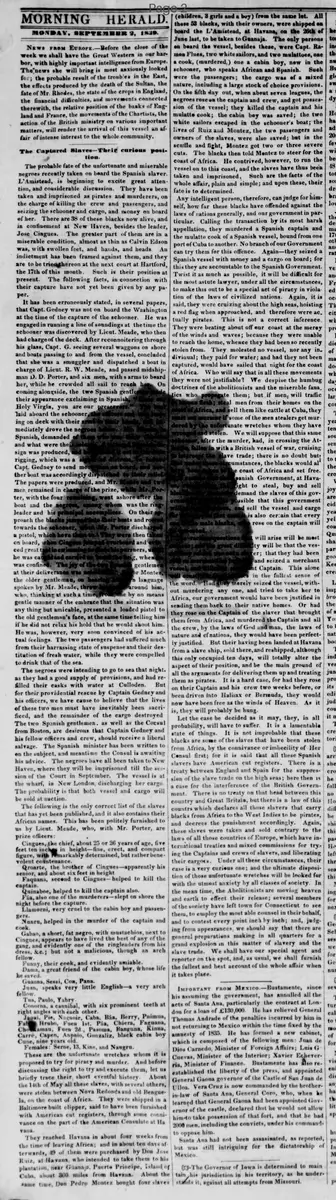
The probable fate of the unfortunate and miserable negroes recently taken on board the Spanish slaver L'Amistad, is beginning to excite great attention, and considerable discussion. They have been taken and imprisoned as pirates and murderers, on the charge of killing the crew and passengers, and seizing the schooner and cargo, and money on board of her. There are 38 of these blacks now alive, and in confinement at New Haven, besides the leader, Jose Cingues. The greater part of them are in a miserable condition, almost as thin as Calvin Edson was, with swollen feet, and hands, and heads. An indictment has been framed against them, and they are to be tried thereon at the next court at Hartford, the 17th of this month. Such is their position at present. The following facts, in connection with their capture have not yet been given by any paper.
It has been erroneously stated, in several papers, that Capt. Gedney was not on board the Washington at the time of the capture of the schooner. He was engaged in running a line of soundings at the time the schooner was discovered by Lieut. Meade, who then had charge of the deck. After reconnoitering through his glass, Capt. G. seeing several negroes on shore and boats passing to and from the vessel, concluded that she was a smuggler and dispatched a boat in charge of Lieut. R. W. Meade, and passed midshipman D. D. Porter, and six men, with arms to board her, while he crowded all sail to reach her. On coming alongside, the two Spanish gentlemen made their appearance exclaiming in Spanish, Holy Virgin, you are our preserver, and laid hold of the schooner. Though the officers and men were immediately drove the negroes from the quarter deck, the Spanish demanded to know what were they doing on board, and what were they. A signal was produced, the American flag from the rigging, which was a sufficient voucher for Capt. Gedney to send another boat. Another boat was accordingly dispatched. The papers were produced, and Mr. Meade and two men remained in charge of the prize, while Mr. Porter, with the four Spaniards, went ashore after the boat and the negroes, one of whom was the ringleader and his principal accomplices. On their approach the blacks jumped to their boats and rowed towards the schooner. Mr. Porter discharged a pistol, which brought them to. They were then on board, when Cingues jumped overboard and caused great consternation among the passengers, but was soon secured. He was calm and erect as ever, when he was confined. The joy of the two Spanish gentlemen at their deliverance was excessive, or Montes. The older gentleman, on beholding Mr. Meade, in broken English language spoken by Mr. Meade, threw his arms around him, who, thinking at such a time, from the very ungentle manner of the embrace that the situation was anything but amicable, presented a loaded pistol to the old gentleman's face, at the same time telling him if he did not relax his hold that he would shoot him. He was, however, very soon convinced of his actual feelings. The two passengers had suffered much from their harassing state of suspense and their destitution of fresh water, while they were compelled to drink that of the sea.
The negroes were intending to go to sea that night, as they had a good supply of provisions, and had refilled their casks with water at Culloden. But for their providential rescue by Captain Gedney and his officers, we have cause to believe that the lives of these two men must have inevitably been sacrificed, and the remainder of the cargo destroyed. The two Spanish gentlemen, as well as the Consul from Boston, are desirous that Captain Gedney and his fellow officers and crew, should receive a liberal salvage. The Spanish minister has been written to on the subject, and meantime the Consul is awaiting his advice. The negroes have all been taken to New Haven, where they will be imprisoned till the session of the Court in September. The vessel is at the wharf, in New London, discharging her cargo. The probability is that both vessel and cargo will be sold at auction.
The following is the only correct list of the slaves that has yet been published, and it also contains their African names. This has been politely furnished to us by Lieut. Meade, who, with Mr. Porter, are prize officers:
Cingues, the chief, about 25 or 26 years of age, five feet ten inches in height—fine, erect, and compact figure, with remarkably determined, but rather benevolent countenance.
Qroarte, the brother of Cingues—apparently his senior, and about six feet in height.
Faquana, second to Cingues—helped to kill the captain.
Quinaboe, helped to kill the captain also.
Faa, also one of the murderers—slept on shore the night before the capture.
Llamorni, very cruel to the cabin boy and passengers.
Nunru, helped in the murder of the captain and cook.
Gabao, a short, fat negro, with mustachios, next to Cingues, appears to have lived the best of any of the gang, and evidently one of the ringleaders from his dress, &c.; but not a malicious, though an arch fellow.
Funny, their cook, and evidently amiable.
Dama, a great friend of the cabin boy, whose life he saved.
Guanna, Sessi, Con, Pana.
Juan, speaks very little English—a very arch fellow.
Tua, Paulo, Yabry.
Conorna, a cannibal, with six prominent teeth at right angles with each other.
Jaoui. Pie, Naguoir. Caba, Baa. Berry, Pnimua,
Fal Hrubo, Fuen 1st. Paa, Chiera, Faguana,
Cho kamau, Fuen 2d, Pasoma, Banguna, Kinna,
Carré, Capen, Anpnio, Gonzaliz, black cabin boy
Cune, nine years old.
Females: Serne, 13, Kine, and Naugru.
These are the unfortunate wretches whom it is proposed to try for piracy and murder. And before discussing the right to try and execute them, let us briefly trace their short eventful history. About the 14th of May all these slaves, with several others, were stolen between Nova Redonda and old Benguela, on the coast of Africa. They were shipped in a Baltimore built clipper, said to have been furnished with American cut registers, through some connivance on the part of the American Consulate at Havana.
They reached Havana in about four weeks from the time of leaving Africa; and in about ten days afterwards, 49 of them were purchased by Don Jose Ruiz, at Havana, who intended to take them to his plantation, near Guanaja, Puerto Principe, Island of Cuba, about 300 miles from Havana. About the same time, Don Pedro Montez bought four slaves (children, 3 girls and a boy) from the same lot. All these 53 blacks, with their owners, were shipped on board the L'Amistad, at Havana, on the 26th of June last, to be taken to Guanaja. The only persons on board the vessel, besides these, were Capt. Ramon Ferrer, two white sailors, and two mulattoes, one a cook, (murdered,) one a cabin boy, now in the schooner, who speaks African and Spanish. Such were the passengers; the cargo was of a mixed nature, including a large stock of choice provisions.
On the fifth day out, when about seven leagues, the negroes rose on the captain and crew, and got possession of the vessel; they killed the captain and his mulatto cook; the cabin boy was saved; the two white sailors escaped in the schooner's boat; the lives of Ruiz and Montez, the two passengers and owners of the slaves, were also saved; but in the scuffle and fight, Montez got two or three severe cuts. The blacks then told Montez to steer for the coast of Africa. He contrived, however, to run the vessel on to this coast, and the slaves have thus been taken and imprisoned. Such are the facts of the whole affair, plain and simple; and upon these, their fate is to be determined.
Any intelligent person, therefore, can judge for himself, how far these blacks have offended against the laws of nations generally, and our government in particular. Calling the transaction by its most harsh appellation, they murdered a Spanish captain and the mulatto cook of a Spanish vessel, bound from one port of Cuba to another. No branch of our Government can try them for this offence. Again—they seized a Spanish vessel with money and a cargo on board; for this they are accountable to the Spanish Government. Twist it as much as possible, it will be difficult for the most astute lawyer, under all the circumstances, to make this out to be a special act of piracy in violation of the laws of civilized nations. Again, it is said, they were cruising about the high seas, hoisting a red flag when approached, and therefore were actually pirates. This is not a correct inference. They were beating about off our coast at the mercy of the winds and waves; because they were unable to reach the home, whence they had been so recently stolen from. They molested no vessel, nor any individual; they paid for water; and had they not been captured, would have sailed that night for the coast of Africa. Who will say that in all these movements they were not justifiable? We despise the humbug doctrines of the abolitionists and the miserable fanatics who propagate them; but if men, will traffic in real flesh and blood men from their homes on the coast of Africa, and sell them like cattle at Cuba, they must run the risk if some of the men stealers get murdered by the unfortunate wretches whom they have so basely stolen. We will suppose that this same slaver, after the murder, had, in crossing the Atlantic, fallen in with a British vessel of war, cruising to intercept the slave trade; there is no doubt but, under all circumstances, the blacks would all have been landed on the coast of Africa and set free. The Spanish Government, at Havana, has no right to steal, buy and sell human beings, and cannot demand the slaves of this government. It is possible that this government may seize the slaves, and sell the vessel and cargo. It is also certain that every one of the 38 blacks, who rose on the captain will be shot. But the questions which will arise will be most serious. The great difficulty will be that the vessel was a Spanish one, and seized a merchant vessel dealt in slave trade. This alone constitutes piracy in the fullest sense of the word. Had they merely seized the vessel, without murdering any one, and tried to take her to Africa, our government would have been justified in sending them back to their native homes. Or had they rose on the Captain of the slaver that brought them from Africa, and murdered the Captain and all the crew, by the laws of God and man, the laws of nature and nations, they would have been perfectly justified. But their having been landed at Havana from a slave ship, sold there, and reshipped, although this only occupied ten days, will totally alter the aspect of their position, and be the main ground of all the arguments for delivering them up and treating them as pirates. It is a hard case, for had they rose on their Captain and his crew two weeks before, or been driven into Halifax or Bermuda, they would now have been free as the winds of Heaven. As it is, they will probably be hung.
Let the case be decided as it may, they, in all probability, will have to suffer. It is a lamentable state of things. It is not improbable that these blacks are some of the slaves that have been stolen from Africa, by the connivance or imbecility of Her Britannic Majesty's Consul first; for it is said that all these Spanish slavers have American cut registers. There is a treaty between England and Spain for the suppression of the slave trade on the high seas; here then is a case for the interference of the British Government. There is no treaty on that head between this country and Great Britain, but there is a law of this country which declares all those slavers that carry blacks from Africa to the West Indies to be pirates, and decrees the punishment accordingly. Again, these slaves were taken and sold contrary to the laws of all those countries of Europe, which have international treaties and mixed commissions for trying the Captains and crews of slavers, and liberating their cargoes. Under all these circumstances, their case is a very curious one; and the ultimate disposition of those unfortunate wretches will be looked for with the utmost anxiety by all classes of society. In the mean time, the Abolitionists are moving heaven and earth to effect their release; several members of the society have left town for Connecticut to see them, to employ the most able counsel in their behalf, and to contest every point inch by inch; and, judging from appearances, we should say that there are general preparations making in all quarters for a grand explosion in this matter of slavery and the slave trade. We shall have our special agent and reporter on the spot, and, as usual, we shall furnish the fullest and best account of the whole affair when it takes place.
What sub-type of article is it?
What themes does it cover?
What keywords are associated?
What entities or persons were involved?
Where did it happen?
Story Details
Key Persons
Location
Off The Coast Of The United States, New Haven, Hartford, Havana, Cuba, Coast Of Africa
Event Date
About The 14th Of May To 26th Of June Last
Story Details
African slaves aboard the Spanish slaver L'Amistad revolted, killed the captain and cook, spared owners Ruiz and Montez, and attempted to return to Africa but were captured by U.S. Navy under Capt. Gedney near Culloden; 38 survivors imprisoned in New Haven awaiting trial for piracy and murder.