Thank you for visiting SNEWPapers!
Sign up free
The National Intelligencer And Washington Advertiser
Washington, District Of Columbia
What is this article about?
In the British House of Commons, Mr. Roscoe of Liverpool delivers a speech supporting the bill to abolish the African slave trade, arguing it will improve conditions for slaves in the West Indies, benefit Africa by ending destructive trade, and calls for gradual implementation with potential compensation for merchants, emphasizing broader economic benefits.
Clipping
OCR Quality
Full Text
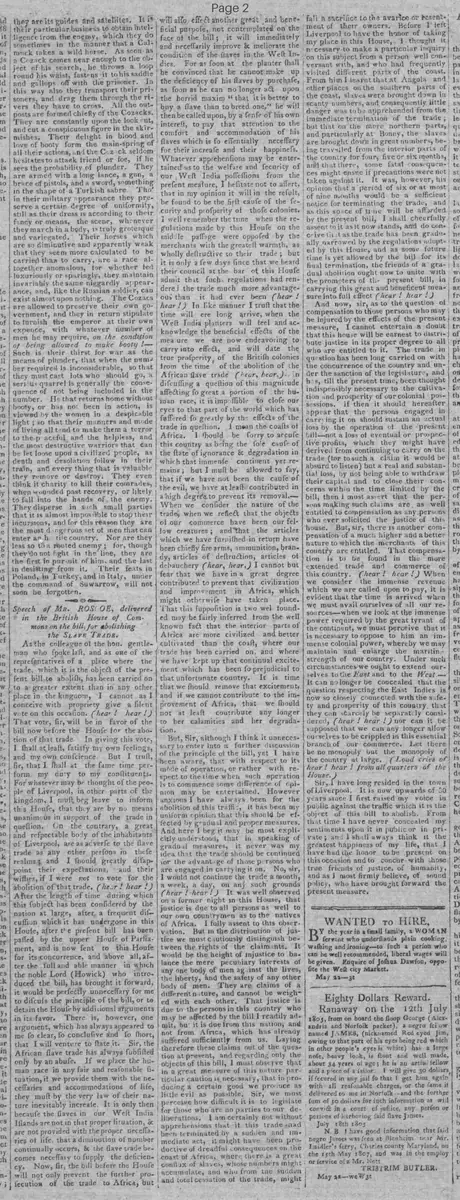
As the colleague of the hon. gentleman who spoke last, and as one of the representatives of a place where the trade, which it is the object of the present bill to abolish, has been carried on to a greater extent than in any other place in the kingdom, I cannot as I conceive with propriety give a silent vote on this occasion. (hear ! hear!) That vote, sir, will be in favor of the bill now before the House for the abolition of that trade In giving this vote, I shall at least, satisfy my own feelings, and my own conscience. But I trust, sir, that I shall at the same time perform my duty to my constituents. For whatever may be thought of the people of Liverpool, in other parts of the kingdom, I must beg leave to inform this House, that they are by no means unanimous in support of the trade in question. On the contrary, a great and respectable body of the inhabitants of Liverpool, are as adverse to the slave trade as any other persons in these realms; and I should greatly disappoint their expectations, and their wishes, if I were not to vote for the abolition of that trade. ( hear ! hear ! ) After the length of time during which this subject has been considered by the nation at large, after a frequent discussion which it has undergone in this House, after the present bill has been passed by the upper House of Parliament, and is now sent to this House for its concurrence, and above all, after the full and able manner in which the noble Lord (Howick) who introduced the bill, has brought it forward, it would be perfectly unnecessary for me to discuss the principle of the bill, or to detain the House by additional arguments in its favor. There is, however, one argument, which has always appeared to me so clear, so conclusive and so short, that I will venture to state it. Sir, the African slave trade has always subsisted only by an abuse. If we place the human race in any fair and reasonable situation, if we provide them with the necessaries and accommodations of life, they must by the very law of their nature inevitably increase. It is only then because the slaves in our West India Islands are not in that proper situation, & are not provided with the proper necessaries of life, that a diminution of number continually occurs, & the slave trade becomes necessary to supply the deficiency. Now, sir, the bill before the House will not only prevent the further prosecution of the trade to Africa, but will also effect another great and beneficial purpose, not contemplated on the face of the bill; it will immediately and necessarily improve & meliorate the condition of the slaves in the West Indies. For as soon as the planter shall be convinced that he cannot make up the deficiency of his slaves by purchase, as soon as he can no longer act upon the horrid maxim " that it is better to buy a slave than to breed one," he will then be called upon, by a sense of his own interest, to pay that attention to the comfort and accommodation of his slaves which is so essentially necessary for their increase and their happiness. Whatever apprehensions may be entertained as to the welfare and security of our , West India possessions from the present measure, I hesitate not to assert, that in my opinion it will in the result, be found to be the first cause of the security and prosperity of those colonies. I well remember the time when the regulations made by this House on the middle passage were opposed by the merchants with the greatest warmth, as wholly destructive to their trade; but it is only a few days since that we heard their council at the bar of this House admit that such regulations had rendered the trade much more advantageous than it had ever been (hear ! hear ! ) In like manner I trust that the time will ere long arrive, when the West India planters will feel and acknowledge the beneficial effects of the measure we are now endeavoring to carry into effect, and will date the true prosperity, of the British colonies from the time of the abolition of the African Slave trade (hear, hear,). In discussing a question of this magnitude affecting so great a portion of the human race, it is impossible to close our eyes to that part of the world which has suffered so greatly by the effects of the trade in question. I mean the coasts of Africa. I should be sorry to accuse this country as being the sole cause of the state of ignorance & degradation in which that immense continent yet remains; but I must be allowed to say, that if we have not been the cause of the evil, we have at least contributed in a high degree to prevent its removal,— When we consider the nature of the trade, when we reflect that the objects of our commerce have been our fellow creatures: and that the articles which we have furnished in return have been chiefly fire arms, ammunition, brandy, articles of destruction, articles of debauchery (hear, hear,) I cannot but fear that we have in a great degree contributed to prevent that civilization and improvement in Africa, which might otherwise have taken place. That this supposition is too well founded may be fairly inferred from the well known fact that the interior parts of Africa are more civilized and better cultivated than the coast, where our trade has been carried on, and where we have kept up that continual excitement which has been so prejudicial to that unfortunate country. It is time that we should remove that excitement, and if we cannot contribute to the improvement of Africa, that we should not at least contribute any longer to her calamities and her degradation.
But, Sir, although I think it unnecessary to enter into a further discussion of the principle of the bill, yet I have been aware, that with respect to its mode of operation, or rather with respect to the time when such operation is to commence some difference of opinion may be entertained. However anxious I have always been for the abolition of this traffic, it has been my uniform opinion that this should be effected by gradual and proper measures. And here I beg it may be most explicitly understood, that in speaking of gradual measures, it never was my idea that the trade should be continued for the advantage of those persons who are engaged in carrying it on. No, sir, I would not continue the trade a month, a week, a day, on any such grounds (hear ! hear!) It was well observed on a former night in this House, that justice is due to all persons as well to our own countrymen as to the natives of Africa. I fully assent to this observation. But in the distribution of justice we must cautiously distinguish between the rights of the claimants. It would be the height of injustice to balance the mere pecuniary interests of any one body of men against the lives, the liberty, and the safety of any other body of men. They are claims of a different nature, and cannot be weighed with each other. That justice is due to the persons in this country who may be affected by the bill I readily admit, bu' it is due from this nation, and not from Africa, which has already suffered sufficiently from us. Laying therefore these claims out of the question at present, and regarding only the objects of this bill, I must observe that in a great measure of this nature particular caution is necessary, that in producing a certain good we produce as little evil as possible. Sir, we must perceive how difficult it is to legislate for those who are no parties to our deliberations. I am certainly not without apprehensions that if this trade had been terminated by a sudden and immediate act, it might have been productive of dreadful consequences on the coast of Africa, where there is a great conflux of slaves, whose numbers might accumulate, and who from the sudden and total cessation of the trade, might fall a sacrifice to the avarice or resentment of their owners. Before I left Liverpool to have the honor of taking my place in this House, I thought it necessary to make a particular inquiry on this subject from a person well conversant with, and who had frequently visited different parts of the coast. From him I learnt that at Angola and other places on the southern parts of the coast, slaves were brought down in scanty numbers, and consequently little danger was to be apprehended from the immediate termination of the trade : but that on the more northern parts, and particularly at Bonny, the slaves are brought down in great numbers, being travailed from the interior parts of the country for four, five or six months, and that there, some fatal consequences might ensue if precautions were not taken against it. It was, however, his opinion that a period of six or at most of nine months would be a sufficient notice for terminating the trade, and as this space of time will be afforded by the present bill, I shall cheerfully assent to it as it now stands, and do conceive that as the trade has been gradually narrowed by the regulations adopted by this House, and as some future time is yet allowed by the bill for its final termination, the friends of a gradual abolition ought now to unite with the promoters of the present bill, in carrying this great and beneficial measure into full effect (hear ! hear ! )
And now, sir, as to the question of compensation to those persons who may be injured by the effects of the present measure, I cannot entertain a doubt that this house will be earnest to distribute justice in its proper degree to all who are entitled to it. The trade in question has been long carried on with the concurrence of the country and under the sanction of the legislature, and has, till the present time, been thought indispensibly necessary to the cultivation and prosperity of our colonial possessions. if then it should hereafter appear that the persons engaged in carrying it on should sustain an actual loss by the operation of the present bill--not a loss of eventual or prospective profits, which they might have derived from continuing to Carry on the trade (for to such a claim it would be absurd to listen) but a real and substantial loss, by not being able to withdraw their capital and to close their concerns within the time limited by the bill, then i must assert that the persons making such claims are, as well entitled to compensation as any persons who ever solicited the justice of this house. But, sir, there is another compensation of a much higher and a better nature to which the merchants of this country are entitled. That compensation is to be found in the more extended trade and commerce of this country. (Chear ! hear !) When we consider the immense revenue which we are called upon to pay, it is evident that the time is arrived when we must avail ourselves of all our resources -when we look at the immense power required by the great tyrant of the continent, we must perceive that it is necessary to oppose to him an immense colonial power, whereby we may maintain and enlarge the maritime. strength of our country. Under such circumstances/we ought to extend ourselves to the East and to the West.-- It can no longer be concealed that the question respecting the East Indies is now so closely connected with the safety and prosperity of this country, that they can scarcely be separately considered, (hear ! hear !)nor can it be supposed that we can any longer allow ourselves to be crippled in this essential branch of our commerce. Let there be no monopoly but the monopoly of the country at large. (Loud cries of hear! hear ! from all quarters of the House.)
Sir, I have long resided in the town of Liverpool, It is now upwards of 30 years since I first raised my voice in public against the traffic which it is the object of this bill to abolish. From that time I have never concealed my sentiments upon it in public or in private; and I shall always think it the greatest happiness of my life, that I have had the honor to be present on this occasion and to concur-with those true friends of justice, of humanity, and as I most firmly believe, of sound policy, who have brought forward the present measure.
What sub-type of article is it?
What keywords are associated?
What entities or persons were involved?
Where did it happen?
Foreign News Details
Primary Location
West Indies
Key Persons
Outcome
abolition of the african slave trade through the bill, expected to improve slave conditions in west indies, reduce calamities in africa, with gradual implementation over six to nine months and potential compensation for merchants' actual losses.
Event Details
Mr. Roscoe, MP for Liverpool, speaks in favor of the bill to abolish the slave trade, noting local opposition in Liverpool, arguing the trade sustains due to poor slave conditions, predicting better treatment post-abolition, highlighting negative impacts on Africa from arms and alcohol trade, advocating gradual cessation to avoid harm on African coasts like Bonny and Angola, and supporting compensation for real losses while emphasizing expanded commerce benefits.