Thank you for visiting SNEWPapers!
Sign up free
The Brattleboro Daily Reformer
Brattleboro, Windham County, Vermont
What is this article about?
During a committee investigation into the Brattleboro Retreat, trustees and staff testify defending Dr. Lawton's administration, patient care, and a $1,000 settlement with former employee Mrs. Guilford to avoid a lawsuit alleging injury. Witnesses deny mistreatment claims and highlight the institution's challenges.
Clipping
OCR Quality
Full Text
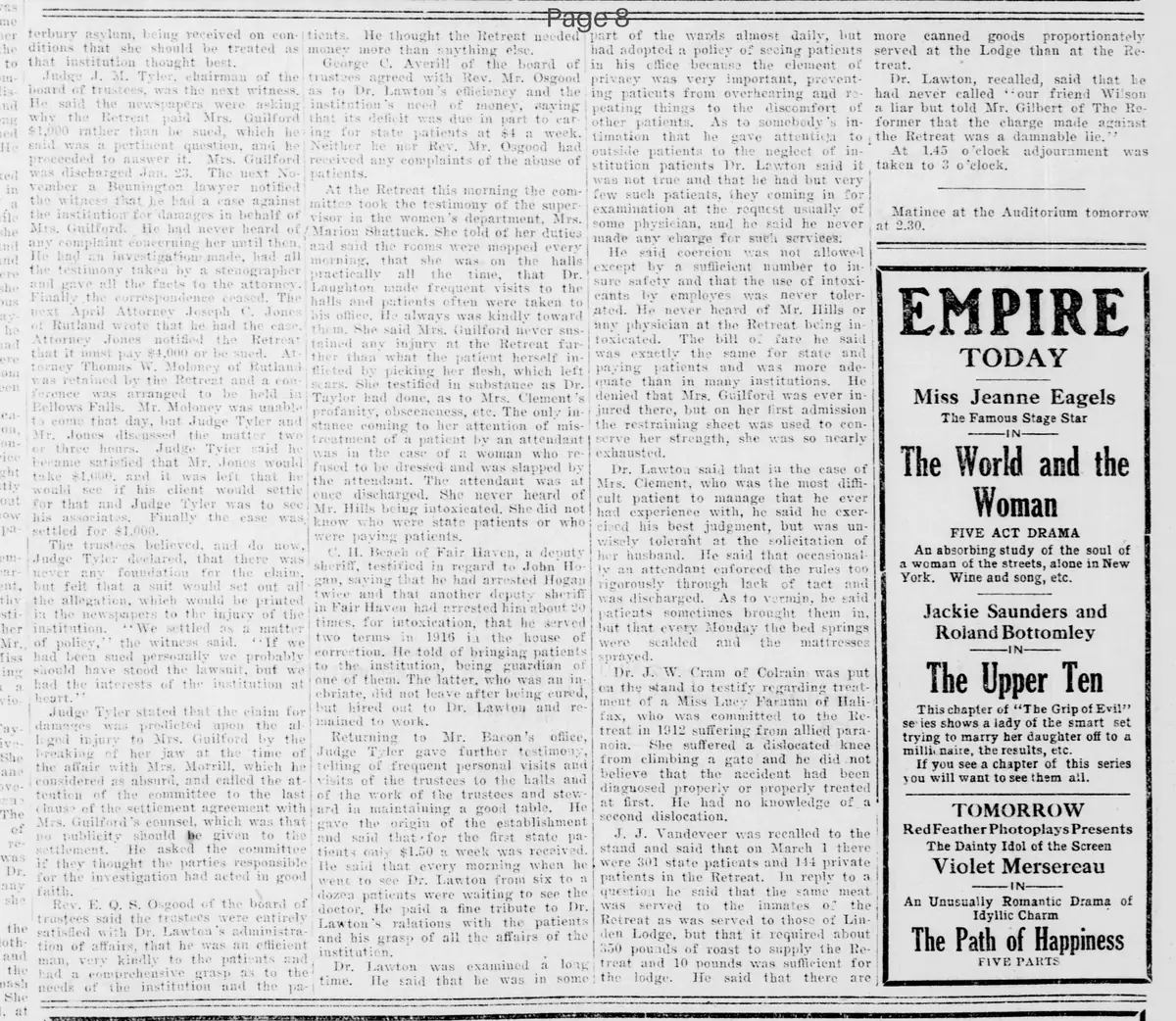
The trustees believed, and do now, Judge Tyler declared, that there was never any foundation for the claim. But felt that a suit would set out all the allegations, which would be printed in the newspapers to the injury of the institution. We settled as a matter of policy," the witness said. "If we had been sued personally we probably should have stood the lawsuit, but we had the interests of the institution at heart."
Judge Tyler stated that the claim for damages was predicated upon the alleged injury to Mrs. Guilford by the breaking of her jaw at the time of the affair with Mrs. Morrill, which he considered as absurd, and called the attention of the committee to the last clause of the settlement agreement with Mrs. Guilford's counsel, which was that no publicity should be given to the settlement. He asked the committee if they thought the parties responsible for the investigation had acted in good faith.
Rev. E. Q. S. Osgood of the board of trustees said the trustees were entirely satisfied with Dr. Lawton's administration of affairs, that he was an efficient man, very kindly to the patients and had a comprehensive grasp as to the needs of the institution and the patients. He thought the Retreat needed money more than anything else.
George C. Averill of the board of trustees agreed with Rev. Mr. Osgood as to Dr. Lawton's efficiency and the institution's need of money, giving that its deficit was due in part to caring for state patients at $4 a week. Neither he nor Rev. Mr. Osgood had received any complaints of the abuse of patients.
At the Retreat this morning the committee took the testimony of the supervisor in the women's department, Mrs. Marion Shattuck. She told of her duties and said the rooms were mopped every morning, that she was on the halls practically all the time, that Dr. Lawton made frequent visits to the halls and patients often were taken to his office, he always was kindly toward them. She said Mrs. Guilford never sustained any injury at the Retreat farther than what the patient herself inflicted by picking her flesh, which left scars. She testified in substance as Dr. Taylor had done, as to Mrs. Clement's profanity, obsceneness, etc. The only instance coming to her attention of mistreatment of a patient by an attendant was in the case of a woman who refused to be dressed and was slapped by the attendant. The attendant was at once discharged. She never heard of Mr. Hills being intoxicated. She did not know who were state patients or who were paying patients.
C. H. Beach of Fair Haven, a deputy sheriff, testified in regard to John Hogan, saying that he had arrested Hogan twice and that another deputy sheriff in Fair Haven had arrested him about 20 times, for intoxication, that he served two terms in 1916 in the house of correction. He told of bringing patients to the institution, being guardian of one of them. The latter, who was an inebriate, did not leave after being cured, but hired out to Dr. Lawton and remained to work.
Returning to Mr. Bacon's office, Judge Tyler gave further testimony, telling of frequent personal visits and visits of the trustees to the halls and of the work of the trustees and steward in maintaining a good table. He gave the origin of the establishment and said that for the first state patients only $1.50 a week was received. He said that every morning when he went to see Dr. Lawton from six to a dozen patients were waiting to see the doctor. He paid a fine tribute to Dr. Lawton's relations with the patients and his grasp of all the affairs of the institution.
Dr. Lawton was examined a long time. He said that he was in some part of the wards almost daily, but had adopted a policy of seeing patients in his office because the element of privacy was very important, preventing patients from overhearing and repeating things to the discomfort of other patients. As to somebody's intimation that he gave attention to outside patients to the neglect of institution patients Dr. Lawton said it was not true and that he had but very few such patients, they coming in for examination at the request usually of some physician, and he said he never made any charge for such services.
He said coercion was not allowed except by a sufficient number to insure safety and that the use of intoxicants by employees was never tolerated. He never heard of Mr. Hills or any physician at the Retreat being intoxicated. The bill of fare he said was exactly the same for state and paying patients and was more adequate than in many institutions. He denied that Mrs. Guilford was ever injured there, but on her first admission the restraining sheet was used to conserve her strength, she was so nearly exhausted.
Dr. Lawton said that in the case of Mrs. Clement, who was the most difficult patient to manage that he ever had experience with, he said he exercised his best judgment, but was unwisely tolerant at the solicitation of her husband. He said that occasionally an attendant enforced the rules too rigorously through lack of tact and was discharged. As to vermin, he said patients sometimes brought them in, but that every Monday the bed springs were scalded and the mattresses sprayed.
Dr. J. W. Cram of Colrain was put on the stand to testify regarding treatment of a Miss Lucy Farnum of Halifax, who was committed to the Retreat in 1912 suffering from allied paranoia. She suffered a dislocated knee from climbing a gate and he did not believe that the accident had been diagnosed properly or properly treated at first. He had no knowledge of a second dislocation.
J. J. Vandeveer was recalled to the stand and said that on March 1 there were 301 state patients and 114 private patients in the Retreat. In reply to a question he said that the same meat was served to the inmates of the Retreat as was served to those of Linen Lodge, but that it required about 50 pounds of roast to supply the Retreat and 10 pounds was sufficient for the lodge. He said that there are more canned goods proportionately served at the Lodge than at the Retreat.
Dr. Lawton, recalled, said that he had never called our friend Wilson a liar but told Mr. Gilbert of The Reformer that the charge made against the Retreat was a damnable lie.
At 1.45 o'clock adjournment was taken to 3 o'clock.
What sub-type of article is it?
What themes does it cover?
What keywords are associated?
What entities or persons were involved?
Where did it happen?
Story Details
Key Persons
Location
The Retreat
Event Date
Jan. 23; 1916
Story Details
Witnesses including trustees and staff testify in defense of the Retreat's administration and patient care during an investigation, explaining a $1,000 settlement with Mrs. Guilford to avoid publicity from a baseless lawsuit alleging injury, praising Dr. Lawton's efficiency, and denying mistreatment claims.