Thank you for visiting SNEWPapers!
Sign up free
The New Hampshire Gazette
Portsmouth, Rockingham County, New Hampshire
What is this article about?
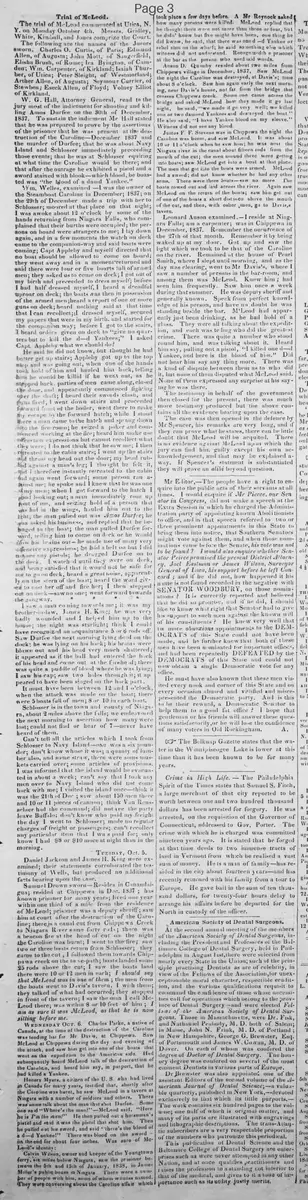
The trial of Alexander McLeod for shooting and killing Amos Durfee during the December 1837 destruction of the steamboat Caroline commenced in Utica, NY, on October 4. Witnesses, including the boat's owner Wm. Welles and others, testified to the attack and McLeod's alleged admissions of involvement and killing Durfee. The prosecution presented evidence of the raid; defense opened arguing alibi.
Clipping
OCR Quality
Full Text
The trial of McLeod commenced at Utica, N. Y. on Monday October 4th. Messrs. Gridley, White, Kimball, and Jones comprise the Court.
The following are the names of the Jurors sworn. Charles O. Curtis, of Paris; Edmund Allen, of Augusta; John Mott, of Sangerfield, Elisha Brush, of Rome; Ira Byington, of Camden; Wm. Carpenter, of Kirkland; Isaiah Thurber, of Utica; Peter Sleight, of Westmoreland; Arthur Allen, of Augusta; Seymour Currier, of Steuben; Eseck Allen, of Floyd; Volney Elliot of Kirkland.
W. G. Hall, Attorney General, read to the jury most of the indictment for shooting and killing Amos Durfee on the 30th of December, 1837. To sustain the indictment Mr Hall stated that he was prepared to prove by the assertions of the prisoner that he was present at the destruction of the Caroline December 1837 and the murder of Durfee; that he was about Navy Island and Schlosser immediately preceding those events: that he was at Schlosser enquiring at what time the Caroline would be there; and that after the outrage he exhibited a pistol and a sword stained with blood-which blood, he boasted was "the blood of a damned Yankee."
Wm. Welles, examined -I was the owner of the Steamboat Caroline in December; 1837; on the 29th of December made a trip with her to Schlosser; moored at that place on that night; I was awoke about 12 o'clock by some of the hands returning from Niagara Falls, who complained that their berths were occupied; the persons on board were strangers to me; I lay down again, and in a few moments the watch on deck came to the companion-way and said boats were coming; Capt Appleby and myself directed that no boat should be allowed to come on board; they went away and in a moment returned and said there were four or five boats full of armed men; they asked us to come on deck; I got out of my berth and proceeded to dress myself; before I had half dressed myself. I heard a dreadful uproar on deck; the boats was then in possession of the armed men; heard a report of one or more guns on deck; heard nothing said at that time that I can recollect: I dressed myself, secured my papers that were in my berth. and started for the companion way; before I got to the stairs, I heard orders given on deck to "give no quarters but to kill the d-d Yankees;" I asked Capt. Appleby what we should do? He said he did not know, but thought he had better get up stairs; Appleby got up to the top step and was going out, when one of the hands took hold of him and hauled him back, telling him he would be killed if he went out, as he stepped back. parties of men came along, closed the door, and apparently commenced fighting over the shaft; I heard their swords clash, and guns fired, I went down stairs and proceeded forward front of the boiler. went there to make my escape by the forward hatch; while I stood there a man came to the hatch and sprang down into the fire-room; he seized a poker and commenced working at the fire; heard him take use of certain expressions but cannot recollect what they were; I do not think that he saw me; I then retreated to the cabin stairs; I went up the stairs and thrust my head out the door; my head rubbed against a man's leg; I thought he felt it, and I therefore instantly retreated to the cabin and again went forward; some person ran against me; he spoke and I knew that he was one of my men; when I got forward to the hatch I stood looking out; a man immediately rose up front of me, and seizing hold of a person that was hid in the wings, hauled him out to the light; the man pulled out was Amos Durfee; he was asked his business, and replied that he belonged to the boat; the man pulled Durfee forward, telling him to come on deck or he would blow his brains out -he made use of many very offensive expressions; he had a belt on but I did not see any pistols; he dragged Durfee on to the deck. I watched until they were on deck, and being satisfied that it would not be safe for me to go on deck, heard a great noise, apparently on the stern of the boat; heard the word given to cast her off and fire her; I then stepped out on deck-saw no one; went forward towards the gangway. I saw a man coming towards me; it was my brother-in-law, James H. King; he was very badly wounded and I helped him up to the house; the night was starlight; think I could have recognized an acquaintance 5 or 6 rods off. Saw Durfee the next morning lying dead on the dock: he was lying on his back; his brains were blown out and his head very much shattered; it appeared as if the ball had entered the back of his head and come out at the forehead; there was quite a puddle of blood where he was lying; I saw his cap; saw two holes through it; it appeared to have been singed on the back part. It must have been between 12 and 1 o'clock, when the attack was made on the boat; there were 5 boats full of men; 8 or 10 in each boat. Schlosser is in the town and county of Niagara, about 2 miles above the falls; we endeavored the next morning to ascertain how many were lost; could not find or hear of 7-never have heard of them. Can't tell all the articles which I took from Schlosser to Navy Island-one was a six pounder; don't know whose it was; a quantity of lumber also, and some straw, there were some muskets carried over; some articles of provisions. I was informed that the island would be evacuated in about a week; can't say that I took any men over to Navy Island who did not come back with me; I visited the island once-think it was the 21st of Dec; saw about 150 men there and 10 or 11 pieces of cannon; think Van Rensselaer had the command; did not see the party leave Buffalo; don't know who paid my freight the day I went to Schlosser; made no regular charges of freight or passengers; can't recollect any particular item that I was paid for; only know I had $8 or $10 more at night than in the morning.
Tuesday. Oct. 5.
Daniel Jackson and James H. King were examined: their statements corroborated the testimony of Wells, but produced no additional facts bearing upon the case.
Samuel Drown sworn-Resides in Canandaigua; resided at Chippewa in Dec. 1837 ; has known prisoner for many years; lived one year within one third of a mile from the residence of McLeod; prisoner was a deputy sheriff; saw him at court after the destruction of the Caroline; there is a canal cut from Chippewa Creek to Niagara River some forty rods; there was a beacon fire at the head of cut on the night the Caroline was burnt; I went to the fire; saw two or three boats return from Schlosser; they came to the cut , I followed them towards Chippewa creek on the tow path; boats landed some 25 rods above the cut; I saw the boats land there were 10 or 12 men in each; I should say that McLeod was in one of them ; the men from the boats went to Davis's tavern, I with them; they talked of what had occurred; they stopped in front of the tavern; I saw the man I call McLeod there; was within 8 or 10 feet of him : I am as sure it was McLeod,as that he is now sitting before me.
Wednesday Oct. 6. Charles Parker, a native of Canada, at the time of the destruction of the Caroline was tending bar for Mr Davis, at Chippewa. Saw McLeod at Chippewa during the day and evening of the attack, and saw him get into one of the boats that went on the expedition to the American side. Had subsequently heard McLeod talk of the destruction of the Caroline, and heard him say, in purport, that he had killed a Yankee.
Henry Myers, a citizen of the U. S. who had lived in Canada for many years, testified that, shortly after the Caroline was burnt, he saw McLeod in a tavern at Niagara with a number of soldiers and others. There was some talk about the man that shot Durfee. Some one said "Where's the man?"—McLeod said, "Here he is I'm the man!" He then pulled out a horseman's pistol and said it was the pistol that shot him. Then he pulled out his sword, and said 'there's the blood of a d-d Yankee!" There was blood on the sword - on the end or about four inches. Was sure of McLeod's identity.
Calvin Wilson, owner and keeper of the Youngtown ferry, six miles below Niagara, saw the prisoner between the 5th and 15th of January, 1838, in James Miller's public house in Niagara There were a number of people with him, some of whom witness named. They were conversing about the Caroline affair which took place a few days before. A Mr Reynolds asked how many persons were killed. McLeod replied that he thought there were not more than three or four, but he didn't know but five might have been, one thing he did know, he said, that there was one d-d Yankee or rebel shot on the wharf; he said something else which witness did not understand. Recognized the prisoner at the bar as the person who used said words.
Anson D. Quimby resided about two miles from Chippewa village in December, 1837, Saw McLeod the night the Caroline was destroyed, at Davis's; time about 8 o'clock. Saw him again early the next morning, near Davis's house, not far from the bridge that crosses Chippewa creek. Some one came across the bridge and asked McLeod how they made it go last night, he said, "we made it go very well; we killed one or two damned Yankees and destroyed the boat." He also said, "I have Yankee blood on my sleeve." Witness did not see any blood.
Justus F. F. Stevens was in Chippewa the night the Caroline was burnt, and saw McLeod. It was about 10 or 11 o'clock when he saw him; he was near the Niagara river in the canal about fifteen rods from the mouth of the cut; the men around there were getting into boats; saw McLeod get into a boat at that place. The men that got into the boats were armed. McLeod had a sword; did not know whether he had any other arms. There were three boats-saw no more The boats rowed out and laid across the river. Again saw McLeod on the return of the boats; saw him get out of one of the boats a short distance above the mouth of the cut, and then, with other men, go to Davis's tavern.
Leonard Anson examined.-I reside at Niagara Falls; am a carpenter; was in Chippewa in December, 1837. Remember the occurrence of the 29th of that month. Remember it by being waked up at my door. Got up and saw the light which we took to be that of the Caroline on the river. Remained at the house of Pearl Smith, where I slept until morning, and as the day was clearing, went to Mr Davis's, where I saw a number of persons in the bar-room, and among them was McLeod. Knew him ; had seen him frequently. Saw him once a week during that summer. He was deputy sheriff and generally known. Speak from perfect knowledge of his person, and have no doubt he was standing beside the bar. McLeod had apparently just been drinking, as he had hold of a glass. They were all talking about the expedition, and each was telling who did the greatest crime. There was quite a number who stood round him, and was talking about it. Heard him say, pulling out a pistol, "I killed one d-d Yankee, and here is the blood of him." Did not hear him say any thing more. There was a kind of dispute between them as to who did it, but none of them disputed what McLeod said. None of them expressed any surprise at his saying he was there.
The testimony in behalf of the government then closed for the present, there was much more testimony produced but the above contains all the evidence bearing upon the case.
The case was then opened in the defence by Mr Spencer, his remarks are very long, and if they can prove what he states, there can be little doubt that McLeod will be acquitted. There is no evidence against McLeod upon which the jury can find him guilty except his own acknowledgement, and that may be explained away. If Spencer's statement is substantiated they will prove an alibi beyond question.
What sub-type of article is it?
What keywords are associated?
What entities or persons were involved?
Where did it happen?
Domestic News Details
Primary Location
Utica, N. Y.
Event Date
Monday October 4th
Key Persons
Outcome
amos durfee shot and killed, brains blown out; james h. king badly wounded; 7 persons missing and presumed lost; steamboat caroline destroyed by fire; trial ongoing with defense arguing alibi.
Event Details
Trial commenced with indictment read for murder of Durfee during Caroline destruction on December 29-30, 1837, at Schlosser. Witnesses testified to armed raid by boats from Canada, capture of boat, orders to kill Yankees, Durfee dragged out and shot, boat set afire. Multiple witnesses identified McLeod as participant, boasting of killing Durfee and showing bloodied weapons.