Thank you for visiting SNEWPapers!
Sign up free
Literary
June 20, 1833
Phenix Gazette
Alexandria, Virginia
What is this article about?
Extracts from 1824 letters by John Randolph of Roanoke to a New York correspondent, covering congressional speeches on Pitt and Fox, the Greek question, Tariff bill debates, personal health, travel plans, and including two humorous jeux d'esprit on political figures.
Clipping
OCR Quality
98%
Excellent
Full Text
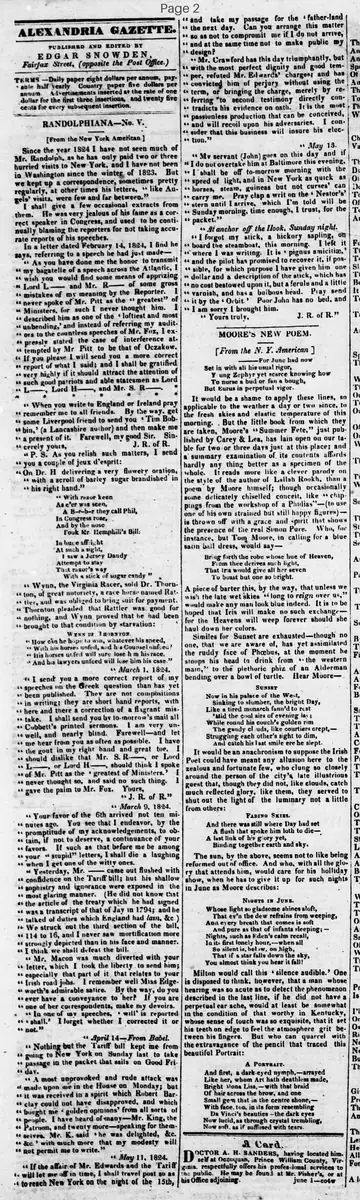
RANDOLPHIANA—No. V.
[From the New York American]
Since the year 1824 I have not seen much of Mr. Randolph, as he has only paid two or three hurried visits to New-York, and I have not been in Washington since the winter of 1823. But we kept up a correspondence, sometimes pretty regularly, at other times his letters, "like Angels' visits, were few and far between."
I shall give a few occasional extracts from them. He was very jealous of his fame as a correct speaker in Congress, and used to be continually blaming the reporters for not taking accurate reports of his speeches.
In a letter dated February 14, 1824, I find he says, referring to a speech he had just made—
"my bagatelle of a speech across the Atlantic, I wish you would find some means of apprizing Lord L— and Mr. R— of some gross mistakes of my meaning by the Reporter. I never spoke of Mr. Pitt as the "greatest" of Ministers, for such I never thought him. I described him as one of the loftiest and most unbending, and instead of referring my auditors to the countless speeches of Mr. Fox, I expressly stated the case of interference at Oczakow. If you please I will send you a more correct report of what I said; and I shall be gratified very highly if it should attract the attention of such good patriots and able statesmen as Lord L—, Lord H—, and Mr. S. R—.
When you write to England or Ireland pray remember me to all friends. By the way, get some Liverpool friend to send you 'Tim Bobbin,' (a Lancashire author) and then make me a present of it. Farewell, my good Sir. Sincerely yours,
J. R. of R.
P. S. As you relish such matters, I send you a couple of jeux d'esprit:
On Dr. H delivering a very flowery oration, with a scroll of barley sugar brandished in his right hand.
"With razor keen
As e'er was seen,
A B-r-b-r they call Phil,
In Congress rose,
And by the nose
Took Mr. Hemphill's Bill:
In huge affright
At such a sight,
I saw a Jersey Dandy
Attempt to stay
That razor's way
With a stick of sugar candy"
Wynn, the Virginia Racer, sold Dr. Thornton, of great notoriety, a race horse named Rattler, and was obliged to bring suit for payment. Thornton pleaded that Rattler was good for nothing, and Wynn proved that he had been brought to that condition by starvation:
WYNN vs. THORNTON.
"How can he hope to win, whatever his speed,
With his horses unfed, and his Counsel unfeed?
His horses unfed will sure lose him his race,
And his lawyers unfeed will lose him his case."
March 1, 1824.
I send you a more correct report of my speeches on the Greek question than has yet been published. They are not compositions in writing; they are short hand reports, with here and there a correction of a flagrant mistake. I shall send you by to-morrow's mail all Cobbett's printed sermons. I am very unwell, and nearly blind. Farewell—and let me hear from you as often as possible. I have the gout in my right hand and great toe. I should dislike that Mr. S. R—, or Lord L—, or Lord H—, should think I spoke of Mr. Pitt as the greatest of Ministers. I never thought so, and said no such thing. I gave the palm to Mr. Fox. Yours,
J. R. of R.
March 9, 1824.
Your favor of the 6th arrived not ten minutes ago. You see that I endeavor, by the promptitude of my acknowledgments, to obtain, if not to deserve, a continuance of your favors. If such as that before me be among your "stupid" letters, I shall die a laughing when I get one of the witty ones.
Yesterday, Mr. — came out flushed with confidence on the Tariff bill; but his shallow sophistry and ignorance were exposed in the most glaring manner. (He did not know that the article of the treaty which he had signed was a transcript of that of Jay in 1794; and he talked of duties which England had laid, &c.) We struck out the third section of the bill, 114 to 16, and I never saw mortification more strongly depicted than in his face and manner.
I think we shall defeat the bill. Mr. Macon was much diverted with your letter, which I took the liberty to send him; especially that part of it that relates to your Irish road jobs. I remember well Miss Edgeworth's admirable satire. By the way, do you ever have a conveyance to her? If you are one of her correspondents, make my devoirs.
…In one of my speeches, 'will' is reported 'shall.' I forget whether I corrected it or not.
April 14—From Babel.
Nothing but the Tariff bill kept me from going to New York on Sunday last to take passage in the packet that sails on Good Friday.
A most unprovoked and rude attack was made upon me in the House on Monday; but it was received in a spirit which Robert Barclay could not have disapproved, and which brought me golden opinions from all sorts of people. I have heard of many—Mr. King, the Patroon, and twenty more—speaking for themselves. Mr. K. said he was delighted, &c., with much more that my modesty will not permit me to write.
May 11, 1824.
If the affair of Mr. Edwards and the Tariff will let me off in time, I shall travel post so as to reach New York on the night of the 15th, and take my passage for the father-land the next day. Can you arrange this matter so as not to compromit me if I do not arrive; and at the same time not to make public my design?
Mr. Crawford has this day triumphantly, but with the most perfect dignity and good temper, refuted Mr. Edwards' charges; and has convicted him of perjury without using the term, or bringing the charge, merely by referring to second testimony directly contradicts his evidence on oath. It is the most passionless production that can be conceived, and will recoil upon his adversaries. I consider that this business will insure his election.
May 13.
My servant (John) goes on this day and if I do not overtake him at Baltimore this evening, I'll be off to-morrow morning with the speed of light, and in New York as quick as horses, steam, guineas but not curses can carry me. Pray clap a writ on the 'Nestor' stern until I arrive, which I'm told will be Sunday morning, time enough, I trust, for the packet.
At anchor off the Hook, Sunday night.
I forgot my stick, a hickory sapling, on board the steamboat this morning. I left it where I was writing. It is 'pignus amicitiæ,' and the pilot has promised to recover it, if possible, for which purpose I have given him one dollar and a description of the stick, which has no cost bestowed upon it, but a ferule and a little varnish, and has a bulbous head. Pray send it by the 'Orbit.' Poor John has no bed, and I am sorry I brought him.
Yours truly,
J. R. of R.
[From the New York American]
Since the year 1824 I have not seen much of Mr. Randolph, as he has only paid two or three hurried visits to New-York, and I have not been in Washington since the winter of 1823. But we kept up a correspondence, sometimes pretty regularly, at other times his letters, "like Angels' visits, were few and far between."
I shall give a few occasional extracts from them. He was very jealous of his fame as a correct speaker in Congress, and used to be continually blaming the reporters for not taking accurate reports of his speeches.
In a letter dated February 14, 1824, I find he says, referring to a speech he had just made—
"my bagatelle of a speech across the Atlantic, I wish you would find some means of apprizing Lord L— and Mr. R— of some gross mistakes of my meaning by the Reporter. I never spoke of Mr. Pitt as the "greatest" of Ministers, for such I never thought him. I described him as one of the loftiest and most unbending, and instead of referring my auditors to the countless speeches of Mr. Fox, I expressly stated the case of interference at Oczakow. If you please I will send you a more correct report of what I said; and I shall be gratified very highly if it should attract the attention of such good patriots and able statesmen as Lord L—, Lord H—, and Mr. S. R—.
When you write to England or Ireland pray remember me to all friends. By the way, get some Liverpool friend to send you 'Tim Bobbin,' (a Lancashire author) and then make me a present of it. Farewell, my good Sir. Sincerely yours,
J. R. of R.
P. S. As you relish such matters, I send you a couple of jeux d'esprit:
On Dr. H delivering a very flowery oration, with a scroll of barley sugar brandished in his right hand.
"With razor keen
As e'er was seen,
A B-r-b-r they call Phil,
In Congress rose,
And by the nose
Took Mr. Hemphill's Bill:
In huge affright
At such a sight,
I saw a Jersey Dandy
Attempt to stay
That razor's way
With a stick of sugar candy"
Wynn, the Virginia Racer, sold Dr. Thornton, of great notoriety, a race horse named Rattler, and was obliged to bring suit for payment. Thornton pleaded that Rattler was good for nothing, and Wynn proved that he had been brought to that condition by starvation:
WYNN vs. THORNTON.
"How can he hope to win, whatever his speed,
With his horses unfed, and his Counsel unfeed?
His horses unfed will sure lose him his race,
And his lawyers unfeed will lose him his case."
March 1, 1824.
I send you a more correct report of my speeches on the Greek question than has yet been published. They are not compositions in writing; they are short hand reports, with here and there a correction of a flagrant mistake. I shall send you by to-morrow's mail all Cobbett's printed sermons. I am very unwell, and nearly blind. Farewell—and let me hear from you as often as possible. I have the gout in my right hand and great toe. I should dislike that Mr. S. R—, or Lord L—, or Lord H—, should think I spoke of Mr. Pitt as the greatest of Ministers. I never thought so, and said no such thing. I gave the palm to Mr. Fox. Yours,
J. R. of R.
March 9, 1824.
Your favor of the 6th arrived not ten minutes ago. You see that I endeavor, by the promptitude of my acknowledgments, to obtain, if not to deserve, a continuance of your favors. If such as that before me be among your "stupid" letters, I shall die a laughing when I get one of the witty ones.
Yesterday, Mr. — came out flushed with confidence on the Tariff bill; but his shallow sophistry and ignorance were exposed in the most glaring manner. (He did not know that the article of the treaty which he had signed was a transcript of that of Jay in 1794; and he talked of duties which England had laid, &c.) We struck out the third section of the bill, 114 to 16, and I never saw mortification more strongly depicted than in his face and manner.
I think we shall defeat the bill. Mr. Macon was much diverted with your letter, which I took the liberty to send him; especially that part of it that relates to your Irish road jobs. I remember well Miss Edgeworth's admirable satire. By the way, do you ever have a conveyance to her? If you are one of her correspondents, make my devoirs.
…In one of my speeches, 'will' is reported 'shall.' I forget whether I corrected it or not.
April 14—From Babel.
Nothing but the Tariff bill kept me from going to New York on Sunday last to take passage in the packet that sails on Good Friday.
A most unprovoked and rude attack was made upon me in the House on Monday; but it was received in a spirit which Robert Barclay could not have disapproved, and which brought me golden opinions from all sorts of people. I have heard of many—Mr. King, the Patroon, and twenty more—speaking for themselves. Mr. K. said he was delighted, &c., with much more that my modesty will not permit me to write.
May 11, 1824.
If the affair of Mr. Edwards and the Tariff will let me off in time, I shall travel post so as to reach New York on the night of the 15th, and take my passage for the father-land the next day. Can you arrange this matter so as not to compromit me if I do not arrive; and at the same time not to make public my design?
Mr. Crawford has this day triumphantly, but with the most perfect dignity and good temper, refuted Mr. Edwards' charges; and has convicted him of perjury without using the term, or bringing the charge, merely by referring to second testimony directly contradicts his evidence on oath. It is the most passionless production that can be conceived, and will recoil upon his adversaries. I consider that this business will insure his election.
May 13.
My servant (John) goes on this day and if I do not overtake him at Baltimore this evening, I'll be off to-morrow morning with the speed of light, and in New York as quick as horses, steam, guineas but not curses can carry me. Pray clap a writ on the 'Nestor' stern until I arrive, which I'm told will be Sunday morning, time enough, I trust, for the packet.
At anchor off the Hook, Sunday night.
I forgot my stick, a hickory sapling, on board the steamboat this morning. I left it where I was writing. It is 'pignus amicitiæ,' and the pilot has promised to recover it, if possible, for which purpose I have given him one dollar and a description of the stick, which has no cost bestowed upon it, but a ferule and a little varnish, and has a bulbous head. Pray send it by the 'Orbit.' Poor John has no bed, and I am sorry I brought him.
Yours truly,
J. R. of R.
What sub-type of article is it?
Epistolary
Essay
What themes does it cover?
Political
Taxation Oppression
What keywords are associated?
Congressional Speeches
Tariff Bill
Political Correspondence
Humorous Verses
Greek Question
Personal Travel
What entities or persons were involved?
J. R. Of R.
Literary Details
Title
Randolphiana—No. V.
Author
J. R. Of R.
Subject
Correspondence On Congressional Speeches And Political Events
Form / Style
Extracts From Personal Letters With Humorous Verses
Key Lines
"My Bagatelle Of A Speech Across The Atlantic, I Wish You Would Find Some Means Of Apprizing Lord L— And Mr. R— Of Some Gross Mistakes Of My Meaning By The Reporter."
"With Razor Keen
As E'er Was Seen,
A B R B R They Call Phil,
In Congress Rose,
And By The Nose
Took Mr. Hemphill's Bill:"
"How Can He Hope To Win, Whatever His Speed,
With His Horses Unfed, And His Counsel Unfeed?"
"Mr. Crawford Has This Day Triumphantly, But With The Most Perfect Dignity And Good Temper, Refuted Mr. Edwards' Charges;"