Thank you for visiting SNEWPapers!
Sign up free
Story
February 17, 1921
The Mountain Echo
Yellville, Marion County, Arkansas
What is this article about?
Veterinary advice column by Dr. H. D. Linker from Hope, Ark., on catarrh of the air-passages and bronchi in young, weakly dogs, detailing causes like cold air exposure and distemper complications, prevention by maintaining warmth and ventilation, and treatments including expectorants, turpentine inhalation, and antipyrine for fever.
Clipping
OCR Quality
98%
Excellent
Full Text
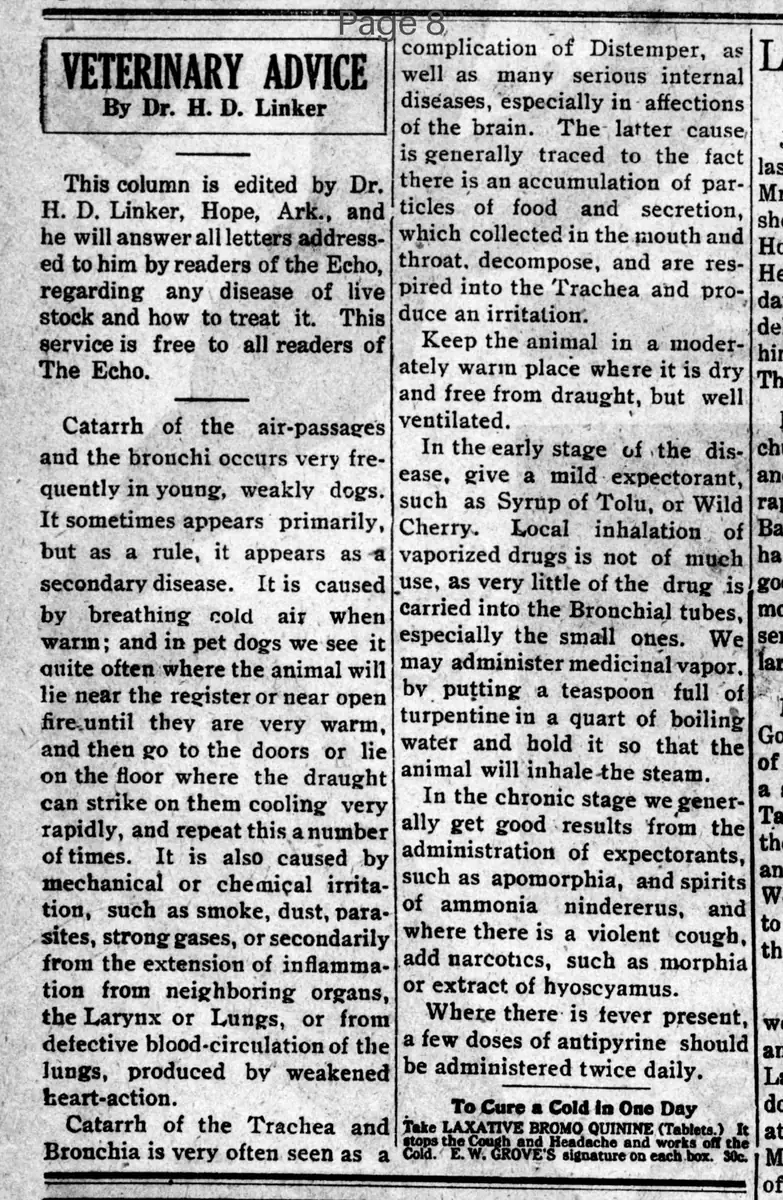
VETERINARY ADVICE
By Dr. H. D. Linker
This column is edited by Dr. H. D. Linker, Hope, Ark., and he will answer all letters addressed to him by readers of the Echo, regarding any disease of live stock and how to treat it. This service is free to all readers of The Echo.
Catarrh of the air-passages and the bronchi occurs very frequently in young, weakly dogs. It sometimes appears primarily, but as a rule, it appears as a secondary disease. It is caused by breathing cold air, when warm; and in pet dogs we see it quite often where the animal will lie near the register or near open fire until they are very warm, and then go to the doors or lie on the floor where the draught can strike on them cooling very rapidly, and repeat this a number of times. It is also caused by mechanical or chemical irritation, such as smoke, dust, parasites, strong gases, or secondarily from the extension of inflammation from neighboring organs, the Larynx or Lungs, or from defective blood-circulation of the Lungs, produced by weakened heart-action.
Catarrh of the Trachea and Bronchia is very often seen as a complication of Distemper, as well as many serious internal diseases, especially infections of the brain. The latter cause is generally traced to the fact there is an accumulation of particles of food and secretion, which collected in the mouth and throat, decompose, and are respired into the Trachea and produce an irritation.
Keep the animal in a moderately warm place where it is dry and free from draught, but well ventilated.
In the early stage of the disease, give a mild expectorant, such as Syrup of Tolu, or Wild Cherry. Local inhalation, of vaporized drugs is not of much use, as very little of the drug is carried into the Bronchial tubes, especially the small ones. We may administer medicinal vapor by putting a teaspoon full of turpentine in a quart of boiling water and hold it so that the animal will inhale the steam.
In the chronic stage we generally get good results from the administration of expectorants, such as apomorphia, and spirits of ammonia nindererus, and where there is a violent cough, add narcotics, such as morphia or extract of hyoscyamus.
Where there is fever present, a few doses of antipyrine should be administered twice daily.
By Dr. H. D. Linker
This column is edited by Dr. H. D. Linker, Hope, Ark., and he will answer all letters addressed to him by readers of the Echo, regarding any disease of live stock and how to treat it. This service is free to all readers of The Echo.
Catarrh of the air-passages and the bronchi occurs very frequently in young, weakly dogs. It sometimes appears primarily, but as a rule, it appears as a secondary disease. It is caused by breathing cold air, when warm; and in pet dogs we see it quite often where the animal will lie near the register or near open fire until they are very warm, and then go to the doors or lie on the floor where the draught can strike on them cooling very rapidly, and repeat this a number of times. It is also caused by mechanical or chemical irritation, such as smoke, dust, parasites, strong gases, or secondarily from the extension of inflammation from neighboring organs, the Larynx or Lungs, or from defective blood-circulation of the Lungs, produced by weakened heart-action.
Catarrh of the Trachea and Bronchia is very often seen as a complication of Distemper, as well as many serious internal diseases, especially infections of the brain. The latter cause is generally traced to the fact there is an accumulation of particles of food and secretion, which collected in the mouth and throat, decompose, and are respired into the Trachea and produce an irritation.
Keep the animal in a moderately warm place where it is dry and free from draught, but well ventilated.
In the early stage of the disease, give a mild expectorant, such as Syrup of Tolu, or Wild Cherry. Local inhalation, of vaporized drugs is not of much use, as very little of the drug is carried into the Bronchial tubes, especially the small ones. We may administer medicinal vapor by putting a teaspoon full of turpentine in a quart of boiling water and hold it so that the animal will inhale the steam.
In the chronic stage we generally get good results from the administration of expectorants, such as apomorphia, and spirits of ammonia nindererus, and where there is a violent cough, add narcotics, such as morphia or extract of hyoscyamus.
Where there is fever present, a few doses of antipyrine should be administered twice daily.
What sub-type of article is it?
Veterinary Advice
What themes does it cover?
Recovery
What keywords are associated?
Catarrh
Dogs
Bronchi
Distemper
Expectorants
Veterinary Treatment
Animal Disease
What entities or persons were involved?
Dr. H. D. Linker
Where did it happen?
Hope, Ark.
Story Details
Key Persons
Dr. H. D. Linker
Location
Hope, Ark.
Story Details
Catarrh in dogs caused by cold air, irritation, or secondary to distemper; treat by keeping warm and ventilated, using expectorants like Syrup of Tolu, turpentine steam, apomorphia, ammonia, narcotics for cough, and antipyrine for fever.