Thank you for visiting SNEWPapers!
Sign up free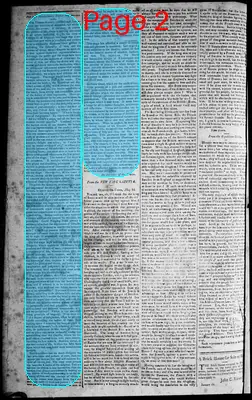
Letter to Editor
June 25, 1808
Alexandria Daily Advertiser
Alexandria, Virginia
What is this article about?
An anonymous advocate defends the theater in a letter to the Alexandria Daily Advertiser, arguing it promotes virtue, refines manners, and instructs on morality, countering clerical objections by highlighting its historical and ethical benefits, with references to Shakespeare and classical antiquity.
Clipping
OCR Quality
75%
Good
Full Text
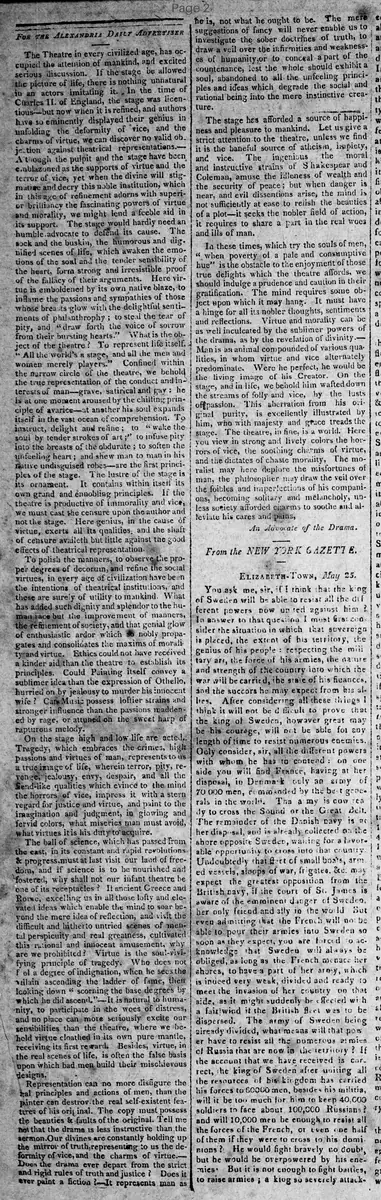
For the Alexandria Daily Advertiser.
The Theatre in every civilized age, has occupied the attention of mankind, and excited interest in an actor's imitating it. In the time of Charles II. of England, the stage was licentious—but now when it is refined, and authors have so eminently displayed their genius in unfolding the deformity of vice, and the charms of virtue, we can discover no valid objection against theatrical representations.
Although the pulpit and the stage have been emblazoned as the supports of virtue and the terror of vice, yet when the divine will stigmatize and decry this noble institution, which in this age of refinement adorns with superior brilliancy the fascinating powers of virtue and morality, we might lend a feeble aid in its support. The stage would hardly need a humble advocate to defend its cause. The sock and the buskin, the humorous and dignified scenes of life, which awaken the emotions of the soul and the tender sensibility of the heart, form strong and irresistible proof of the fallacy of their arguments. Here virtue is emboldened by its own native blaze, to inflame the passions and sympathies of those whose breasts glow with the delightful sentiments of philanthropy; to steal the tear of pity, and "draw forth the voice of sorrow from their bursting hearts." What is the object of the theatre? To represent life itself. "All the world's a stage, and all the men and women merely players." Confined within the narrow circle of the theatre, we behold the true representation of the conduct and interests of man—grave, satirical and gay: he is at one moment aroused by the chilling principle of avarice—at another his soul expands itself in the vast ocean of comprehension. To instruct, delight and refine; to "wake the soul by tender strokes of art;" to infuse pity into the breasts of the obdurate; to soften the unfeeling heart; and shew man to man in his native undisguised robes—are the first principles of the stage. The lustre of the stage is its ornament. It contains within itself its own grand and ennobling principles. If the theatre is productive of immorality and vice, we must cast the censure upon the author and not the stage. Here genius, in the cause of virtue, exerts all its qualities: and the shaft of censure availeth but little against the good effects of theatrical representation.
To polish the manners, to observe the proper degrees of decorum, and refine the social virtues, in every age of civilization have been the intentions of theatrical institutions, and these are surely of utility to mankind. What has added such dignity and splendor to the human race but the improvement of manners, the refinement of society, and that genial glow of enthusiastic ardor which so nobly propagates and consolidates the maxims of morality and virtue. Ethics could not have received a kinder aid than the theatre to establish its principles. Could Painting itself convey a sublimer idea than the expression of Othello, hurried on by jealousy to murder his innocent wife? Can Music possess loftier strains and stronger influence than the passions maddened by rage, or attuned on the sweet harp of rapturous melody.
On the stage high and low life are acted. Tragedy, which embraces the crimes, high passions and virtues of man, represents to us a true image of life, wherein terror, pity, revenge, jealousy, envy, despair, and all the fiend-like qualities which evince to the mind the horrors of vice, impress it with a stern regard for justice and virtue, and paint to the imagination and judgment, in glowing and fervid colors, what miseries man must avoid, what virtues it is his duty to acquire.
The ball of science, which has passed from the east, in its constant and rapid revolutions & progress, must at last visit our land of freedom, and if science is to be nourished and fostered, why shall not our infant theatre be one of its receptacles? If ancient Greece and Rome, excelling us in all those lofty and elevated ideas which enable the mind to soar beyond the mere idea of reflection, and visit the difficult and hitherto untried scenes of mental perspicuity and real greatness, cultivated this rational and innocent amusement, why are we prohibited? Virtue is the soul-vivifying principle of tragedy. Who does not feel a degree of indignation, when he sees the villain ascending the ladder of fame, then looking down "scorning the base degrees by which he did ascent." It is natural to humanity, to participate in the woes of distress, and no place can more seriously excite our sensibilities than the theatre, where we behold virtue clothed in its own pure mantle, receiving its first reward. Besides, virtue, in the real scenes of life, is often the false basis upon which bad men build their mischievous designs.
Representation can no more disfigure the natural principles and actions of men, than the painter can destroy the real self-existent features of his original. The copy must possess the beauties & faults of the original. Tell me not that the drama is less instructive than the sermon. Our divines are constantly holding up the mirror of truth, representing to us the deformity of vice, and the charms of virtue. Does the drama ever depart from the strict and rigid rules of truth and justice? Does it ever paint a fiction? It represents man as he is, not what he ought to be. The mere suggestions of fancy will never enable us to investigate the sober doctrines of truth, to draw a veil over the infirmities and weaknesses of humanity, or to conceal a part of the countenance, lest the whole should exhibit a soul, abandoned to all the unfeeling principles and ideas which degrade the social and rational being into the mere instinctive creature.
The stage has afforded a source of happiness and pleasure to mankind. Let us give a strict attention to the theatre, unless we find it is the baneful source of atheism, impiety, and vice. The ingenious, the moral and instructive strains of Shakespeare and Coleman, amuse the idleness of wealth and the security of peace; but when danger is near, and evil dissentions arise, the mind is not sufficiently at ease to relish the beauties of a plot—it seeks the nobler field of action, it requires to share a part in the real woes and ills of man.
In these times, which try the souls of men, "when poverty of a pale and consumptive hue" is the obstacle to the enjoyment of those true delights which the theatre affords, we should indulge a prudence and caution in their gratification. The mind requires some object upon which it may hang. It must have a hinge for all its nobler thoughts, sentiments and reflections. Virtue and morality can be as well inculcated by the sublimer powers of the drama, as by the revelation of divinity.
Man is an animal compounded of various qualities, in whom virtue and vice alternately predominate. Were he perfect, he would be the living image of his Creator. On the stage, and in life, we behold him watered down the streams of folly and vice, by the lusts of passion. This aberration from his original purity, is excellently illustrated by him, who with majesty and grace treads the stage. The theatre, in fine, is a world. Here you view in strong and lively colors the horrors of vice, the soothing charms of virtue, and the dictates of chaste morality. The moralist may here deplore the misfortunes of man, the philosopher may draw the veil over the foibles and imperfections of his companions, becoming solitary and melancholy, unless society afforded charms to soothe and alleviate his cares and pains.
An Advocate of the Drama.
The Theatre in every civilized age, has occupied the attention of mankind, and excited interest in an actor's imitating it. In the time of Charles II. of England, the stage was licentious—but now when it is refined, and authors have so eminently displayed their genius in unfolding the deformity of vice, and the charms of virtue, we can discover no valid objection against theatrical representations.
Although the pulpit and the stage have been emblazoned as the supports of virtue and the terror of vice, yet when the divine will stigmatize and decry this noble institution, which in this age of refinement adorns with superior brilliancy the fascinating powers of virtue and morality, we might lend a feeble aid in its support. The stage would hardly need a humble advocate to defend its cause. The sock and the buskin, the humorous and dignified scenes of life, which awaken the emotions of the soul and the tender sensibility of the heart, form strong and irresistible proof of the fallacy of their arguments. Here virtue is emboldened by its own native blaze, to inflame the passions and sympathies of those whose breasts glow with the delightful sentiments of philanthropy; to steal the tear of pity, and "draw forth the voice of sorrow from their bursting hearts." What is the object of the theatre? To represent life itself. "All the world's a stage, and all the men and women merely players." Confined within the narrow circle of the theatre, we behold the true representation of the conduct and interests of man—grave, satirical and gay: he is at one moment aroused by the chilling principle of avarice—at another his soul expands itself in the vast ocean of comprehension. To instruct, delight and refine; to "wake the soul by tender strokes of art;" to infuse pity into the breasts of the obdurate; to soften the unfeeling heart; and shew man to man in his native undisguised robes—are the first principles of the stage. The lustre of the stage is its ornament. It contains within itself its own grand and ennobling principles. If the theatre is productive of immorality and vice, we must cast the censure upon the author and not the stage. Here genius, in the cause of virtue, exerts all its qualities: and the shaft of censure availeth but little against the good effects of theatrical representation.
To polish the manners, to observe the proper degrees of decorum, and refine the social virtues, in every age of civilization have been the intentions of theatrical institutions, and these are surely of utility to mankind. What has added such dignity and splendor to the human race but the improvement of manners, the refinement of society, and that genial glow of enthusiastic ardor which so nobly propagates and consolidates the maxims of morality and virtue. Ethics could not have received a kinder aid than the theatre to establish its principles. Could Painting itself convey a sublimer idea than the expression of Othello, hurried on by jealousy to murder his innocent wife? Can Music possess loftier strains and stronger influence than the passions maddened by rage, or attuned on the sweet harp of rapturous melody.
On the stage high and low life are acted. Tragedy, which embraces the crimes, high passions and virtues of man, represents to us a true image of life, wherein terror, pity, revenge, jealousy, envy, despair, and all the fiend-like qualities which evince to the mind the horrors of vice, impress it with a stern regard for justice and virtue, and paint to the imagination and judgment, in glowing and fervid colors, what miseries man must avoid, what virtues it is his duty to acquire.
The ball of science, which has passed from the east, in its constant and rapid revolutions & progress, must at last visit our land of freedom, and if science is to be nourished and fostered, why shall not our infant theatre be one of its receptacles? If ancient Greece and Rome, excelling us in all those lofty and elevated ideas which enable the mind to soar beyond the mere idea of reflection, and visit the difficult and hitherto untried scenes of mental perspicuity and real greatness, cultivated this rational and innocent amusement, why are we prohibited? Virtue is the soul-vivifying principle of tragedy. Who does not feel a degree of indignation, when he sees the villain ascending the ladder of fame, then looking down "scorning the base degrees by which he did ascent." It is natural to humanity, to participate in the woes of distress, and no place can more seriously excite our sensibilities than the theatre, where we behold virtue clothed in its own pure mantle, receiving its first reward. Besides, virtue, in the real scenes of life, is often the false basis upon which bad men build their mischievous designs.
Representation can no more disfigure the natural principles and actions of men, than the painter can destroy the real self-existent features of his original. The copy must possess the beauties & faults of the original. Tell me not that the drama is less instructive than the sermon. Our divines are constantly holding up the mirror of truth, representing to us the deformity of vice, and the charms of virtue. Does the drama ever depart from the strict and rigid rules of truth and justice? Does it ever paint a fiction? It represents man as he is, not what he ought to be. The mere suggestions of fancy will never enable us to investigate the sober doctrines of truth, to draw a veil over the infirmities and weaknesses of humanity, or to conceal a part of the countenance, lest the whole should exhibit a soul, abandoned to all the unfeeling principles and ideas which degrade the social and rational being into the mere instinctive creature.
The stage has afforded a source of happiness and pleasure to mankind. Let us give a strict attention to the theatre, unless we find it is the baneful source of atheism, impiety, and vice. The ingenious, the moral and instructive strains of Shakespeare and Coleman, amuse the idleness of wealth and the security of peace; but when danger is near, and evil dissentions arise, the mind is not sufficiently at ease to relish the beauties of a plot—it seeks the nobler field of action, it requires to share a part in the real woes and ills of man.
In these times, which try the souls of men, "when poverty of a pale and consumptive hue" is the obstacle to the enjoyment of those true delights which the theatre affords, we should indulge a prudence and caution in their gratification. The mind requires some object upon which it may hang. It must have a hinge for all its nobler thoughts, sentiments and reflections. Virtue and morality can be as well inculcated by the sublimer powers of the drama, as by the revelation of divinity.
Man is an animal compounded of various qualities, in whom virtue and vice alternately predominate. Were he perfect, he would be the living image of his Creator. On the stage, and in life, we behold him watered down the streams of folly and vice, by the lusts of passion. This aberration from his original purity, is excellently illustrated by him, who with majesty and grace treads the stage. The theatre, in fine, is a world. Here you view in strong and lively colors the horrors of vice, the soothing charms of virtue, and the dictates of chaste morality. The moralist may here deplore the misfortunes of man, the philosopher may draw the veil over the foibles and imperfections of his companions, becoming solitary and melancholy, unless society afforded charms to soothe and alleviate his cares and pains.
An Advocate of the Drama.
What sub-type of article is it?
Persuasive
Philosophical
Ethical Moral
What themes does it cover?
Morality
Social Issues
Education
What keywords are associated?
Theater Defense
Moral Virtue
Stage Morality
Vice Deformity
Social Refinement
Shakespeare Drama
Classical Antiquity
What entities or persons were involved?
An Advocate Of The Drama
For The Alexandria Daily Advertiser
Letter to Editor Details
Author
An Advocate Of The Drama
Recipient
For The Alexandria Daily Advertiser
Main Argument
the theater is a noble institution that refines society, promotes virtue over vice, and provides moral instruction through dramatic representations, countering objections from the clergy by emphasizing its alignment with ethical principles and historical precedents.
Notable Details
References Shakespeare: 'All The World's A Stage'
Mentions Othello And Jealousy
Cites Ancient Greece And Rome
Quotes: 'Wake The Soul By Tender Strokes Of Art'
Compares Stage To Pulpit And Sermon