Thank you for visiting SNEWPapers!
Sign up free
The Central Presbyterian
Richmond, Virginia
What is this article about?
Letter VII recounts the historical process of reconciliation and union between the divided Southern Presbyterian Church bodies (United Synod and General Assembly) during the Civil War era, highlighting Rev. James H. C. Leach's involvement and the cautious steps toward unity on the Confession of Faith platform, culminating in 1864.
Clipping
OCR Quality
Full Text
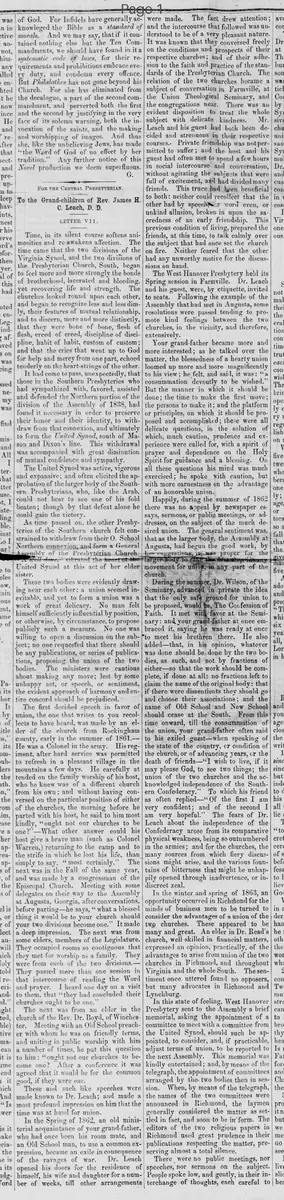
To the Grand-children of Rev. James H. C. Leach, D. D.
LETTER VII.
Time, in its silent course softens animosities and re-awakens affection. The time came that the two divisions of the Virginia Synod, and the two divisions of the Presbyterian Church, South, began to feel more and more strongly the bonds of brotherhood, lacerated and bleeding, yet recovering life and strength. The churches looked round upon each other, and began to recognize less and less dimly, their features of mutual relationship, and to discern, more and more distinctly, that they were bone of bone, flesh of flesh, creed of creed, discipline of discipline, habit of habit, custom of custom: and that the cries that went up to God for help and mercy from one part, echoed tenderly on the heart-strings of the other.
It had come to pass, unexpectedly, that those in the Southern Presbyteries who had sympathized with, favored, assisted and defended the Northern portion of the division of the Assembly of 1838, had found it necessary in order to preserve their honor and their identity, to withdraw from that connexion, and ultimately to form the United Synod, south of Mason and Dixon's line. This withdrawal was accompanied with great diminution of mutual confidence and sympathy The United Synod was active, vigorous and expansive; and often elicited the approbation of the larger body of the Southern Presbyterians, who, like the Arab, could not bear to see one of his fold beaten; though by that defeat alone he could gain the victory.
As time passed on, the other Presbyteries of the Southern church felt constrained to withdraw from their O. School Northern connexion. and form a General Assembly of the Presbyterian Church, well done." vibrated the heart at the United Synod at this act of her elder sister.
These two bodies were evidently drawing near each other: a union seemed inevitable, and yet to form a union was a work of great delicacy. No man felt himself sufficiently influential by position, or otherwise, by circumstance, to propose publicly such a measure. No one was willing to open a discussion on the subject; no one requested that there should be any publications, or series of publications, proposing the union of the two bodies. The ministers were cautious about making any move; lest by some unhappy act, or speech, or sentiment, the evident approach of harmony and entire concord should be prejudiced.
The first decided speech in favor of union, the one that writes to you recollects to have heard, was made by an elder of the church from Rockingham county, early in the summer of 1861.— He was a Colonel in the army. His regiment, after hard service was permitted to refresh in a pleasant village in the mountains a few days. He carefully attended on the family worship of his host, who he knew was of a different church from his own; and without having conversed on the particular position of either of the churches, the morning before he parted with his host, he said to him most kindly, "ought not our churches to be one?"—What other answer could his host give a brave man (such as Colonel Warren,) returning to the camp and to the strife in which he lost his life, than simply to say, " most certainly."
The next was in the Fall of the same year, and was made by a congressman of the Episcopal Church. Meeting with some delegates on their way to the Assembly at Augusta, Georgia, after conversations, before parting—he says, " what a blessed thing it would be to your church should your two divisions become one." It made a deep impression. The next was from some elders, members of the Legislature. They occupied rooms so contiguous that they met for worship as a family. They were from each of the two divisions.- They passed more than one session in that intercourse of reading the Word and prayer. I heard one day on a visit to them, that "they had concluded their churches ought to be one.
The next was from an elder in the church of the Rev. Dr. Boyd. of Winchester. Meeting with an Old School preacher with whom he was on friendly terms, and uniting in public worship with him a number of times, he put this question to him: "ought not our churches to become one? After a conference it was agreed that it would be for the common good, if they were one.
These and such like speeches were made known to Dr. Leach: and made a most profound impression on him that the time was at hand for union.
In the Spring of 1862, an old ministerial acquaintance of your grand-father, who had once been his room mate, and an Old School man, to use a common expression, became an exile in consequence of the ravages of war. Dr. Leach opened his doors for the residence of himself. his wife and daughter for a number of weeks, till other arrangements were made. The fact drew attention; and the intercourse that followed was understood to be of a very pleasant nature. It was known that they conversed freely on the conditions and prospects of their respective churches; and of their adhesion to the faith and practice of the standards of the Presbyterian Church. The relation of the two churches became a subject of conversation in Farmville, at the Union Theological Seminary, and the congregations near. There was an evident disposition to treat the whole subject with delicate kindness. Mr. Leach and his guest had both been decided and strenuous in their respective courses. Private friendship was not permitted to suffer; and the host and his guest had often met to spend a few hours in social intercourse and conversation, without agitating the subjects that were full of excitement, and had divided many friends. This truce had been beneficial to both: neither could recollect that the other had by speech or word even, or unkind allusion, broken in upon the sacredness of an early friendship. This previous condition of living, prepared the friends, at this time, to talk calmly over the subject that had once set the church on fire. Neither feared that the other had any unworthy motive for the discussions on hand.
The West Hanover Presbytery held its Spring session in Farmville. Dr. Leach and his guest, were, by etiquette, invited to seats." Following the example of the Assembly that had met in Augusta, some resolutions were passed tending to promote kind feelings between the two churches, in the vicinity, and therefore. extensively.
Your grand-father became more and more interested: as he talked over the matter, the blessedness of a hearty union loomed up more and more magnificently to his view; he felt, and said, it was: "a consummation devoutly to be wished."
But the manner in which it should be done; the time to make the first move: the persons to make it; and the platform or principles, on which it should be proposed and accomplished; these were all delicate questions, in the solution of which, much caution, prudence and experience were called for, with a spirit of prayer and dependence on the Holy Spirit for guidance and a blessing. On all these questions his mind was much exercised; he spoke with caution, but with more earnestness on the advantage of an honorable union.
Happily, during the summer of 1862 there was no appeal by newspaper essays, sermons, or public meetings, or addresses, on the subject of the much desired union. The general sentiment was. that as the larger body, the Assembly at Augusta, had begun the good work, by honorable suggestions, it was proper for the larger body to take- YEt steps in any movement for union, in any part of the church.
During the summer, Dr. Wilson, of the Seminary, advanced in private the idea that the only safe ground for union to be proposed, would be, The Confession of Faith. It met with favor at the Seminary: and your grand-father at once embraced it, saying he was ready at once to meet his brethren there. He also added-that, in his opinion, whatever was done should be done by the two bodies, as such, and not by fractions of either-so that the work should be complete, if done at all: no fractions left to claim the name of the original body: that if there were dissentients they should go and choose their associations; and the name of Old School and New School should cease at the South. From this time onward, till the consummation of the union, your grand-father often said to his exiled guest--when speaking of the state of the country, or condition of the church, or of advancing years, or the death of friends-"I wish to live, if it may please God, to see two things; the union of the two churches and the acknowledged independence of the Southern Confederacy." To which his friend as often replied-"Of the first I am very confident; and of the second I am very hopeful." The fears of Dr. Leach about the independence of the Confederacy arose from its comparative physical weakness, being so outnumbered in the armies; and for the churches. the many sources from which fiery discussions might arise, and the various fountains of bitterness that might be unhappily opened through inadvertence, or indiscreet zeal.
In the winter and spring of 1863, an opportunity occurred in Richmond for the minds of business men to be turned to consider the advantages of a union of the two churches. These appeared to be many and great. An elder in Dr. Read's church, well skilled in financial matters. expressed an opinion, practically, of the advantages to arise from union of the two churches in Richmond, and throughout Virginia and the whole South. The sentiment once uttered found no opposers, but many advocates in Richmond and Lynchburg.
In this state of feeling, West Hanover Presbytery sent to the Assembly a brief memorial, asking the appointment of a committee to meet with a committee from the United Synod, should such be appointed, to consider, and, if practicable, adjust terms of union, to be reported to the next Assembly. This memorial was kindly entertained; and, by means of the telegraph, the appointment of committees arranged by the two bodies then in session. When, by means of the telegraph, the names of the two committees were announced in Richmond, the laymen generally considered the matter as settled in fact, and soon to be in form. The editors of the two religious papers in Richmond used great prudence in their publications respecting the matter, preserving almost a total silence. There were no public meetings, nor speeches, nor sermons on the subject. People spoke low, and gently, in their interchange of thoughts, each careful to avoid making any hindrance in the accomplishment of what all desired.
The chairmen of the two committees, Drs. Dabney and Stiles, had a conference at the Union Theological Seminary. The two committees assembled in Lynchburg in July; and held a conference of some days; and, as the result, a paper was unanimously adopted, proposing articles of union on the platform of the Confession of Faith; to be considered by the General Assembly and the United Synod. The articles were soon extensively known; the mass of the two churches were satisfied, and the form of union was considered as only wanting the sanction of the Assembly and United Synod to be in full operation. In fact, multitudes considered the thing settled.
Dr. Leach expressed great satisfaction, and was earnestly desirous that all discussions and arrangements should be conducted in the same spirit of kindness in which the business had so far been conducted.
In the fall of 1864 the two Synods of Virginia met in Lexington and formed one body. The meeting was harmonious. May the union last forever.
C. C. R.
What sub-type of article is it?
What themes does it cover?
What keywords are associated?
What entities or persons were involved?
Letter to Editor Details
Author
C. C. R.
Recipient
To The Grand Children Of Rev. James H. C. Leach, D. D.
Main Argument
this letter narrates the gradual softening of divisions and the delicate process leading to the 1864 union of the southern presbyterian church's united synod and general assembly, emphasizing rev. leach's hopeful involvement and the consensus on unity via the confession of faith amid civil war challenges.
Notable Details