Thank you for visiting SNEWPapers!
Sign up free
The National Intelligencer And Washington Advertiser
Washington, District Of Columbia
What is this article about?
Pseudonymous essay by Algernon Sidney vindicating the Jefferson administration's repeal of internal taxes and abolition of the 1801 judiciary system. Argues that experience proves these measures maintain order, reduce expenses, preserve liberty, and relieve the people without impairing government finances or credit.
Merged-components note: These three components form a single continuous letter to the editor titled 'A VINDICATION OF THE MEASURES OF THE PRESENT ADMINISTRATION' by Algernon Sidney, No. I, spanning columns on page 1 and continuing onto page 2. The third component was mislabeled as 'editorial' but is part of this letter discussing taxes and government economy.
Clippings
1 of 2
OCR Quality
Full Text
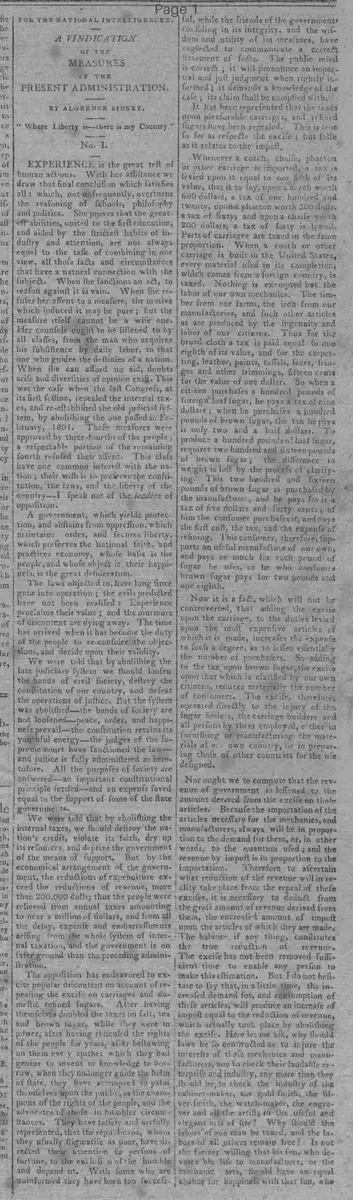
A VINDICATION
OF THE
MEASURES
OF THE
PRESENT ADMINISTRATION.
BY ALGERNON SIDNEY.
"Where Liberty is—there is my Country."
No. I.
EXPERIENCE is the great test of human actions. With her assistance we draw that final conclusion which satisfies all: which, not unfrequently, overturns the reasoning of schools, philosophy and politics. She proves that the greatest abilities, united to the first education, and aided by the strictest habits of industry and attention, are not always equal to the task of combining in one view, all those facts and circumstances that have a natural connection with the subject. When she sanctions an act, to reason against it is vain. When she refuses her assent to a measure, the motive which induced it may be pure; but the measure itself cannot be a wise one.
Her counsels ought to be listened to by all classes, from the man who acquires his subsistence by daily labor, to that one who guides the destinies of a nation.
When she can afford no aid, doubts arise and diversities of opinion exist. This was the case when the last Congress, at its first session, repealed the internal taxes, and re-established the old judicial system, by abolishing the one passed in February, 1801. These measures were approved by three-fourths of the people; a respectable portion of the remaining fourth resumed their silence. This class have one common interest with the nation; their wish is to preserve the constitution, the laws, and the liberty of the country—I speak not of the leaders of opposition.
A government, which yields protection, and abstains from oppression, which maintains order, and secures liberty, which preserves the national faith, and practices economy, whose basis is the people, and whose object is their happiness, is the great desideratum.
The laws objected to, have long since gone into operation; the evils predicted have not been realized: Experience proclaims their value; and the murmurs of discontent are dying away. The time has arrived when it has become the duty of the people to re-consider the objections, and decide upon their validity.
We were told that by abolishing the late judiciary system we should loosen the bands of civil society, destroy the constitution of our country, and defeat the operations of justice. But the system was abolished—the bands of society are not loosened—peace, order, and happiness prevail—the constitution retains its youthful energy—the judges of the supreme court have sanctioned the law—and justice is fully administered as heretofore. All the purposes of society are answered—an important constitutional principle settled—and an expense saved equal to the support of one of the state governments.
We were told that by abolishing the internal taxes, we should destroy the nation's credit, violate its faith, dry up its resources, and deprive the government of the means of support. But by the economical arrangement of the government, the reductions of expenditure exceed the reductions of revenue, more than 200,000 dollars; thus the people were relieved from annual taxes amounting to near a million of dollars, and from all the delay, expense and embarrassments arising from the whole system of internal taxation, and the government is on safer ground than the preceding administration.
The opposition has endeavored to excite popular discontent on account of repealing the excise on carriages and domestic refined sugars. After having themselves doubled the taxes on salt, tea and brown sugar, while they were in power, after having ridiculed the rights of the people for years, after bestowing on them every epithet which they had genius to invent or knowledge to borrow, when they no longer guide the helm of state, they have attempted to palm themselves upon the public, as the champions of the rights of the people, and the advocates of those in humbler circumstances. They have falsely and artfully represented, that the republicans, whom they usually stigmatize as poor, have directed their attention to persons of fortune, to the exclusion of the humble and dependent. With some who are uninformed they have been too successful.
While the friends of the government confiding in its integrity, and the wisdom and utility of its measures, have neglected to communicate a correct statement of facts. The public mind is correct; it will pronounce an impartial and just judgment when rightly informed: it demands a knowledge of the case: its claim shall be complied with.
It has been represented that the taxes upon pleasurable carriages, and refined sugars have been repealed. This is true so far as respects the excise: but false as it relates to the impost.
Whenever a coach, chaise, phaeton or other carriage is imported, a tax is levied upon it equal to one fifth of its value, that is to say, upon a coach worth 600 dollars, a tax of one hundred and twenty, upon a phaeton worth 300 dolls. a tax of sixty; and upon a chaise worth 200 dollars, a tax of forty is levied.
Parts of carriages are taxed in the same proportion. When a coach or other carriage is built in the United States, every material used in its completion, which comes from a foreign country, is taxed, Nothing is exempted but the labor of our own mechanics. The timber from our farms, the iron from our manufactories, and such other articles as are produced by the ingenuity and labor of our citizens. Thus for the broad cloth a tax is paid equal to one eighth of its value, and for the carpeting, leather, paints, nails, laces, rings and other trimmings, fifteen cents for the value of one dollar. So when a citizen purchases a hundred pounds of foreign loaf sugar, he pays a tax of nine dollars; when he purchases a hundred pounds of brown sugar, the tax he pays is only two and a half dollars. To produce a hundred pounds of loaf sugar, requires two hundred and sixteen pounds of brown sugar; the difference in weight is lost by the process of clarifying. This two hundred and sixteen pounds of brown sugar is purchased by the manufacturer, and he pays for it a tax of five dollars and forty cents; of him the consumer purchases it, and pays the first cost, the tax. and the expense of refining. This consumer, therefore, supports a useful manufacture of our own, and pays as much for each pound of sugar he uses, as he who consumes brown sugar pays for two pounds and one eighth.
Now it is a fact, which will not be controverted, that adding the excise upon the carriage. to the duties levied upon the most expensive articles of which it is made, increases the expense to such a degree, as to lessen essentially the number of purchasers. So adding to the tax upon brown sugar, the excise upon that which is clarified by our own citizens, reduces materially the number of consumers. The excise, therefore, operated directly to the injury of the sugar boilers, the carriage builders and all persons by them employed, either in furnishing or manufacturing the materials of our own country, or in preparing those of other countries for the use designed,
Nor ought we to compute that the revenue of government is lessened to the amount derived from these excise on those articles. Because the importation of the articles necessary for the mechanics, and manufacturers, always will be in proportion to the demand for them, or, in other words, to the quantum used; and the revenue by impost is in proportion to the importation.
Therefore to ascertain what reduction of the revenue will in reality take place from the repeal of these excises, it is necessary to deduct from the gross amount of revenue derived from them, the increased amount of impost upon the articles of which they are made.
The balance, if any thing, constitutes the true reduction of revenue.
The excise has not been removed sufficient time to enable any person to make this estimation. But I do not hesitate to say that, in a little time, the increased demand for, and consumption of these articles, will produce an increase of impost equal to the reduction of revenue, which actually took place by abolishing the excise. Here let me ask, why should laws be so constructed as to injure the interests of these mechanics and manufacturers, and to check their laudable enterprise and industry, any more than they should be, to check the industry of the cabinet-maker, the gold smith, the silver-smith, the watch-maker, the engraver and all the artists in the useful and elegant arts of life? Why Should the labors of one man be taxed, and the labors of all others remain free? Is not the farmer willing that his son, who devotes his life to manufactures, or the mechanic arts, should have an equal chance for happiness with that son, who devotes himself to agriculture? Are not the other mechanics, and other manufacturers willing that the sugar boilers and carriage builders should stand on equal ground with themselves? All must pay for the support of government. While the nation relies on import for her revenues, the tax is laid directly on the labors and products of other countries, and indirectly on our own citizens, the consumer of the richest and most valuable articles pays the highest tax, the consumer of the plainest and cheapest, the least. For instance, he, who consumes the richest tea, pays as great a tax for a single pound, as he, who consumes common tea, pays for three pounds and a third. Each man pays only in proportion to what he consumes; but the farmer pays least of all, because he lives most within himself.
The government by repealing the internal taxes has given equal play to the genius, enterprise and activity of all. It has removed the shackles which retarded the operations of industry. An excise system is to the body politic, what the consumption is to the natural body. It steals upon the frame. It operates imperceptibly. It deceives the patient from time to time, with the appearance of returning health, but it gradually undermines the system and ends in dissolution. Thus the nation perishes, while the officers, bloated and swelled by rioting on her property, expire of a dropsy.
The humble and distressed condition of the common people of Europe, furnishes proof of the truth of this assertion too impressive and irresistible ever to be forgotten by the citizens of this country.
It has been suggested that these articles are chiefly used by the wealthy, and are therefore more proper objects of taxation, But when the excise was removed from other articles, to have retained it on these would have required a continuance of the whole host of excisemen at an expense, nearly if not fully equal to the whole revenue. Nor is it believed that, when the reduction of import, naturally derivable from the excise, is added to the expense of that system, there would arise a cent of clear revenue.
In some states it is admitted Congress might collect an excise upon those articles at a moderate expense. I refer to those states, which, like Massachusetts and Connecticut, are replete with population and possess a proportionate number of carriages. In the other states it is far different. In Massachusetts there is one carriage to every 1107 acres of land, in Pennsylvania there is but one to every 15,017, and in Virginia to every 16,212, so that the travel and expense of the collector in going for the tax, or of the citizen in going to pay it, in Virginia and Pennsylvania, is fourteen times as much as it is in Massachusetts.
In Connecticut there is one carriage to every 1,748 acres, while in North Carolina there is only one to every 11,329. The real expense therefore of collecting that tax is six times as great in North Carolina as in Connecticut. The evil in the western country and south of the Potomac, is increased by the scarcity of bank notes. The expense of the actual travel must be incurred; the facilities of the public mails can not be substituted. Neither does it result from this that necessity produces any inequality or injustice in the articles taxed, or in the mode of taxing them. In most countries an inequality might necessarily exist, happily for the people of these states it is not their case.
As it relates to all internal objects of taxation, each state within its limits possesses a right extensive and concurrent with the United States. Nothing therefore is easier than for a state to correct any inequality, which may result from the taxes of the Union. Should Congress levy a tax on any article, the state, whose citizens feel the pressure of the tax, will relieve the article from state taxes. Does Congress repeal her taxes, and surrender to the states all the sources of internal taxation, it enables the states to lessen the burdens of their present systems, by drawing a revenue from these restored resources. Either of the states may levy a tax on carriages, domestic distilled spirits and refined sugars, and it is to be presumed that the Legislature will wherever the interest of the state requires it. These articles therefore are not exempted from taxation; they are yielded up to the discretion of the state legislatures. Is it not astonishing that states should complain of a surrender of revenue to their use? Ought they not to rejoice that the general government has furnished them with the means of removing from the poor the poll or capitation tax? And cannot the equalization of taxes be better effected by the acts of the state governments, who legislate for small sections and can adapt their laws to the condition of their citizens, than by the laws of Congress, which must operate by one rule over all the people of this union, however dissimilar and unlike their conditions.
We are told that the annual appropriation of even millions three hundred thousand dollars, towards the discharge of the principal and interest of the national debt, was deceptive, and calculated to inspire hopes, which would never be realized. Experience has demonstrated that the government, notwithstanding it has repealed the internal taxes, has been enabled, in the past year, to discharge of national debt. eight millions forty five thousand eight hundred and seven dollars; while not a cent has been borrowed or reloaned, nor a tax of any kind created. The Treasury too so far from being exhausted, on the first of January, 1803, was possessed of, five millions twenty thousand two hundred and thirty dollars and sixty two cents, a thing altogether unprecedented. The reduction of the public debt by means of the bank shares is included in this estimate.
We are now told that no credit is due to the government, because the monies have been derived from the imports, which were established by former administrations. What? Is there no credit due to a government that administers the finances of a nation with economy, frugality and sound discretion? Because I have furnished my agent with a capital necessary for my use, is he not entitled to my confidence for the integrity, prudence and judgment he has displayed in the management of my affairs? Does not the man justly challenge a higher claim to that confidence, who faithfully applies the monies I have entrusted to him, than the one who devises the most methods of drawing my money from my pocket? Or is he exclusively entitled to it, who has devised the means of taking from me the fruits of my own industry?
It is true that those alone are fit to be entrusted with the government, who unite to prudence and discretion in expenditure, that knowledge of the country and its interests, which may enable them, if necessity require, to augment her revenues by additional taxes, least injurious to the people, and most congenial with their genius, condition and feelings. It is equally true that the present government has not created any taxes. But it is not true that the opposition deserve any more credit for the creation of the revenue system, than belongs to the persons in office. That system was contemplated by the old Congress under the confederation; they repeatedly solicited the States to vest them with power to levy an impost. The refusal of those States principally interested in importations, in a great measure produced the necessity for a convention. The convention calculated upon the imposts to support the government they recommended to the people. The rights of general taxation were given that the powers of the government might be equal to every exigency. When the federal government went into operation, the present system of impost was adopted by general consent; many of the officers of the government & friends of the administration, were eminently useful in its establishment.
Indeed one principal objection against the late order of things was, that the late administration would not rely upon impost alone for revenue, but insisted upon establishing the stamp tax, and a general system of internal taxation, oppressive to the interior, expensive in the extreme, and productive of daily embarrassments. Of those who possess a knowledge of public affairs, who is there that can deny these facts? From what source then does the opposition derive its pretensions?
Among various other objections which have been offered against the reduction of taxes, it has been said the people were naturally averse to taxation, and with difficulty brought to submit to new contributions. That these systems were in operation, the people had become accustomed to them, and it was most wise & prudent to retain them; because they might be wanted at some future day.
This objection amounts to this: "You must tax the people when you do not want their money, to be able to tax them when you do want it."
In countries where the iron hand of despotism rules, where the interests of the sovereign are distinct from, and opposed to, the interests of the subject, where fear binds him to his master, it is undoubtedly necessary to keep fast the chains by which he is bound. How dissimilar is our case? If the revenues are wisely and judiciously expended, the exigencies of the state are the exigencies of the people themselves. The government is theirs-Its object, their happiness- They mould and fashion it to their own liking, and there is no one to say, "why do ye so." Can it be possible that a people so circumstanced will refuse those contributions, which their own security and happiness demand?
Here again let us test this objection by experience. In the war of 1757 the people of these states contributed with liberality to its support. They have struggled through and supported an arduous war of eight years, with an unanimity unparalleled in the history of nations.
They have submitted quietly to the existing taxes, and to all those which have been repealed, with the solitary exception of the discontents which have been manifested by three or four Counties in Pennsylvania. A part of these discontents, probably, would have been easily allayed, had not the then Secretary of the treasury believed them calculated to further his views. I boldly challenge the enemies of the government to produce from the annals of the world a people, who have more uniformly yielded a ready obedience to law, or more cheerfully contributed to the necessities of state. Yet in every instance when the governments no longer wanted the taxes, the people were relieved from them.
For my own part I acknowledge I feel indignant when I reflect upon the objection I have combated. I pledge myself voluntarily to contribute my proportion of whatever the necessities of government may require, and I enter my solemn protest against being taxed unnecessarily, for the purpose of drilling me.
A former Secretary of the treasury, and many of his adherents, have advocated a principle, which, if correct, certainly proves the internal taxes ought not to have been repealed. It is this : "That the people ought to be taxed as far as they can pay." I dissent from this principle; it will produce a despotism. To that species of government it is essentially necessary; for an independent yeomanry will never be slaves.
While the soil is owned and cultivated by the same persons, liberty is safe. But once oppress the people with a system of taxation, which shall bring the class of moderate planters and farmers in arrear, although the deficit may be small, still, eventually, it will produce the effect. A consumption will prey upon the vitals of the republic. The nation will become a body of landlords and tenants; one class rich, the other poor and dependent : or in other words, one will become masters, and the other slaves.
To give health to the natural body, the blood must flow with regularity, and in due proportion to all its parts; so, to give vigor and vital energy to the body politic, the attention of government must be directed to all. The interests of all must be consulted. While the rich are protected, the interests of the common citizens should be carefully guarded, and tenderly watched over. That inequality which the nature of things is constantly producing, should be checked in its career, not offered and accelerated in its progress : Of consequence government should levy as few taxes as possible; because in whatever mode they are levied, the body of the people must pay the greater proportion of them, and they are not wealthy. The constant pressure of taxes will depress them. Look to the nations who have gone before us.
I have read of the paupers of England amounting to one seventh of her numbers, and supported by an annual tax of nearly fourteen millions of dollars, a sum far exceeding the whole revenue of the United States ; of the poverty of the people of Scotland and Ireland, of their wretched support, their thatched roofs and cottages. I have read of the vassals of Russia and Poland ; of the beggars of Portugal, and her degraded peasantry, kneeling to the contemptible Fidalgoes, and of the Lazaroni of Naples, who dwell in the caverns of the earth.
I have read of the people of France driven to madness by the pressure of public burdens, and presenting an awful lesson to rulers, of husbands prostituting their wives, and fathers their daughters, to procure the necessaries of life. And, as I read, the tear of pity stole from my eye. I have frequently read of dissensions, rebellions and civil wars which originated in oppression, and the miseries of the people. May Heaven preserve us from such calamities! But I never have read of a nation, who were ruined by enjoying the fruits of their industry.
I have never heard of a people who rebelled because they were not taxed. To the opposition is due the credit of discovering, that the government had justly forfeited its claims to the confidence of the people, by permitting them to apply their own monies to their own use.
What sub-type of article is it?
What themes does it cover?
What keywords are associated?
What entities or persons were involved?
Letter to Editor Details
Author
Algernon Sidney
Recipient
The National Intelligencer
Main Argument
the present administration's repeal of internal taxes and abolition of the 1801 judiciary system are vindicated by experience, as they promote economy, preserve liberty, reduce unnecessary burdens on the people, and maintain government solvency without predicted harms.
Notable Details