Thank you for visiting SNEWPapers!
Sign up free
Morning Star
Limerick, York County, Maine
What is this article about?
David Marks concludes a debate in the Morning Star, defending foot-washing as a gospel ordinance commanded by Christ in John 13, practiced by early Free-Will Baptists like Randall and Buzzell. He refutes Brother Burbank's claims, provides scriptural propositions, and notes its observance in various churches, emphasizing humility and obedience.
Merged-components note: Merged split components of a single letter to the editor by David Marks discussing the ordinance of washing the saints' feet, including the concluding hymn; original labels were literary, letter_to_editor, and poem.
Clippings
1 of 2
OCR Quality
Full Text
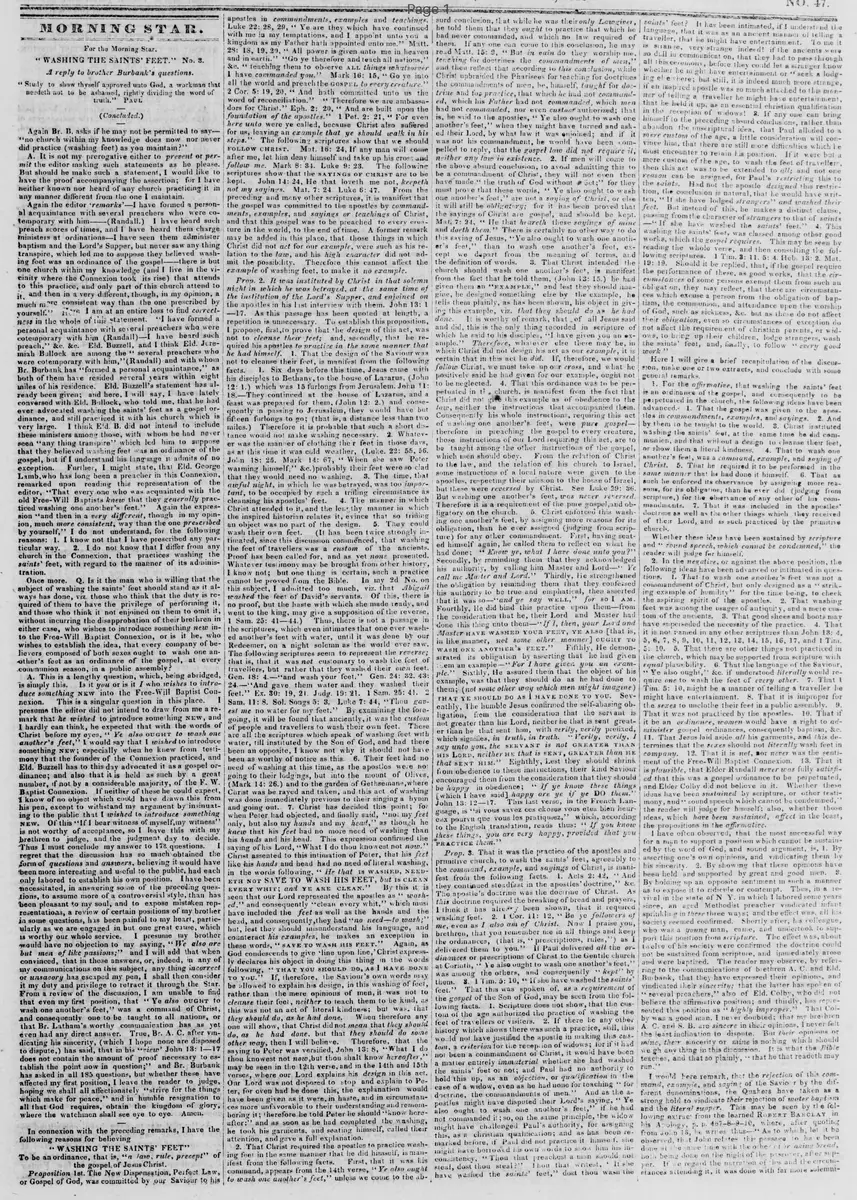
For the Morning Star.
"WASHING THE SAINTS' FEET." NO. 5.
In reply to brother Burbank's questions.
"Study to show thyself approved unto God, a workman that needeth not to be ashamed, rightly dividing the word of truth."
PAUL.
(Concluded.)
Again Br. B. asks if he may not be permitted to say-- "no church within my knowledge does now nor never did practice (washing feet) as you maintain?"
A. It is not my prerogative either to prevent or permit the editor making such statements as he please. But should he make such a statement, I would like to have the proof accompanying the assertion; for I have neither known nor heard of any church practicing it in any manner different from the one I maintain.
Again the editor remarks--"I have formed a personal acquaintance with several preachers who were contemporary with him--(Randall.) I have heard such preach scores of times, and I have heard them charge ministers at ordinations--I have seen them administer baptism and the Lord's Supper, but never saw any thing transpire, which led me to suppose they believed washing feet was an ordinance of the gospel---there is but one church within my knowledge (and I live in the vicinity where the Connexion took its rise) that attends to this practice, and only part of this church attend to it, and then in a very different, though, in my opinion, a much more consistent way than the one prescribed by yourself."
Here I am at an entire loss to find correctness in the whole of this statement. "I have formed a personal acquaintance with several preachers who were contemporary with him (Randall)--I have heard such preach," &c. &c. Eld. Buzzell, and I think Eld. Jeremiah Bullock are among the "several preachers who were contemporary with him,"(Randall) and with whom Br. Burbank has "formed a personal acquaintance," as both of them have resided several years within eight miles of his residence. Eld. Buzzell's statement has already been given; and here I will say, I have lately conversed with Eld. Bullock, who told me, that he had ever advocated washing the saints' feet as a gospel ordinance, and still practiced it with his church which is very large. I think Eld. B. did not intend to include these ministers among those, with whom he had never seen "any thing transpire" which led him to suppose that they believed washing feet was an ordinance of the gospel, but if I understand his language it admits of no exception. Farther, I might state, that Eld. George Lamb, who has long been a preacher in this Connexion, remarked upon reading this representation of the editor, That every one who was acquainted with the old Free-Will Baptists knew that they generally practiced washing one another's feet. Again the expression "and then in a very different, though in my opinion, much more consistent, way than the one prescribed by yourself," I do not understand, for the following reasons: 1. I know not that I have prescribed any particular way. 2. I do not know that I differ from any church in the Connexion, that practices washing the saints' feet, with regard to the manner of its administration.
Once more. Q. Is it the man who is willing that the subject of washing the saints' feet should stand as it always has done, viz. those who think that the duty is required of them to have the privilege of performing it, and those who think it not enjoined on them to omit it, without incurring the disapprobation of their brethren in either case, who wishes to introduce something new into the Free-Will Baptist Connexion, or is it he, who wishes to establish the idea, that every company of believers composed of both sexes ought to wash one another's feet as an ordinance of the gospel, at every communion season, in a public assembly?
A. This is a lengthy question, which, being abridged, is simply this. Is it you or is it I who wishes to introduce something New into the Free-Will Baptist Connexion. This is a singular question in this place.
I
presume the editor did not intend to draw from me a remark that he wished to introduce something New, and I hardly can think, he expected that with the words of Christ before my eyes, "Ye also ought to wash one another's feet," I would say that I wished to introduce something New; especially when he knew from testimony that the founder of the Connexion practiced, and Eld. Buzzell has to this day advocated it as a gospel ordinance; and also that it is held as such by a great number, if not by a considerable majority, of the F. W. Baptist Connexion. If neither of these he could expect, I know of no object which could have drawn this from his pen, except to withstand my argument by insinuating to the public that I wished to introduce something New. Of this I bear witness of myself, my witness is not worthy of acceptance, so I leave this with my brethren to judge, and the judgment day to decide.
Thus I must conclude my answer to Br. B's questions. I regret that the discussion has so much obtained the form of questions and answers, believing it would have been more interesting and useful to the public, had each only labored to establish his own position. I have been necessitated, in answering some of the preceding questions, to assume more of a controversial style, than has been pleasant to my soul, and to expose mistaken representations, a review of certain positions of my brother in some questions, has been painful to my heart, particularly as we are engaged in but one great cause, which is worthy our whole service. I presume my brother would have no objection to my saying, "We also are but men of like passions;" and I will add that when convinced, that in these answers, or, indeed, in any of my communications on this subject, any thing incorrect or unsavory has escaped my pen, I shall then consider it my duty and privilege to retract it through the Star.
From a review of the discussion, I am unable to find that even my first position, that "Ye also ought to wash one another's feet," was a command of Christ, and consequently one to be taught to all nations, or that Br. Latham's worthy communication has as yet even had any direct answer. True, Br. A. C. after vindicating his sincerity, (which I hope none are disposed to dispute,) has said, that in his "view" John 13: 1--17 does not contain the amount of proof necessary to establish the point now in question; and Br. Burbank has asked in all 185 questions, but whether these have affected my first position, I leave the reader to judge, hoping we shall all affectionately "strive for the things which make for peace," and in humble resignation to all that God requires, obtain the kingdom of glory, where the watchmen shall see eye to eye. Amen.
In connexion with the preceding remarks, I have the following reasons for believing
"WASHING THE SAINTS' FEET"
To be an ordinance, that is, "a law, rule, precept"
of
the gospel of Jesus Christ.
Proposition 1st. The New Dispensation, Perfect Law, or Gospel of God, was committed by our Saviour to his apostles in commandments, examples and teachings.
Luke 22: 28, 29, "Ye are they which have continued with me in my temptations, and I appoint unto you a kingdom as my Father hath appointed unto me." Matt. 28: 18, 19, 20, "All power is given unto me in heaven and in earth." "Go ye therefore and teach all nations," &c. "teaching them to observe ALL things whatsoever I have commanded you." Mark 16: 15, "Go ye into all the world and preach the Gospel to every creature." 2 Cor. 5: 19, 20, "And hath committed unto us the word of reconciliation." "Therefore we are ambassadors for Christ." Eph. 2: 20, "And are built upon the foundation of the apostles." 1 Pet. 2: 21, "For even hereunto were ye called, because Christ also suffered for us, leaving an example that ye should walk in his steps." The following scriptures show that we should FOLLOW CHRIST. Mat. 16: 24, If any man will come after me, let him deny himself and take up his cross and follow me. Mark 8: 34. Luke 9: 23. The following scriptures show that the SAYINGS OF CHRIST are to be kept. John 14: 24, He that loveth me not, keepeth not my sayings. Mat. 7: 24. Luke 6: 47. From the preceding and many other scriptures, it is manifest that the gospel was committed to the apostles by commandments, examples, and sayings or teachings of Christ, and that this gospel was to be preached to every creature in the world, to the end of time. A former remark may be added in this place, that those things in which Christ did not act for our example, were such as his relation to the law, and his high character did not admit the possibility. Therefore this cannot affect the example of washing feet, to make it no example.
Prop. 2. It was instituted by Christ in that solemn night in which he was betrayed, at the same time of the institution of the Lord's Supper, and enjoined on the apostles in his last interview with them. John 13: 1--17. As this passage has been quoted at length, a repetition is unnecessary. To establish this proposition, I propose, first, to prove that the design of this act, was not to cleanse their feet; and, secondly, that he required his apostles to practice in the same manner that he had himself. 1. That the design of the Saviour was not to cleanse their feet, is manifest from the following facts. 1. Six days before this time, Jesus came with his disciples to Bethany, to the house of Lazarus, (John 12: 1.) which was 15 furlongs from Jerusalem. John 11: 18.--They continued at the house of Lazarus, and a feast was prepared for them, (John 12: 2.) and consequently in passing to Jerusalem, they would have but fifteen furlongs to go; (that is, a distance less than two miles.) Therefore it is probable that such a short distance would not make washing necessary. 2. Whatever was the manner of clothing the feet in those days, as at this time it was cold weather, (Luke. 22: 55, 56. John 18: 25. Mark 14: 67, "When she saw Peter warming himself," &c. ) probably their feet were so clad that they would need no washing. 3. The time, that awful night, in which he was betrayed, was too important, to be occupied by such a trifling circumstance as cleansing his apostles' feet. 4. The manner in which Christ attended to it, and the lengthy manner in which the inspired historian relates it, evince that so trifling an object was no part of the design. 5. They could wash their own feet. (It has been twice strongly intimated, since this discussion commenced, that washing the feet of travellers was a custom of the ancients. Proof has been called for, and as yet none presented. Whatever testimony may be brought from other history, I know not; but one thing is certain, such a practice cannot be proved from the Bible. In my 2d No. on this subject, I admitted too much, viz. that Abigail washed the feet of David's servants. Of this, there is no proof, but the haste with which she made ready, and went to the king, may give a supposition of the reverse, 1 Sam. 25: 41-44.) Thus, there is not a passage in the scriptures, which even intimates that one ever washed another's feet with water, until it was done by our Redeemer, on a night solemn as the world ever saw. The following scriptures seem to represent the reverse; that is, that it was not customary to wash the feet of travellers, but rather that they washed their own feet. Gen. 18: 4.-"and wash your feet." Gen. 24: 32. 43: 24.-"And gave them water and they washed their feet." Ex. 30: 19, 21. Judg. 19: 21. 1 Sam. 25: 41. 2 Sam. 11: 8. Sol. Songs 5: 3. Luke 7: 44, "Thou gavest me no water for my feet." By examining the foregoing, it will be found that anciently, it was the custom of people and travellers to wash their own feet. These are all the scriptures which speak of washing feet with water, till instituted by the Son of God, and had there been an opposite, I know not why it should not have been as worthy of notice as this. 6. Their feet had no need of washing at this time, as the apostles were not going to their lodgings, but into the mount of Olives, (Mark 14: 26.) and to the garden of Gethsemane, where Christ was betrayed and taken, and this act of washing was done immediately previous to their singing a hymn and going out. 7. Christ has decided this point; for when Peter had objected, and finally said, "not my feet only, but also my hands and my head," as though he knew that his feet had no more need of washing than his hands and his head. This expression confirmed the saying of his Lord, "What I do thou knowest not now." Christ assented to this intimation of Peter, that his feet like his hands and head had no need of literal washing, in the words following, "He that is WASHED, NEEDeth NOT SAVE TO WASH HIS FEET, but IS CLEAN EVERY WHIT; and ye are clean." By this it is seen that our Lord represented the apostles as "washed." and consequently "clean every whit," which must have included the feet as well as the hands and the head, and consequently, they had "no need--to wash;" but, lest they should misunderstand his language, and counteract his examples, he makes an exception in these words, "SAVE TO WASH HIS FEET." Again, as God condescends to give "line upon line," Christ expressly declares his object in doing this thing in the words following, "THAT YOU SHOULD DO, AS I HAVE DONE TO YOU." If, therefore, the Saviour's own words may be allowed to explain his design, in this washing of feet, rather than the mere opinions of men, it was not to cleanse their feet, neither to teach them to be kind, as this was not an act of literal kindness; but was, that they should do, as he had done. When therefore any one will show, that Christ did not mean that they should do, as he had done, but that they should do some other way, then I will believe. Therefore, that the saying to Peter was verified, John 13: 8, "What I do thou knowest not now, but thou shalt know hereafter," may be seen in the 12th verse, and in the 14th and 15th verses, where our Lord explains his design in this act. Our Lord was not disposed to stop and explain to Peter, for even had he done this, the explanation would have been given as it were, in haste, and in circumstances more unfavorable to their understanding and remembering it; therefore he told Peter he should "know hereafter:" and as soon as he had completed the washing, he took his garments, and seating himself, called their attention, and gave a full explanation.
2. That Christ required the apostles to practice washing feet in the same manner that he did himself, is manifest from the following facts. First, that it was his command, appears from the 14th verse, "Ye also ought to wash one another's feet," unless we come to the absurd conclusion, that while he was their only Lawgiver, he told them that they ought to practice that which he had never commanded, and which no law required of them. If any one can come to this conclusion, he may read Matt. 15: 9, "But in vain do they worship me, teaching for doctrines the commandments of men," and then reflect that according to this conclusion, while Christ upbraided the Pharisees for teaching for doctrines the commandments of men, he, himself, taught for doctrine and for practice, that which he had not commanded, which his Father had not commanded, which men had not commanded, nor even custom authorized; that is, he said to the apostles, "Ye also ought to wash one another's feet," when they might have turned and asked their Lord, by what law it was enjoined; and if it was not his commandment, he would have been compelled to reply, that the gospel law did not require it, neither any law in existence. 2. If men will come to the above absurd conclusion, to avoid admitting this to be a commandment of Christ, they will not even then have made "the truth of God without effect;" for they must prove that these words, "Ye also ought to wash one another's feet," are not a saying of Christ, or else it will still be obligatory; for it has been proved that the sayings of Christ are gospel, and should be kept. Mat. 7: 24, "He that heareth these sayings of mine and doeth them." There is certainly no other way to do this saying of Jesus, "Ye also ought to wash one another's feet," than to wash one another's feet, except we depart from the meaning of terms, and the definition of words. 3. That Christ intended the church should wash one another's feet, is manifest from the fact that he told them, (John 13: 15.) he had given them an "EXAMPLE," and lest they should imagine, he designed something else by the example, he tells them plainly, as has been shown, his object in giving this example, viz. that they should do as he had done. It is worthy of remark, that of all Jesus said and did, this is the only thing recorded in scripture of which he said to his disciples, "I have given you an example." Therefore, whatever else there may be, in which Christ did not design his act as our example, it is certain that in this act he did. If, therefore, we would follow Christ, we must take up our cross, and what he positively said he had given for our example, ought not to be neglected. 4. That this ordinance was to be perpetuated in the church, is manifest from the fact that Christ did not give this example as of obedience to the law, neither the instructions that accompanied them. Consequently his whole instructions, requiring this act of washing one another's feet, were pure gospel--therefore in preaching the gospel to every creature, those instructions of our Lord requiring this act, are to be taught among the other instructions of the gospel, which men should obey. From the relation of Christ to the law, and the relation of his church to Israel, some instructions of a local nature were given to the apostles, respecting their mission to the house of Israel, but these were reversed by Christ. See Luke 24: 36. But washing one another's feet, was never reversed. Therefore it is a requirement of the pure gospel, and obligatory on the church. 5. Christ enforced this washing one another's feet, by assigning more reasons for its obligation, than he ever assigned (judging from scripture) for any other commandment. First, having seated himself again, he called them to reflect on what he had done; "Know ye, what I have done unto you?" Secondly, by reminding them that they acknowledged his authority, by calling him Master and Lord--"Ye call me Master and Lord." Thirdly, he strengthened the obligation by reminding them that they confessed his authority to be true and emphatical, then asserted that it was so--"and ye say well, for so I am." Fourthly. He did bind this practice upon them--from the consideration that he, their Lord and Master had done this thing unto them--"If I, then, your Lord and Master HAVE WASHED YOUR FEET, YE ALSO [that is, in like manner, not some other manner] ought to WASH ONE ANOTHER'S FEET." Fifthly, He demonstrated its obligation by asserting that he had given them an example--"For I have given you an example." Sixthly, He assured them that the object of his example, was that they should do as he had done to them; (not some other way which men might imagine) THAT YE SHOULD DO AS I HAVE DONE TO YOU. Seventhly, The humble Jesus confirmed the self-abasing obligation, from the consideration that the servant is not greater than his Lord, neither he that is sent greater than he that sent him, with verily, verily prefixed, which signifies, in truth, in truth. "Verily, verily, I say unto you, the servant is not greater than his Lord, neither he that is sent, greater than he that sent him." Eighthly, Lest they should shrink from obedience to these instructions, their kind Saviour encouraged them from the consideration that they should be happy in obedience; "If ye know these things [which I have said] happy are ye if ye do them."
John 13: 12--17. This last verse, in the French language, is "Si vous savez ces choses vous etes bien heureux, pourvu que vous les pratiquez," which, according to the English translation, reads thus: "If you know these things, you are very happy, provided that you PRACTICE them."
Prop. 3. That it was the practice of the apostles and primitive church, to wash the saints' feet, agreeably to the command, example, and sayings of Christ, is manifest from the following facts. 1. Acts 2: 42, "And they continued steadfast in the apostles' doctrine," &c. The apostle's doctrine was the doctrine of Christ. As this doctrine required the breaking of bread and prayers, I think it has already been shown, that it required washing feet. 2. 1 Cor. 11: 1, 2, "Be ye followers of me, even as I also am of Christ. Now I praise you, brethren, that you remember me in all things and keep the ordinances, (that is, "prescriptions, rules,") as I delivered them to you." If Paul delivered all the ordinances or prescriptions of Christ to the Gentile church at Corinth, "Ye also ought to wash one another's feet," was among the others, and consequently "kept" by them. 3. I Tim. 5: 10, "If she have washed the saints' feet." That this was spoken of, as a requirement of the gospel of the Son of God, may be seen from the following facts. 1. Scripture does not show, that the custom of the age authorized the practice of washing the feet of travellers or visitors. 2. If there be any other history which shows there was such a practice, still, this would not have justified the apostle in making this custom, a criterion for the reception of widows; for if it had not been a commandment of Christ, it would have been a matter entirely immaterial whether she had washed the saints' feet or not; and Paul had no authority to hold this up, as an objection, or qualification in the case of a widow, even as he had none for teaching "for doctrine, the commandments of men." And as the apostles might have disputed their Lord's saying, "Ye also ought to wash one another's feet," if he had not commanded it; so, on the same principle, the widow might have challenged Paul's authority, for assigning this, as a christian qualification; and as has been remarked before, if Paul did not practice it himself, she might have borrowed his own words to show him his inconsistency, "Thou that preachest a man should not steal, dost thou steal?" Thou that writest, "If she have washed the saints' feet," dost thou wash the saints' feet? It has been intimated, if I understand the language, that it was as an ancient manner of telling a traveller, that he might have entertainment. To me it is strange, very strange indeed! if the ancients were so dull in communication, that they had to pass through all this ceremony, before they could let a stranger know whether he might have entertainment or "seek a lodging elsewhere;" but still, it is indeed much more strange, if an inspired apostle was so much attached to this manner of telling a traveller he might have entertainment, that he held it up, as an essential christian qualification in the reception of widows! 4. If any one can bring himself to the preceding absurd conclusions, rather than abandon the unscriptural idea, that Paul alluded to a mere custom of the age, a little consideration will convince him, that there are still more difficulties which he must encounter to retain his position. If it were but a mere custom of the age, to wash the feet of travellers, then this act was to be extended to all; and not one reason can be assigned, for Paul's restricting this to the saints. Had not the apostle designed this restriction, the conclusion is natural, that he would have written, "If she have lodged strangers" and washed their feet. But instead of this, he makes a distinct clause, passing from the character of strangers to that of saints--"If she have washed the saints' feet." 4. This washing the saints' feet, was classed among other good works, which the gospel requires. This may be seen by reading the whole verse, and then consulting the following scriptures. 1 Tim. 3: 11. 5: 4. Heb. 13: 2. Mat. 19: 19. Should it be replied, that, if the gospel require the performance of these, as good works, that the circumstances of some persons exempt them from such an obligation, they may reflect, that there are circumstances which excuse a person from the obligation of baptism, the communion, and attendance upon the worship of God, such as sickness, &c. but as these do not affect their obligation, even so circumstances of exception do not affect the requirement of christian parents, or widows, to bring up their children, lodge strangers, wash the saints' feet, and, finally, to follow "every good work."
Here I will give a brief recapitulation of the discussion, make one or two extracts, and conclude with some general remarks.
1. For the affirmative, that washing the saints' feet is an ordinance of the gospel, and consequently to be perpetuated in the church, the following ideas have been advanced.--1. That the gospel was given to the apostles in commandments, examples, and sayings. 2. And by them to be taught to the world. 3. Christ instituted washing the saints' feet, at the same time he did communion, and that without a design to cleanse their feet, or show them a literal kindness. 4. That to wash one's another's feet, was a command, example, and saying of Christ. 5. That he required it to be performed in the same manner that he had done it himself. 6. That as such he enforced its observance by assigning more reasons, for its obligation, than he ever did (judging from scripture,) for the observance of any other of his commandments. 7. That it was included in the apostles' doctrine as well as the other things which they received of their Lord, and as such practiced by the primitive church.
Whether these ideas have been sustained by scripture and "sound speech, which cannot be condemned," the reader will judge for himself.
2. In the negative, or against the above position, the following ideas have been advanced or intimated in questions. 1. That to wash one another's feet was not a commandment of Christ, but only designed as a "striking example of humility" for the time being, to check the aspiring spirit of the apostles. 2. That washing feet was among the usages of antiquity, and a mere custom of the ancients. 3. That good shoes and boots may have superseded the necessity of the practice. 4. That it is not named in any other scriptures than John 13: 4, 5, 6, 7, 8, 9, 10, 11, 12, 13, 14, 15, 16, 17, and 1 Tim. 5: 10. 5. That there are other things not practiced in the church, which may be supported from scripture with equal plausibility. 6. That the language of the Saviour, "Ye also ought," &c. if understood literally would require one to wash the feet of every other. 7. That 1 Tim. 5: 10, might be a manner of telling a traveller he might have entertainment. 8. That it is improper for the sexes to unclothe their feet in a public assembly. 9. That it was not practiced by the apostles. 10. That if it be an ordinance, women would have a right to administer gospel ordinances, consequently baptism, &c. 11. That Jesus laid aside all his garments, and this determines that the sexes should not literally wash feet in company. 12. That it is not, nor never was the sentiment of the Free-Will Baptist Connexion. 13. That it is plausible, that Elder Randall never was fully satisfied that this was a gospel ordinance to be perpetuated, and Elder Colby did not believe in it. Whether these ideas have been sustained by scripture, or other testimony, and "sound speech which cannot be condemned," the reader will judge for himself: also, whether those ideas, which have been sustained, affect in the least, the propositions in the affirmative.
I have often observed, that the most successful way for a man to support a position which cannot be sustained by the word of God, and sound argument, is. 1. By asserting one's own opinions, and vindicating them by his sincerity. 2. By showing that these opinions have been held and supported by great and good men. 3. By holding up an opposite sentiment in such a manner as to expose it to ridicule or contempt. Thus, in a revival in the state of N. Y. in which I labored some years since, an aged Methodist preacher vindicated infant sprinkling in these three ways; and the effect was, all his society seemed confirmed. Shortly after, his colleague, who was a young man, came, and undertook to support this position from scripture. The effect was, about twelve of his society were convinced the doctrine could not be sustained from scripture, and immediately arose and were baptized. The reader may observe, by referring to the communications of brethren A. C. and Eld. B., that they have expressed their opinions, and vindicated their sincerity: that the latter has spoken of "several preachers," also of Eld. Colby, who did not believe the affirmative position; and thirdly, has represented this position as "highly improper." That Colby was a good man, I never doubted; that my brethren A. C. and S. B. are sincere in their opinions, I never felt the least inclination to dispute. But their opinions or mine, their sincerity or mine is nothing which should weigh any thing in this discussion. It is what the Bible teaches, and that so plainly, … that he that readeth may run."
I would here remark, that the rejection of this command, example, and saying of the Saviour by the different denominations, the Quakers have taken as a strong hold to vindicate their rejection of water baptism and the literal supper. This may be seen by the following extract from the learned ROBERT BARCLAY in his Apology, p. 407-8-9-10, where, after quoting from John 13, he writes thus--"As to which, let it be observed, that John relates this passage to have been done at the same time with the other act of breaking bread, both being done on the night of the passover, after supper. If we regard the narration of his and the circumstances attending it, it was done with far more solemnity
ty, and prescribed far more punctually and particularly than the supper. It is said only 'If he was eating he took bread;' so that this would seem to have been an occasional business; but when he rose up, he laid water, he washed their feet, he wiped them with the towel by his garments, he girded himself, he poured out the water; and this he did to all of them; which are circumstances surely far more observable than those noted in the other. The former was a practice common among the Jews, used by all masters of families on that occasion; but this, as to the manner and person acting it, to wit: for the master to rise up and wash the feet of his servants and disciples, was more singular and observable, not pleaded by our adversaries, nor yet mentioned in the Bible. In the breaking of bread and giving of wine, it is next, that he particularly put them into the hands of all; so they from hand to hand; but here it is mentioned, but breaking it, and blessing it, gave it to the nearest, and that he washed not the feet of one or two, but of many. He saith not in the former, that if they do not eat of that bread and drink of that wine, they shall be prejudiced by it: but here he saith expressly to Peter, that if he wash him not he hath no part with him, which being spoken upon Peter's refusing to let him wash his feet, would seem to import no less, than not the continuance only, but even the necessity of this ceremony. In the former he saith, as it were passing by, 'Do this in remembrance of me;' but here he sitteth down again, he desires them to consider what he hath done, he tells them positively, that as he hath done to them, so ought they to do to one another; and yet again he redoubles that precept, by telling them he has given them an example, that they should do so likewise. If we respect the nature of the thing, it hath as much in it as either baptism or the breaking of bread; seeing it is an outward element of a cleansing nature, applied to the outward man by the command and example of Christ, to signify an inward purifying. I would willingly propose this seriously to men who will be pleased to make use of them, and not be imposed upon, nor abused by the custom or tradition of others; whether this ceremony, if we respect either the circumstances wherewith it was performed, or the time that it was appointed in, or the command enjoining the use of it, hath not as much to recommend it for a standing ordinance of the gospel. I wonder then what reason the Papists can give, why they have not numbered it among the sacraments, except merely 'Voluntas Ecclesiae and Traditio Patrum.' Then after admitting that this ceremony was practiced somewhat by the Catholics, inasmuch as the Pope and some other persons, used to do it once a year to some poor people, and remarking that this ceremony is not practiced by the Protestants at all, &c. he writes thus, 'For if we look into the plain scriptures, what can be thence inferred to urge the one, which may not likewise be said against the discontinuance of the other? If they say, that the former of washing the feet was only a ceremony; what have they, whence they can show that this breaking of bread is more? If they say, that the former was only a sign of humility and purifying, what have they to prove that this was more? If they say, one was for a time, and was no evangelical ordinance; what hath this to make it such, that the other wanted? Surely there is no way of reason to evade this; neither can any thing be alleged, that the one should cease and not the other; or the one continue, and not the other; but the mere opinions of the affirmers which by custom, education and tradition hath begotten in the hearts of people a greater reverence for, and esteem of the one, than the other; which if it had fallen out to be as much recommended to us by tradition, would no doubt have been as tenaciously pleaded for, as having no less foundation in scripture. But since the former, to wit, the washing of one another's feet, is justly laid aside as not binding on Christians, so ought also the other for the same reason.' Thus have the Quakers used this as a weapon with which to contend against the plain Bible doctrine of water baptism and the Supper instituted by the Head of the church. But they find scripture to prove a spiritual baptism and communion. Yet by examining the communications against washing the saints' feet, it will be seen that they have not shown the slightest intimation from the word of God that there is such a thing as spiritually washing feet. When any one will show how we can wash feet spiritually, I shall think Solomon's saying, 'There is no new thing under the sun' has become obsolete. Brother Burbank says, in the conclusion of his questions, 'I feel disposed to wash your feet at every convenient opportunity--That is, to serve you in the performance of every act of kindness and friendship in my power to perform, and that your situation may require, as I would have you to conduct towards me under similar circumstances.' Whether this definition of washing feet can be found in the Bible, or in any analogy, or process, or connexion of language, without departing from the 'meaning of terms and the definition of words,' the reader will judge. Again, it having been intimated that attending to this ordinance in a public assembly, is highly improper, I would here remark, if I may judge from what I have seen of the practice, this intimation is without a just foundation. I have united in the same with my brethren in N. Y. and the western country, I presume, a hundred times, and so far from ever knowing any bad consequences, its attendance has been blessed with glorious effects, which, if delineated, would fill a volume folio. Two of these, I will name. Eld. Samuel Wire, one of our most useful preachers in the west, whose name has been several times seen in the Star, when a wicked man, attended a Free-Will Baptist meeting in Phelps, at which the preaching and communion touched not his heart; but as soon as he saw the brethren and sisters, in separate companies, begin to wash each other's feet, it touched his heart like a sharp arrow, and he exclaimed within himself, 'O my God! what does this mean? What humility is this!' This never left him till he was converted, which was in a few days, when he began to preach Jesus. Again, Elder Rufus Cheney removed from N. Y. to Portsmouth, on the Ohio river, some years since, where he spent solitary months, as it were, alone, preaching with little success; but wishing once more to break bread, and wash feet, though there were but two or three to unite with him, he appointed a meeting for the purpose. Of all that was done, nothing seemed to move upon the assembly till they began to wash one another's feet. This appeared so much like Jesus, that the assembly was immediately in a flood of tears. A powerful revival followed, and soon he had a church of one hundred and twelve members. Again, I would observe, though it is assuming quite a responsibility to speak for a religious body. From my acquaintance in the Holland Purchase Y. M. I will say, it is with them a general sentiment and practice, though there are some exceptions. It has been practiced by many churches of the Open Communion Baptists in N. Y. and also by a whole Association of Separate Baptists in the south part of Ohio, with whom the omission of it is made a bar to communion. It is also practiced by many, if not nearly all, the numerous congregations of New Lights and by several congregations of Calvinistic Baptists in Ohio, and (if I was correctly informed when I travelled through that country nine years since) by several churches of Presbyterians and some societies of Methodists; also by a numerous people in U. Canada, who, I think, are called Mennonists. Further, I would remark, as men need something more than to be convinced baptism and communion are required in the gospel, in order to come to these; that is, as they need the spirit of regeneration, and the spirit of fellowship with the sufferings of Christ; so do they need the spirit of humility to practice this ordinance. Hence, I have observed, that even those who believe in it, when they wax proud, will generally neglect it.
I conclude with the following hymn, which I found nine years since in Ohio.
1 When Jesus Christ was here below,
He taught his people what to do,
And if we would his precepts keep,
We must attend to washing feet.
2 For on that night he was betray'd,
He for us all a pattern laid:
Soon as his supper he did eat,
He rose and wash'd his brethren's feet,
3 The Lord, who made the earth and sky.
Arose and laid his garments by,
And wash'd all their feet, to show that we
Like Christ, should always humble be.
4 He washed them all, tho' all were clean,
Save Judas, who was full of sin;
May none of us, like Judas sell
Our Lord for gold, and go to hell.
5 Peter said, Lord it shall not be;
Thou shalt not stoop to washing me.
O that no Christian now may say,
I cannot Jesus' word obey.
6 Ye call me 'Lord, and Master,' too,
Then 'do as I have done to you:'
All my commands and sayings keep
And show your love by washing feet.
7 Ye shall be happy if ye know
And do these things by faith below;
And I'll protect you till you die,
And then remove you far on high."
David Marks, 3d.
N. B. To one of the conductors of the Star, by request, I gave encouragement of furnishing an article on 'Christian Forbearance,' as a conciliating conclusion of this discussion. At present I have not time; but, 'if the Lord will,' I think I shall in the future.
D. M.
What sub-type of article is it?
What themes does it cover?
What keywords are associated?
What entities or persons were involved?
Letter to Editor Details
Author
David Marks, 3d.
Recipient
For The Morning Star
Main Argument
washing the saints' feet is a commanded gospel ordinance instituted by christ in john 13 as an example of humility to be practiced literally by believers at communion, perpetuated in the church, and supported by apostolic doctrine, countering claims it is merely a custom or optional.
Notable Details