Thank you for visiting SNEWPapers!
Sign up free
Editorial
August 26, 1829
Pawtucket Herald, And Independent Inquirer
Pawtucket, Providence County, Rhode Island
What is this article about?
Anti-Masonic editorial installment arguing Freemasonry is an imposture, originating from European operative masons' guilds rather than ancient or divine sources, with no evidence for existence in Solomon's time.
Clipping
OCR Quality
95%
Excellent
Full Text
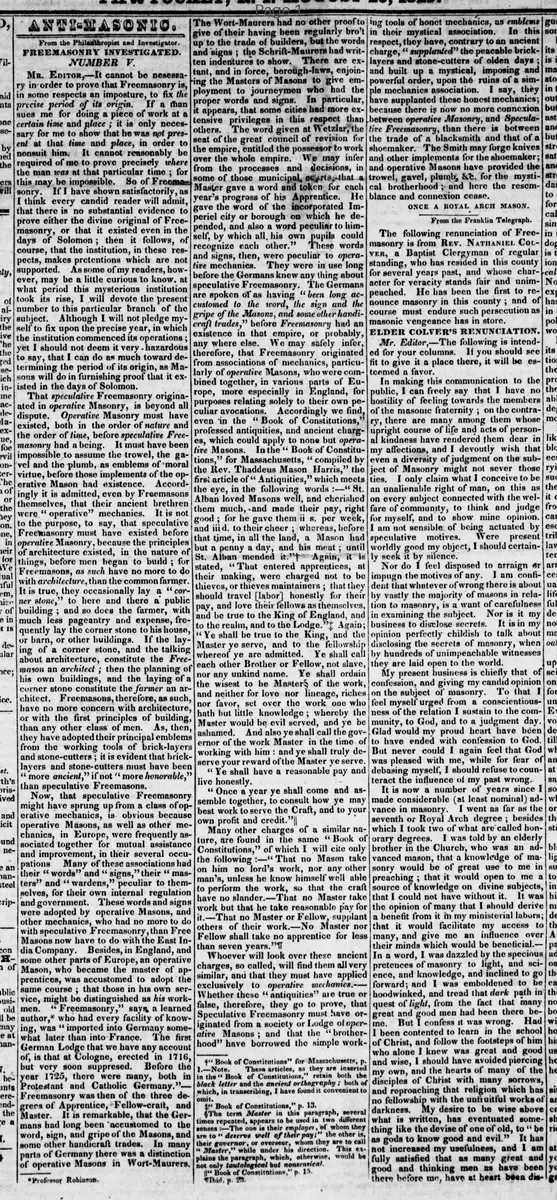
ANTI-MASONIC.
From the Philanthropist and Investigator.
FREEMASONRY INVESTIGATED.
NUMBER V.
Mr. Editor,—It cannot be necessary in order to prove that Freemasonry is in some respects an imposture, to fix the precise period of its origin. If a man sues me for doing a piece of work at a certain time and place; it is only necessary for me to show that he was not present at that time and place, in order to nonsuit him. It cannot reasonably be required of me to prove precisely where the man was at that particular time; for this may be impossible. So of Freemasonry. If I have shown satisfactorily, as I think every candid reader will admit, that there is no substantial evidence to prove either the divine original of Freemasonry, or that it existed even in the days of Solomon; then it follows, of course, that the institution, in these respects, makes pretensions which are not supported. As some of my readers, however, may be a little curious to know, at what period this mysterious institution took its rise, I will devote the present number to this particular branch of the subject. Although I will not pledge myself to fix upon the precise year, in which the institution commenced its operations: yet I should not deem it very hazardous to say, that I can do as much toward determining the period of its origin, as Masons will do in furnishing proof that it existed in the days of Solomon.
That speculative Freemasonry originated in operative Masonry, is beyond all dispute. Operative Masonry must have existed, both in the order of nature and the order of time, before speculative Freemasonry had a being. It must have been impossible to assume the trowel, the gavel and the plumb, as emblems of moral virtue, before those implements of the operative Mason had existence. Accordingly it is admitted, even by Freemasons themselves, that their ancient brethren were "operative" mechanics. It is not to the purpose, to say, that speculative Freemasonry must have existed before operative Masonry, because the principles of architecture existed, in the nature of things, before men began to build: for Freemasons, as such have no more to do with architecture, than the common farmer.
It is true, they occasionally lay a "corner stone," to here and there a public building; and so does the farmer, with much less pageantry and expense, frequently lay the corner stone to his house, or barn, or other buildings. If the laying of a corner stone, and the talking about architecture, constitute the Freemason an architect; then the planning of his own buildings, and the laying of a corner stone constitute the farmer an architect. Freemasons, therefore, as such, have no more concern with architecture, or with the first principles of building, than any other class of men. As, then, they have adopted their principal emblems from the working tools of brick-layers and stone-cutters; it is evident that brick-layers and stone-cutters must have been "more ancient," if not "more honorable," than speculative Freemasons.
Now, that speculative Freemasonry might have sprung up from a class of operative mechanics, is obvious because operative Masons, as well as other mechanics, in Europe, were frequently associated together for mutual assistance and improvement, in their several occupations. Many of these associations had their "words" and "signs," their "masters" and "wardens," peculiar to themselves, for their own internal regulation and government. These words and signs were adopted by operative Masons, and other mechanics, who had no more to do with speculative Freemasonry, than Free Masons now have to do with the East India Company. Besides, in England, and some other parts of Europe, an operative Mason, who became the master of apprentices, was accustomed to adopt the same course; that those in his own service, might be distinguished as his workmen. "Freemasonry," says a learned author,* who had every facility of knowing, was "imported into Germany somewhat later than into France. The first German Lodge that we have any account of, is that at Cologne, erected in 1716, but very soon suppressed. Before the year 1725, there were many, both in Protestant and Catholic Germany."
Freemasonry was then of the three degrees of Apprentice, Fellow-craft, and Master. It is remarkable, that the Germans had long been accustomed to the word, sign, and gripe of the Masons, and some other handicraft trades. In many parts of Germany there was a distinction of operative Masons in Wort-Maurers.
*Professor Robinson,
The Wort-Maurers had no other proof to give of their having been regularly bro't up to the trade of builders, but the words and signs; the Schrit-Maurers had written indentures to show. There are extant, and in force, borough-laws, enjoining the Masters of Masons to give employment to journeymen who had the proper words and signs. In particular, it appears, that some cities had more extensive privileges in this respect than others. The word given at Wetzlar, the seat of the great council of revision for the empire, entitled the possessor to work over the whole empire. We may infer from the processes and decisions, in some of those municipal courts that a Master gave a word and token for each year's progress of his Apprentice. He gave the word of the incorporated Imperial city or borough on which he depended, and also a word peculiar to himself, by which all his own pupils could recognize each other." These words and signs, then, were peculiar to operative mechanics. They were in use long before the Germans knew any thing about speculative Freemasonry. The Germans are spoken of as having "been long accustomed to the word, the sign and the gripe of the Masons, and some other handicraft trades," before Freemasonry had an existence in that empire, or probably any where else. We may safely infer, therefore, that Freemasonry originated from associations of mechanics. particularly of operative Masons, who were combined together, in various parts of Europe, more especially in England, for purposes relating solely to their own peculiar avocations. Accordingly we find, even in the "Book of Constitutions," professed antiquities, and ancient charges, which could apply to none but operative Masons. In the "Book of Constitutions," for Massachusetts, "compiled by the Rev. Thaddeus Mason Harris," the first article of "Antiquities," which meets the eye, in the following words: —"St. Alban loved Masons well, and cherished them much, —and made their pay, right good; for he gave them ii s. per week, and iiid. to their cheer; whereas, before that time, in all the land, a Mason had but a penny a day, and his meat; until St. Alban mended it." Again, it is stated, "That entered apprentices, at their making, were charged not to be thieves, or thieves maintainers; that they should travel [labor] honestly for their pay, and love their fellows as themselves, and be true to the King of England, and to the realm, and to the Lodge." Again; "Ye shall be true to the King, and the Master ye serve, and to the fellowship whereof ye are admitted. Ye shall call each other Brother or Fellow, not slave, nor any unkind name. Ye shall ordain the wisest to be Masters of the work. and neither for love nor lineage, riches nor favor, set over the work one who hath but little knowledge; whereby the Master would be evil served, and ye be ashamed. And also ye shall call the governor of the work Master in the time of working with him: and ye shall truly deserve your reward of the Master ye serve. "Ye shall have a reasonable pay and live honestly.
"Once a year ye shall come and assemble together, to consult how ye may best work to serve the Craft, and to your own profit and credit."
Many other charges of a similar nature, are found in the same "Book of Constitutions," of which I will cite only the following: —"That no Mason take on him no lord's work, nor any other man's, unless he know himself well able to perform the work, so that the craft have no slander. —That no Master take work but that he take reasonable pay for it. —That no Master or Fellow, supplant others of their work. —No Master nor Fellow shall take no apprentice for less than seven years."
Whoever will look over these ancient charges, so called, will find them all very similar, and that they must have applied exclusively to operative mechanics. — Whether these "antiquities" are true or false, therefore, they go to prove, that Speculative Freemasonry must have originated from a society or Lodge of operative Masons; and that the "brotherhood" have borrowed the simple working tools of honest mechanics, as emblems
From the Philanthropist and Investigator.
FREEMASONRY INVESTIGATED.
NUMBER V.
Mr. Editor,—It cannot be necessary in order to prove that Freemasonry is in some respects an imposture, to fix the precise period of its origin. If a man sues me for doing a piece of work at a certain time and place; it is only necessary for me to show that he was not present at that time and place, in order to nonsuit him. It cannot reasonably be required of me to prove precisely where the man was at that particular time; for this may be impossible. So of Freemasonry. If I have shown satisfactorily, as I think every candid reader will admit, that there is no substantial evidence to prove either the divine original of Freemasonry, or that it existed even in the days of Solomon; then it follows, of course, that the institution, in these respects, makes pretensions which are not supported. As some of my readers, however, may be a little curious to know, at what period this mysterious institution took its rise, I will devote the present number to this particular branch of the subject. Although I will not pledge myself to fix upon the precise year, in which the institution commenced its operations: yet I should not deem it very hazardous to say, that I can do as much toward determining the period of its origin, as Masons will do in furnishing proof that it existed in the days of Solomon.
That speculative Freemasonry originated in operative Masonry, is beyond all dispute. Operative Masonry must have existed, both in the order of nature and the order of time, before speculative Freemasonry had a being. It must have been impossible to assume the trowel, the gavel and the plumb, as emblems of moral virtue, before those implements of the operative Mason had existence. Accordingly it is admitted, even by Freemasons themselves, that their ancient brethren were "operative" mechanics. It is not to the purpose, to say, that speculative Freemasonry must have existed before operative Masonry, because the principles of architecture existed, in the nature of things, before men began to build: for Freemasons, as such have no more to do with architecture, than the common farmer.
It is true, they occasionally lay a "corner stone," to here and there a public building; and so does the farmer, with much less pageantry and expense, frequently lay the corner stone to his house, or barn, or other buildings. If the laying of a corner stone, and the talking about architecture, constitute the Freemason an architect; then the planning of his own buildings, and the laying of a corner stone constitute the farmer an architect. Freemasons, therefore, as such, have no more concern with architecture, or with the first principles of building, than any other class of men. As, then, they have adopted their principal emblems from the working tools of brick-layers and stone-cutters; it is evident that brick-layers and stone-cutters must have been "more ancient," if not "more honorable," than speculative Freemasons.
Now, that speculative Freemasonry might have sprung up from a class of operative mechanics, is obvious because operative Masons, as well as other mechanics, in Europe, were frequently associated together for mutual assistance and improvement, in their several occupations. Many of these associations had their "words" and "signs," their "masters" and "wardens," peculiar to themselves, for their own internal regulation and government. These words and signs were adopted by operative Masons, and other mechanics, who had no more to do with speculative Freemasonry, than Free Masons now have to do with the East India Company. Besides, in England, and some other parts of Europe, an operative Mason, who became the master of apprentices, was accustomed to adopt the same course; that those in his own service, might be distinguished as his workmen. "Freemasonry," says a learned author,* who had every facility of knowing, was "imported into Germany somewhat later than into France. The first German Lodge that we have any account of, is that at Cologne, erected in 1716, but very soon suppressed. Before the year 1725, there were many, both in Protestant and Catholic Germany."
Freemasonry was then of the three degrees of Apprentice, Fellow-craft, and Master. It is remarkable, that the Germans had long been accustomed to the word, sign, and gripe of the Masons, and some other handicraft trades. In many parts of Germany there was a distinction of operative Masons in Wort-Maurers.
*Professor Robinson,
The Wort-Maurers had no other proof to give of their having been regularly bro't up to the trade of builders, but the words and signs; the Schrit-Maurers had written indentures to show. There are extant, and in force, borough-laws, enjoining the Masters of Masons to give employment to journeymen who had the proper words and signs. In particular, it appears, that some cities had more extensive privileges in this respect than others. The word given at Wetzlar, the seat of the great council of revision for the empire, entitled the possessor to work over the whole empire. We may infer from the processes and decisions, in some of those municipal courts that a Master gave a word and token for each year's progress of his Apprentice. He gave the word of the incorporated Imperial city or borough on which he depended, and also a word peculiar to himself, by which all his own pupils could recognize each other." These words and signs, then, were peculiar to operative mechanics. They were in use long before the Germans knew any thing about speculative Freemasonry. The Germans are spoken of as having "been long accustomed to the word, the sign and the gripe of the Masons, and some other handicraft trades," before Freemasonry had an existence in that empire, or probably any where else. We may safely infer, therefore, that Freemasonry originated from associations of mechanics. particularly of operative Masons, who were combined together, in various parts of Europe, more especially in England, for purposes relating solely to their own peculiar avocations. Accordingly we find, even in the "Book of Constitutions," professed antiquities, and ancient charges, which could apply to none but operative Masons. In the "Book of Constitutions," for Massachusetts, "compiled by the Rev. Thaddeus Mason Harris," the first article of "Antiquities," which meets the eye, in the following words: —"St. Alban loved Masons well, and cherished them much, —and made their pay, right good; for he gave them ii s. per week, and iiid. to their cheer; whereas, before that time, in all the land, a Mason had but a penny a day, and his meat; until St. Alban mended it." Again, it is stated, "That entered apprentices, at their making, were charged not to be thieves, or thieves maintainers; that they should travel [labor] honestly for their pay, and love their fellows as themselves, and be true to the King of England, and to the realm, and to the Lodge." Again; "Ye shall be true to the King, and the Master ye serve, and to the fellowship whereof ye are admitted. Ye shall call each other Brother or Fellow, not slave, nor any unkind name. Ye shall ordain the wisest to be Masters of the work. and neither for love nor lineage, riches nor favor, set over the work one who hath but little knowledge; whereby the Master would be evil served, and ye be ashamed. And also ye shall call the governor of the work Master in the time of working with him: and ye shall truly deserve your reward of the Master ye serve. "Ye shall have a reasonable pay and live honestly.
"Once a year ye shall come and assemble together, to consult how ye may best work to serve the Craft, and to your own profit and credit."
Many other charges of a similar nature, are found in the same "Book of Constitutions," of which I will cite only the following: —"That no Mason take on him no lord's work, nor any other man's, unless he know himself well able to perform the work, so that the craft have no slander. —That no Master take work but that he take reasonable pay for it. —That no Master or Fellow, supplant others of their work. —No Master nor Fellow shall take no apprentice for less than seven years."
Whoever will look over these ancient charges, so called, will find them all very similar, and that they must have applied exclusively to operative mechanics. — Whether these "antiquities" are true or false, therefore, they go to prove, that Speculative Freemasonry must have originated from a society or Lodge of operative Masons; and that the "brotherhood" have borrowed the simple working tools of honest mechanics, as emblems
What sub-type of article is it?
Moral Or Religious
Social Reform
What keywords are associated?
Freemasonry
Operative Masons
Origins
Imposture
Secret Societies
European Guilds
Anti Masonic
What entities or persons were involved?
Freemasons
Operative Masons
Professor Robinson
St. Alban
Rev. Thaddeus Mason Harris
Editorial Details
Primary Topic
Origins Of Freemasonry As An Imposture From Operative Masons
Stance / Tone
Anti Freemasonry, Critical Of Its Pretensions To Ancient And Divine Origins
Key Figures
Freemasons
Operative Masons
Professor Robinson
St. Alban
Rev. Thaddeus Mason Harris
Key Arguments
No Substantial Evidence For Divine Origin Or Existence In Solomon's Days
Speculative Freemasonry Originated From Operative Masonry Associations In Europe
Emblems Derived From Working Tools Of Brick Layers And Stone Cutters
Ancient Charges Apply Exclusively To Operative Mechanics
Freemasons Have No Special Connection To Architecture Beyond Symbolism
German Operative Masons Used Words And Signs Long Before Speculative Freemasonry