Thank you for visiting SNEWPapers!
Sign up free
The Daily Missoulian
Missoula, Missoula County, Montana
What is this article about?
Supervising Engineer H. N. Savage outlines U.S. Reclamation Service plans to irrigate 100,000-125,000 acres on Montana's Flathead reservation, starting immediately with three units at Jocko, Mission, and Polson, employing local Indians.
Clipping
OCR Quality
Full Text
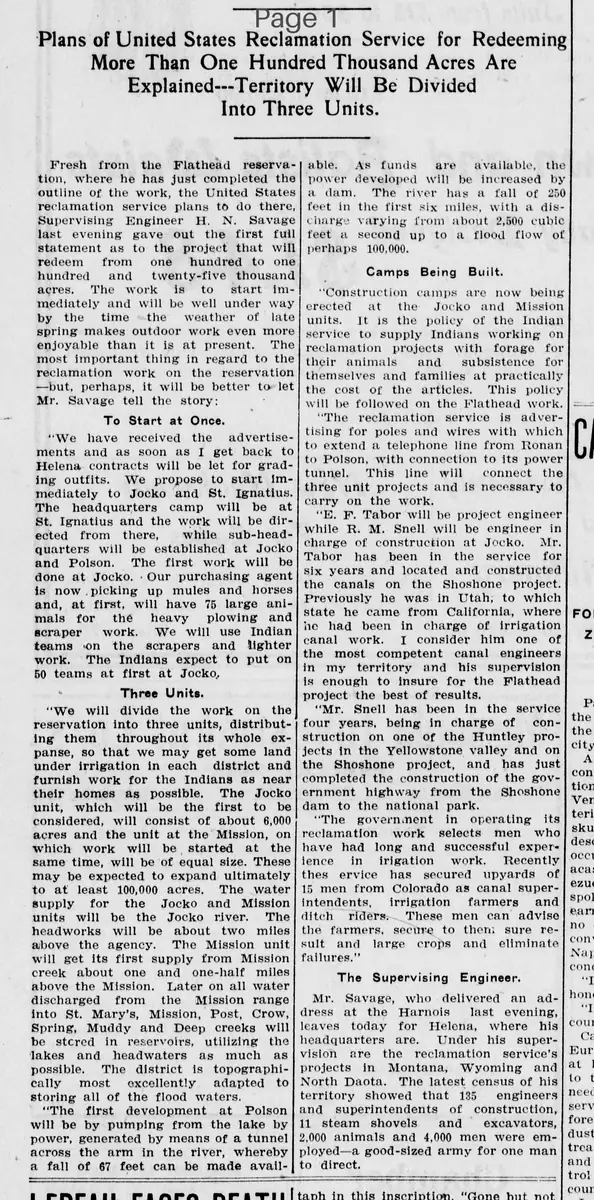
More Than One Hundred Thousand Acres Are
Explained---Territory Will Be Divided
Into Three Units.
Fresh from the Flathead reservation, where he has just completed the outline of the work the United States reclamation service plans to do there, Supervising Engineer H. N. Savage last evening gave out the first full statement as to the project that will redeem from one hundred to one hundred and twenty-five thousand acres. The work is to start immediately and will be well under way by the time the weather of late spring makes outdoor work even more enjoyable than it is at present. The most important thing in regard to the reclamation work on the reservation—but, perhaps, it will be better to let Mr. Savage tell the story:
To Start at Once.
"We have received the advertisements and as soon as I get back to Helena contracts will be let for grading outfits. We propose to start immediately to Jocko and St. Ignatius. The headquarters camp will be at St. Ignatius and the work will be directed from there, while sub-headquarters will be established at Jocko and Polson. The first work will be done at Jocko. Our purchasing agent is now picking up mules and horses and, at first, will have 75 large animals for the heavy plowing and scraper work. We will use Indian teams on the scrapers and lighter work. The Indians expect to put on 50 teams at first at Jocko.
Three Units.
"We will divide the work on the reservation into three units, distributing them throughout its whole expanse, so that we may get some land under irrigation in each district and furnish work for the Indians as near their homes as possible. The Jocko unit, which will be the first to be considered, will consist of about 6,000 acres and the unit at the Mission, on which work will be started at the same time, will be of equal size. These may be expected to expand ultimately to at least 100,000 acres. The water supply for the Jocko and Mission units will be the Jocko river. The headworks will be about two miles above the agency. The Mission unit will get its first supply from Mission creek about one and one-half miles above the Mission. Later on all water discharged from the Mission range into St. Mary's, Mission, Post, Crow, Spring, Muddy and Deep creeks will be stored in reservoirs, utilizing the lakes and headwaters as much as possible. The district is topographically most excellently adapted to storing all of the flood waters.
"The first development at Polson will be by pumping from the lake by power, generated by means of a tunnel across the arm in the river, whereby a fall of 67 feet can be made available. As funds are available, the power developed will be increased by a dam. The river has a fall of 250 feet in the first six miles, with a discharge varying from about 2,500 cubic feet a second up to a flood flow of perhaps 100,000.
Camps Being Built.
"Construction camps are now being erected at the Jocko and Mission units. It is the policy of the Indian service to supply Indians working on reclamation projects with forage for their animals and subsistence for themselves and families at practically the cost of the articles. This policy will be followed on the Flathead work.
"The reclamation service is advertising for poles and wires with which to extend a telephone line from Ronan to Polson, with connection to its power tunnel. This line will connect the three unit projects and is necessary to carry on the work.
"E. F. Tabor will be project engineer while R. M. Snell will be engineer in charge of construction at Jocko. Mr. Tabor has been in the service for six years and located and constructed the canals on the Shoshone project. Previously he was in Utah, to which state he came from California, where he had been in charge of irrigation canal work. I consider him one of the most competent canal engineers in my territory and his supervision is enough to insure for the Flathead project the best of results.
"Mr. Snell has been in the service four years, being in charge of construction on one of the Huntley projects in the Yellowstone valley and on the Shoshone project, and has just completed the construction of the government highway from the Shoshone dam to the national park.
"The government in operating its reclamation work selects men who have had long and successful experience in irrigation work. Recently the service has secured upwards of 15 men from Colorado as canal superintendents, irrigation farmers and ditch riders. These men can advise the farmers, secure to them sure results and large crops and eliminate failures."
The Supervising Engineer.
Mr. Savage, who delivered an address at the Harnois last evening, leaves today for Helena, where his headquarters are. Under his supervision are the reclamation service's projects in Montana, Wyoming and North Dakota. The latest census of his territory showed that 135 engineers and superintendents of construction, 11 steam shovels and excavators, 2,000 animals and 4,000 men were employed—a good-sized army for one man to direct.
What sub-type of article is it?
What keywords are associated?
What entities or persons were involved?
Where did it happen?
Domestic News Details
Primary Location
Flathead Reservation
Key Persons
Outcome
project to redeem 100,000 to 125,000 acres through irrigation, divided into three units; employment for indians; construction camps and telephone line to be built.
Event Details
United States Reclamation Service plans to start immediate work on irrigating the Flathead reservation, dividing it into three units: Jocko (6,000 acres), Mission (6,000 acres), and Polson. Water from Jocko River, Mission Creek, and Flathead Lake via pumping and dams. Indians to provide teams and labor, supplied with forage and subsistence at cost.