Thank you for visiting SNEWPapers!
Sign up free
Story
March 27, 1811
The Rhode Island Republican
Newport, Newport County, Rhode Island
What is this article about?
Samuel L. Mitchill's 1810 report to New York's Tammany Society evaluates a proposal to change their May anniversary from the 12th to 13th, citing Gregorian calendar adjustments for solar year accuracy, including historical reforms by Julius Caesar and Pope Gregory XIII, and England's 1752 adoption.
Clipping
OCR Quality
95%
Excellent
Full Text
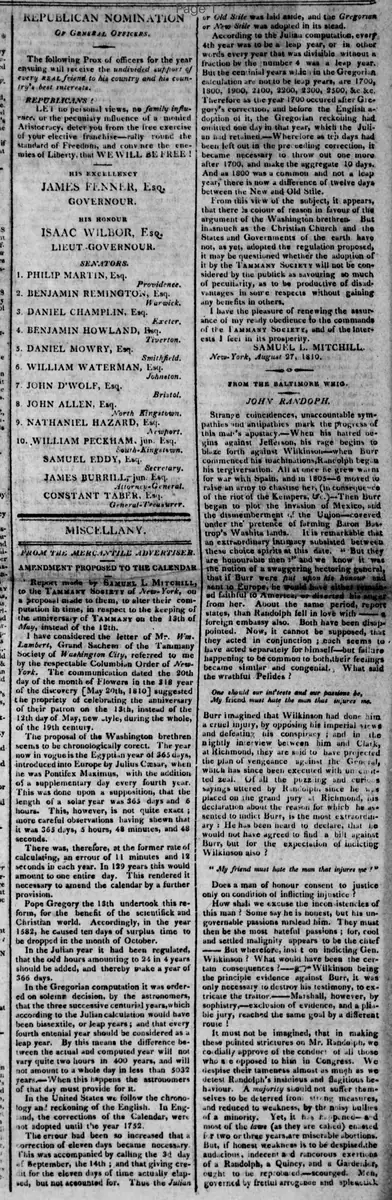
MISCELLANY.
FROM THE MERCANTILE ADVERTISER
AMENDMENT PROPOSED TO THE CALENDAR
Report made by SAMUEL L. MITCHILL, to the TammaNY Society of New-York, on a proposal made to them, to alter their computation in time, in respect to the keeping of the anniversary of Tammany on the 13th of May, instead of the 12th.
I have considered the letter of Mr. Wm. Lambert, Grand Sachem of the Tammany Society of Washington City, referred to me by the respectable Columbian Order of New-York. The communication dated the 20th day of the month of Flowers in the 318 year of the discovery [May 20th, 1810] suggested the propriety of celebrating the anniversary of their patron on the 13th, instead of the 12th day of May, new style, during the whole, of the 19th century.
The proposal of the Washington brethren seems to be chronologically correct. The year now in vogue is the Egyptian year of 365 days, introduced into Europe by Julius Caesar, when he was Pontifex Maximus, with the addition of a supplementary day every fourth year. This was done upon a supposition, that the length of a solar year was 365 days and 6 hours. This, however, is not quite exact ; more careful observations having shewn that it was 365 days, 5 hours, 48 minutes, and 48 seconds.
There was, therefore, at the former rate of calculating, an error of 11 minutes and 12 seconds in each year. In 129 years this would amount to one entire day. This rendered it necessary to amend the calendar by a further provision.
Pope Gregory the 13th undertook this reform, for the benefit of the scientifick and Christian world. Accordingly, in the year 1582, he caused ten days of surplus time to be dropped in the month of October.
In the Julian year it had been regulated, that the odd hours amounting to 24 in 4 years should be added, and thereby make a year of 366 days.
In the Gregorian computation it was ordered on solemn decision, by the astronomers, that the three successive centurial years, which according to the Julian calculation would have been bissextile, or leap years; and that every fourth centurial year should be considered as a leap year. By this means the difference between the actual and computed year will not vary quite two hours in 400 years, and will not amount to a whole day in less than 5032 years. When this happens the astronomers of that day must provide for it.
In the United States we follow the chronology and reckoning of the English. In England, the corrections of the Calendar, were not adopted until the year 1752. The error had been so increased that a correction of eleven days became necessary. This was accompanied by calling the 3d day of September, the 14th ; and that giving credit for the eleven days of time actually elapsed, but not accounted for. Thus the Julian or Old Style was laid aside, and the Gregorian or New Style was adopted in its stead.
According to the Julian computation, every 4th year was to be a leap year, or in other words every year that was divisible without a fraction by the number 4 was a leap year. But the centurial years when in the Gregorian calculation are not to be leap years, are 1700, 1800, 1900, 2100, 2200, 2300, 2500, &c.&c.
Therefore as the year 1700 occurred after Gregory's correction, and before the English adoption of it, the Gregorian reckoning had omitted one day in that year, which the Julian had retained. Wherefore as ten days had been left out in the preceding correction, it became necessary to throw out one more after 1700, and make the aggregate 11 days. And as 1800 was a common and not a leap year, there is now a difference of twelve days between the New and Old Style.
From this view of the subject, it appears, that there is colour of reason in favour of the argument of the Washington brethren- But inasmuch as the Christian Church and the States and Governments of the earth. have not, as yet, adopted the regulation proposed, it may be questioned whether the adoption of' it by the TAMMANY SOCIETY will not be considered by the publick as savouring so much of peculiarity, as to be productive of disadvantages in some respects without gaining any benefits in others.
I have the pleasure of renewing the assurance of my ready obedience to the commands of the Tammany Society, and of the interest I feel in its prosperity.
SAMUEL L. MITCHILL.
New-York, August 27, 1810.
FROM THE MERCANTILE ADVERTISER
AMENDMENT PROPOSED TO THE CALENDAR
Report made by SAMUEL L. MITCHILL, to the TammaNY Society of New-York, on a proposal made to them, to alter their computation in time, in respect to the keeping of the anniversary of Tammany on the 13th of May, instead of the 12th.
I have considered the letter of Mr. Wm. Lambert, Grand Sachem of the Tammany Society of Washington City, referred to me by the respectable Columbian Order of New-York. The communication dated the 20th day of the month of Flowers in the 318 year of the discovery [May 20th, 1810] suggested the propriety of celebrating the anniversary of their patron on the 13th, instead of the 12th day of May, new style, during the whole, of the 19th century.
The proposal of the Washington brethren seems to be chronologically correct. The year now in vogue is the Egyptian year of 365 days, introduced into Europe by Julius Caesar, when he was Pontifex Maximus, with the addition of a supplementary day every fourth year. This was done upon a supposition, that the length of a solar year was 365 days and 6 hours. This, however, is not quite exact ; more careful observations having shewn that it was 365 days, 5 hours, 48 minutes, and 48 seconds.
There was, therefore, at the former rate of calculating, an error of 11 minutes and 12 seconds in each year. In 129 years this would amount to one entire day. This rendered it necessary to amend the calendar by a further provision.
Pope Gregory the 13th undertook this reform, for the benefit of the scientifick and Christian world. Accordingly, in the year 1582, he caused ten days of surplus time to be dropped in the month of October.
In the Julian year it had been regulated, that the odd hours amounting to 24 in 4 years should be added, and thereby make a year of 366 days.
In the Gregorian computation it was ordered on solemn decision, by the astronomers, that the three successive centurial years, which according to the Julian calculation would have been bissextile, or leap years; and that every fourth centurial year should be considered as a leap year. By this means the difference between the actual and computed year will not vary quite two hours in 400 years, and will not amount to a whole day in less than 5032 years. When this happens the astronomers of that day must provide for it.
In the United States we follow the chronology and reckoning of the English. In England, the corrections of the Calendar, were not adopted until the year 1752. The error had been so increased that a correction of eleven days became necessary. This was accompanied by calling the 3d day of September, the 14th ; and that giving credit for the eleven days of time actually elapsed, but not accounted for. Thus the Julian or Old Style was laid aside, and the Gregorian or New Style was adopted in its stead.
According to the Julian computation, every 4th year was to be a leap year, or in other words every year that was divisible without a fraction by the number 4 was a leap year. But the centurial years when in the Gregorian calculation are not to be leap years, are 1700, 1800, 1900, 2100, 2200, 2300, 2500, &c.&c.
Therefore as the year 1700 occurred after Gregory's correction, and before the English adoption of it, the Gregorian reckoning had omitted one day in that year, which the Julian had retained. Wherefore as ten days had been left out in the preceding correction, it became necessary to throw out one more after 1700, and make the aggregate 11 days. And as 1800 was a common and not a leap year, there is now a difference of twelve days between the New and Old Style.
From this view of the subject, it appears, that there is colour of reason in favour of the argument of the Washington brethren- But inasmuch as the Christian Church and the States and Governments of the earth. have not, as yet, adopted the regulation proposed, it may be questioned whether the adoption of' it by the TAMMANY SOCIETY will not be considered by the publick as savouring so much of peculiarity, as to be productive of disadvantages in some respects without gaining any benefits in others.
I have the pleasure of renewing the assurance of my ready obedience to the commands of the Tammany Society, and of the interest I feel in its prosperity.
SAMUEL L. MITCHILL.
New-York, August 27, 1810.
What sub-type of article is it?
Curiosity
Historical Event
What themes does it cover?
Fortune Reversal
What keywords are associated?
Calendar Reform
Tammany Society
Gregorian Calendar
Leap Year
Julian Calendar
What entities or persons were involved?
Samuel L. Mitchill
Wm. Lambert
Pope Gregory The 13th
Julius Caesar
Where did it happen?
New York
Story Details
Key Persons
Samuel L. Mitchill
Wm. Lambert
Pope Gregory The 13th
Julius Caesar
Location
New York
Event Date
August 27, 1810
Story Details
Samuel L. Mitchill considers a proposal from the Tammany Society of Washington to shift their anniversary from May 12 to May 13 due to Gregorian calendar corrections, explaining Julian and Gregorian reforms, leap year rules, and historical adoptions in England and the US.